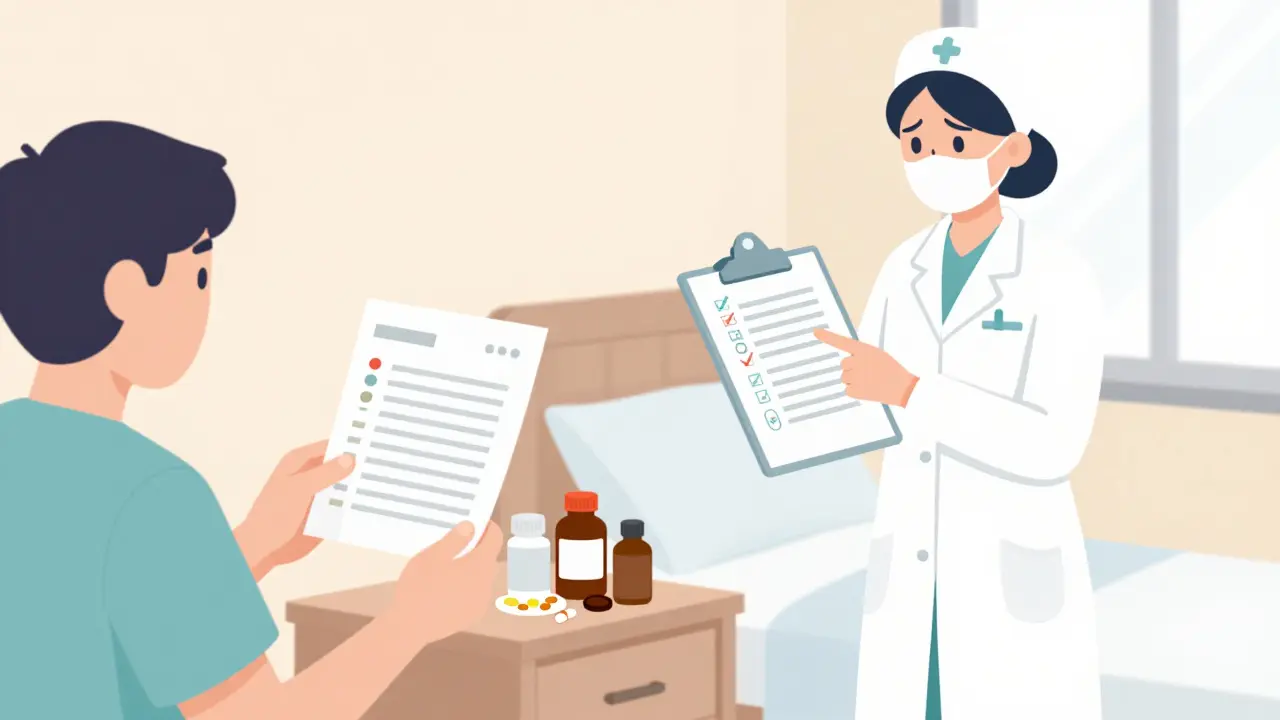
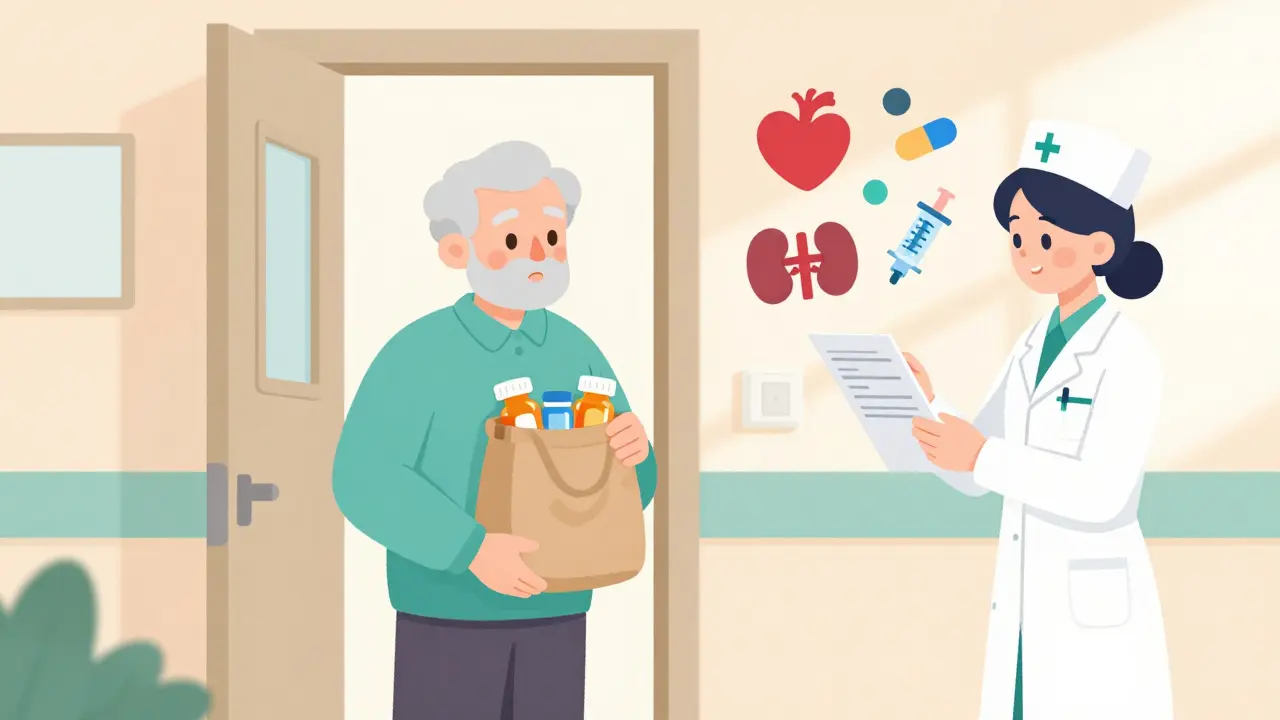
Leaving the hospital should mean you’re on the road to recovery-not staring at a pile of new pills wondering what changed, why, and whether they’ll clash with what you were already taking. Every year, over 800,000 Americans experience a preventable adverse drug event after leaving the hospital. Many of these aren’t caused by bad luck. They’re caused by a simple breakdown: medication reconciliation didn’t happen right.
What Medication Reconciliation Actually Means
Medication reconciliation isn’t just a checklist. It’s the process of making sure every single medication you’re supposed to take at home matches exactly what the hospital intended you to take when you left. That includes prescriptions, over-the-counter drugs, vitamins, herbal supplements, and even things like insulin or blood pressure patches. It’s not about what you think you took. It’s about what you actually took before admission, what changed during your stay, and what you’re supposed to take now.The Joint Commission made this a national patient safety goal back in 2006. By 2023, 98% of U.S. hospitals claimed to have a formal process. But here’s the problem: only about 65% of them actually do it well at discharge. That gap is where mistakes happen.
Why This Matters More Than You Think
Think about this: 82% of U.S. adults take at least one medication. Nearly 30% take five or more. The more meds you’re on, the higher the chance one will interact with another-especially when something gets added, removed, or changed without clear communication.Take warfarin, a blood thinner. If it’s stopped during surgery and never restarted at discharge, you could develop a blood clot. That’s not rare. One Reddit user shared a case where a patient was readmitted with a pulmonary embolism because warfarin was discontinued pre-op and forgotten at discharge. Another common issue: stopping a statin for liver concerns during hospitalization, then never restarting it. That raises heart attack risk. A 2022 study found that 18.7% of medication changes made in the hospital are unintentionally continued after discharge-often leading to dangerous interactions.
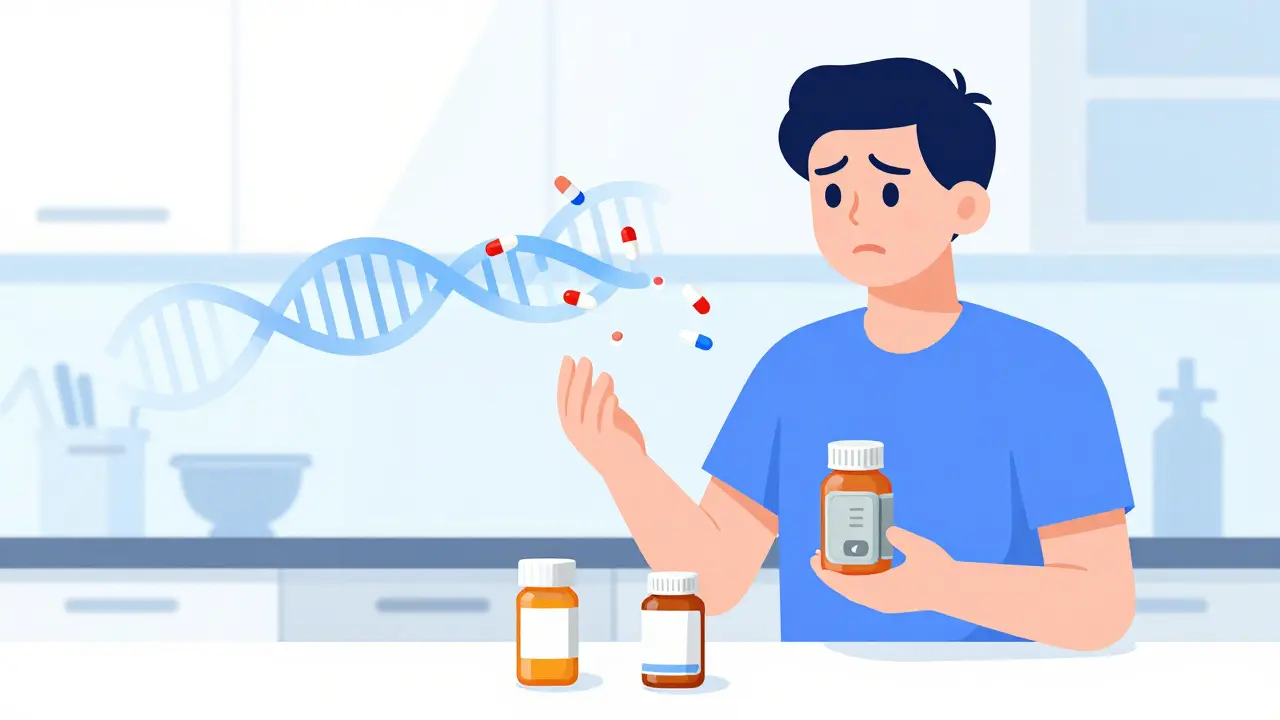
Patients on anticoagulants, diabetes meds, or heart drugs are at highest risk. And it’s not just prescriptions. Herbal supplements like St. John’s wort can interfere with antidepressants. Calcium supplements can block thyroid meds. Even common painkillers like ibuprofen can spike blood pressure or hurt your kidneys if you’re already on ACE inhibitors.
The Step-by-Step Process You Need to Follow
You don’t have to wait for the hospital to get it right. You can take control. Here’s what to do-before, during, and after discharge.- Before admission: Make your own list. Write down every medication you take: name, dose, frequency, and why you take it. Include vitamins, supplements, and over-the-counter drugs. Keep this list on your phone and in your wallet. Hospitals often don’t have accurate home meds because patients forget or can’t remember names.
- At discharge: Get the written list. Ask for a printed, updated medication list from the discharge nurse or pharmacist. Don’t settle for verbal instructions. The discharge summary is the most reliable source-only 17.3% error rate compared to 42.1% for patient self-report.
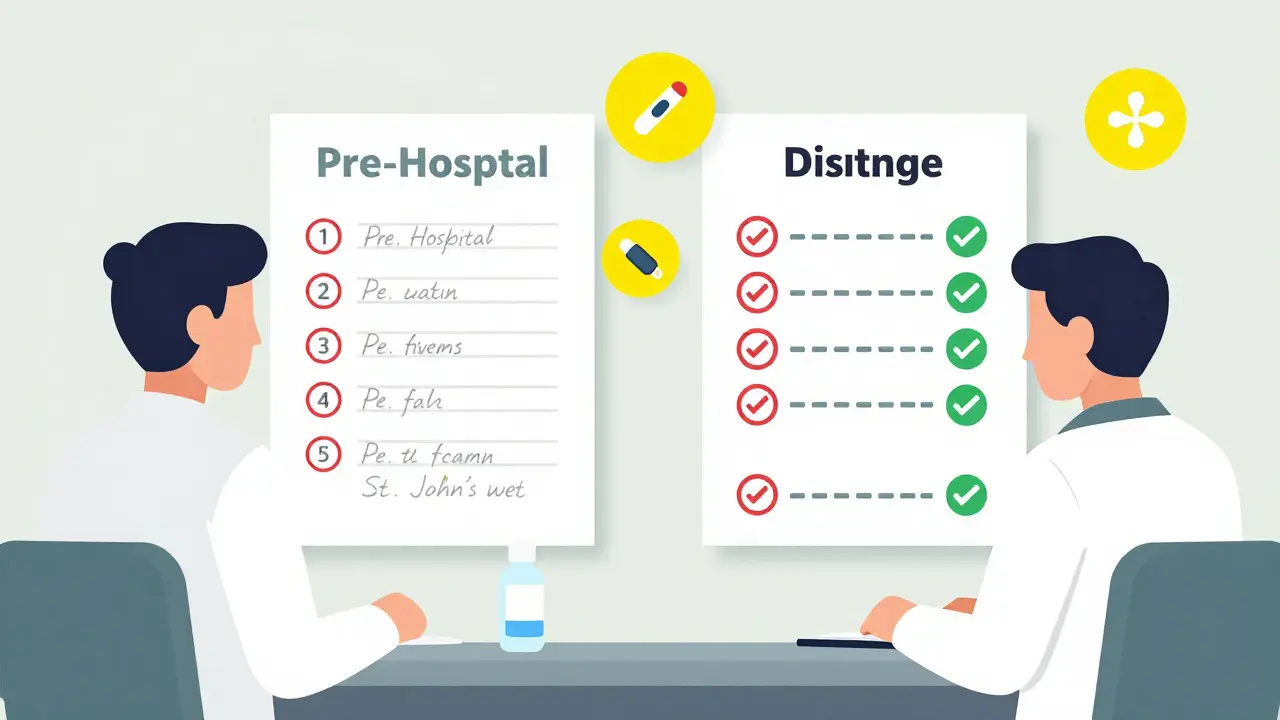
- Compare it to your pre-hospital list. Side by side. Circle anything new. Cross out anything removed. Question anything changed. If you don’t understand why a change was made, ask: “Why was this added? Why was this stopped? Is this temporary or permanent?”
- Verify with your primary doctor within 7 days. Medicare requires a Transitional Care Management visit (codes 99495 or 99496) within 7-14 days of discharge. This visit must include medication reconciliation. If your doctor doesn’t bring it up, ask: “Did you get my updated med list from the hospital? Can we go over it together?”
- Use a pill organizer and a meds journal. Write down when you take each pill. Note any side effects. This helps you and your doctor spot problems early.
What Hospitals Should Be Doing (But Often Don’t)
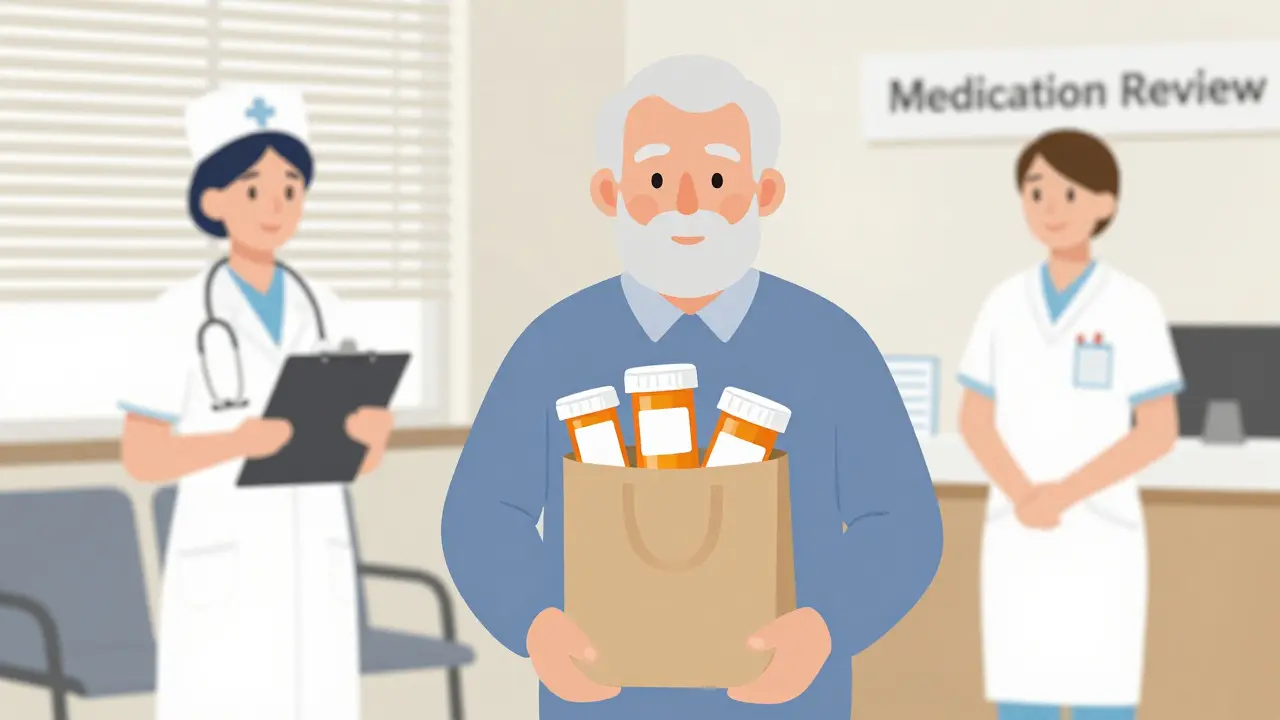
Ideally, hospitals should have a pharmacist review your meds at discharge. Studies show pharmacist-led reconciliation cuts 30-day readmissions by nearly 15%. But most hospitals don’t have enough pharmacists. The average time spent on reconciliation is just 7.3 minutes-when experts say you need 15 to 20 minutes to do it right.Common mistakes:
- Forgetting to restart chronic meds (like beta-blockers or antidepressants) that were paused during hospitalization.
- Adding new drugs without checking for interactions with existing ones.
- Changing doses without explaining why.
- Not updating the list in the patient’s EMR so the primary care doctor gets the right version.
Patients who stayed in the ICU are 2.3 times more likely to have a medication discontinued and never restarted. If you or a loved one was in the ICU, double-check every single med.
What to Do If Something Doesn’t Add Up
If your discharge meds list doesn’t match what you were taking before, or if you’re unsure why something changed:- Call the hospital’s pharmacy department. Most have discharge support lines.
- Ask for a phone consult with a pharmacist. Many hospitals offer this free.
- Don’t take a new med until you’ve confirmed it with your regular doctor or pharmacist.
- If you feel rushed or dismissed, say: “I’m concerned this could cause a bad reaction. Can we delay starting this until I’ve spoken with my doctor?”
One patient shared on Reddit that after being told to start a new blood pressure med, she checked her old list and realized it was the same one she’d been on for years-but the dose had been doubled without explanation. She called her doctor and found out it was a clerical error. That’s the kind of mistake that can cause a fall, a stroke, or worse.

Technology Can Help-But It’s Not Perfect
New tools are emerging. Some hospitals now use AI to scan discharge summaries for missing meds. Mayo Clinic’s system catches 94% of omissions. But AI can’t ask you if you’ve been taking your cholesterol pill for the last six months. Only you can do that.Starting in January 2024, hospitals are required to send your updated med list electronically to your primary care provider within 24 hours via FHIR APIs. This should reduce delays. But if your doctor doesn’t check their inbox, it won’t help.
Technology is a tool-not a replacement-for human verification. Always talk to a person.
Who’s Responsible When Things Go Wrong?
Legally, the hospital is responsible for providing accurate discharge instructions. But in practice, the burden often falls on the patient. That’s why you need to be your own advocate.Medicare tracks discharge communication through the HCAHPS survey. Only 58% of patients say they received clear medication instructions. If you didn’t, you’re not alone. But you can still act.
If you have a bad reaction because of a discharge error, document everything: the meds you were given, the date, your symptoms. Contact your doctor. Then call the hospital’s patient relations department. You have the right to a clear, accurate medication plan.
What You Can Do Today
You don’t need to wait for the system to fix itself. Here’s your action plan:- If you’re about to be discharged: Ask for your updated med list in writing before you leave.
- If you’ve already been discharged: Pull out your pre-hospital med list and compare it to what you were given. Look for gaps.
- Call your pharmacist. They can check for interactions between your old and new meds.
- Set a reminder for a doctor’s visit within 7 days. Don’t assume they’ll call you.
- Keep your med list updated on your phone. Use a free app like MyTherapy or Medisafe.
Medication reconciliation isn’t a one-time event. It’s an ongoing conversation between you, your doctors, and your pharmacist. The hospital’s job is to start it. Your job is to keep it going.
so like... uhhh meds are hard? lol i took my grandmas lisinopril by accident once and thought i was gonna die. turns out i just felt weird. also why do hospitals give you 12 new pills and no one tells you what they do? 🤷♀️
another hospital scam. they don't care if you die as long as the billing code gets entered. i had my beta-blocker pulled in the ER and no one mentioned it for 3 weeks. i had a panic attack and ended up back in the ICU. the pharmacist said 'oh we forgot' like it was a typo on a grocery list. lol
man i love how this post breaks it down so clearly. i used to think meds were just 'take what they give you' until my dad got discharged with 7 new pills and zero explanation. now we use MyTherapy and he calls his pharmacist every time something changes. small steps, but it saves lives.
Medication reconciliation isn’t a bureaucratic checkbox-it’s a moral obligation. Every unverified change is a potential cascade: a fall, a stroke, a readmission, a family shattered by preventable error. The system fails when it treats patients as data points. We must demand clarity, not compliance.
my aunt got discharged with a new statin she’d been allergic to since 2015. the discharge nurse said 'it was on the chart'-but the chart had her 2010 meds. i called the hospital pharmacy at 11pm and they apologized and sent a courier with the right script. never trust a digital list without a human double-check. also-why do they always say 'you'll get a call' but never do?
Medication reconciliation: the quiet, invisible, and utterly vital act of preserving human life through documentation. It is not a procedure-it is a covenant. Between patient and provider. Between history and future. Between the chaos of acute care and the fragile stability of home. Yet we treat it like a footnote. And so, we pay-in blood, in ER visits, in grief. The 15-minute standard? That’s not a target. It’s a minimum. Anything less is negligence dressed in white coats.
And yet-how many of us carry our own lists? How many of us ask, ‘Why was this stopped?’ before swallowing the pill? We outsource our agency to institutions that are overwhelmed, under-resourced, and underpaid. But the truth is: no algorithm, no FHIR API, no pharmacist on a 7-minute break can replace the vigilance of a person who refuses to be passive.
I keep my list on my phone, in my wallet, printed in my binder, and read aloud to my daughter every Sunday. She’s seven. She knows what lisinopril does. She knows why I don’t take ibuprofen. She knows the names of the pills that keep me alive.
This isn’t about healthcare reform. It’s about human responsibility. The hospital starts the conversation. But you? You must keep it alive.
And if they tell you it’s ‘not their job’ to explain? Tell them it’s yours to demand it.
Dear fellow seekers of truth, the pharmaceutical-industrial complex has engineered this chaos deliberately. Observe: hospitals are incentivized to discharge quickly. Pharmacists are understaffed. Electronic records are fragmented. The 65% 'effective' reconciliation rate? A carefully curated illusion. Behind this lies a system that profits from chronic illness, not cure. Stopping your statin? That’s not a mistake-it’s a strategy to keep you coming back. The AI tools? They scan, but they do not understand the soul of your suffering. Only the patient, armed with a printed list and unyielding courage, can pierce the veil.
Remember: the hospital will not save you. The doctor will not save you. The pharmacist will not save you. You must save yourself. And if you do not? The system will simply move on to the next body.
YES. This is so important. I had to fight for 3 days to get my mom’s diabetes meds restarted after her hip surgery. The nurses kept saying 'we’ll get to it'-but they didn’t. She ended up in ketoacidosis. Don’t wait. Don’t assume. Bring your list. Ask for the pharmacist. If they’re busy, wait. This isn’t a favor-it’s your life. I’m so glad this post exists. Share it with everyone you know.
My mom’s discharge list had her blood pressure med listed as 'BP Tab 10mg'-no name, no manufacturer. I called the pharmacy. They had no idea what it was. Turned out it was carvedilol, but the doctor’s handwriting was illegible, and the EMR auto-filled the wrong generic. Took 48 hours to fix. Hospitals need better handwriting training. Or, better yet-no handwriting at all.
While the sentiment expressed herein is commendable, the empirical validity of the 800,000 preventable adverse drug event statistic requires contextualization. According to the 2021 JAMA Patient Safety report, only 38% of such events are attributable to discharge reconciliation failures; the remainder stem from polypharmacy, non-adherence, or pharmacy dispensing errors. Furthermore, the assertion that 'pharmacist-led reconciliation reduces readmissions by 15%' is drawn from a single-center study (Barnes et al., 2020) with a non-representative cohort. The proposed action plan, while logically structured, lacks cost-benefit analysis and ignores socioeconomic barriers to patient advocacy. One cannot universalize best practices without addressing systemic inequities in access to primary care, transportation, and health literacy. Therefore, while vigilance is prudent, the framing herein risks oversimplification of a multidimensional problem.