What Is Vestibular Rehabilitation Therapy?
When your inner ear balance system gets damaged-whether from an infection, aging, or injury-you don’t just feel dizzy. You lose your sense of where your body is in space. Walking feels risky. Turning your head makes the room spin. Standing up can trigger nausea. This isn’t just "getting old." It’s a real neurological issue called vestibular dysfunction.
Vestibular rehabilitation therapy (VRT) is the most effective, science-backed way to fix this. It’s not medication. It’s not surgery. It’s a series of simple, targeted exercises your brain learns to use its remaining balance systems to compensate for what’s damaged. Developed in the 1980s and refined over decades, VRT is now standard care at major hospitals like Penn Medicine, Princeton Sports and Family Medicine, and Texas Health Resources.
The goal? Four clear outcomes: better gaze stability (so your vision doesn’t blur when you move), improved posture control, less vertigo, and the ability to do daily tasks without fear. Studies show patients see a 68% improvement in gaze stability and a 73% boost in balance after consistent therapy. Headaches drop by 37%. Nausea drops by 42%.
How Vestibular Exercises Actually Work
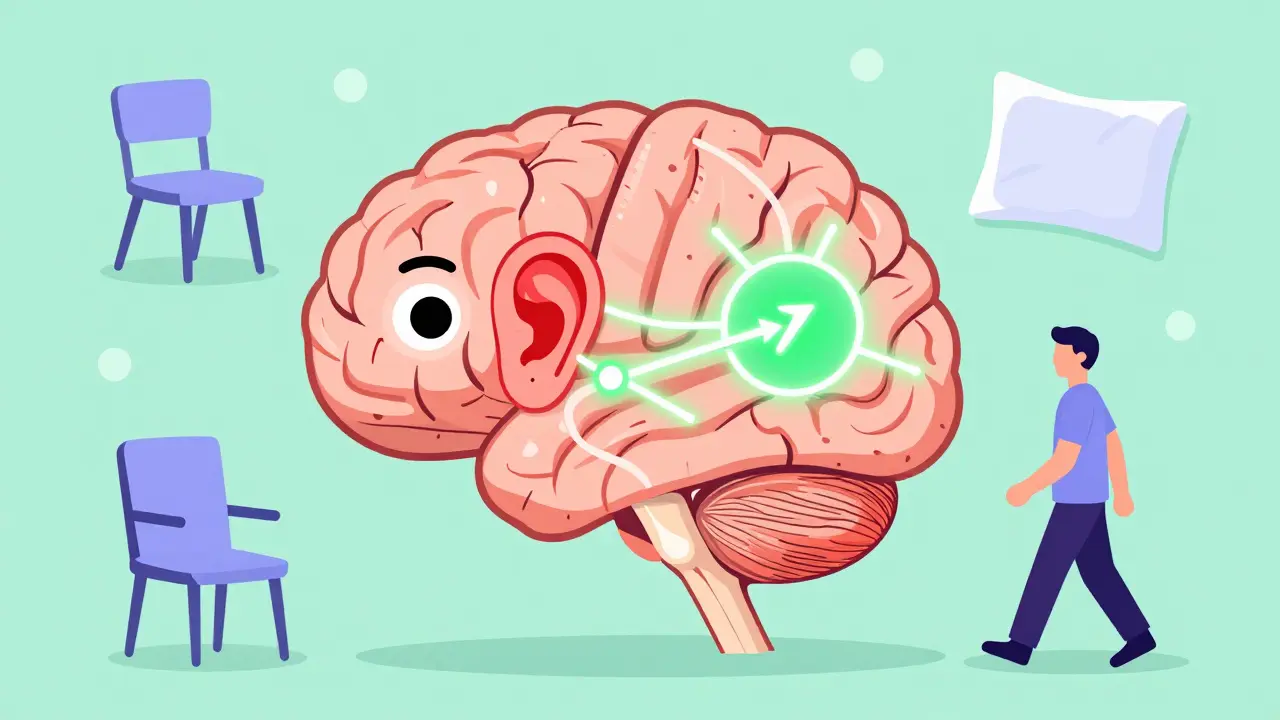
Your vestibular system is like a faulty GPS. When it sends wrong signals, your brain gets confused. But your brain doesn’t give up. It adapts. That’s neuroplasticity-the same process that lets stroke patients relearn how to walk.
Vestibular exercises force your brain to rebuild its balance map. They do this through four key mechanisms:
- Vestibular adaptation: Your brain recalibrates how it interprets signals from your inner ear.
- Substitution: Your eyes, muscles, and joints step in to help when your inner ear can’t.
- Habituation: Repeated exposure to movements that trigger dizziness teaches your brain to ignore them.
- Sensory reweighting: You learn to rely more on your feet and vision than your inner ear.
These aren’t magic tricks. They’re physical training. Every time you do a head movement that makes you dizzy, you’re not making things worse-you’re rewiring your brain. The discomfort? It’s the signal your brain is learning.
Core Vestibular Exercises You Can Do at Home
You don’t need fancy gear. No machines. Just your body and a safe space. Most programs include these five types of exercises, done daily:
1. Gaze Stability Training
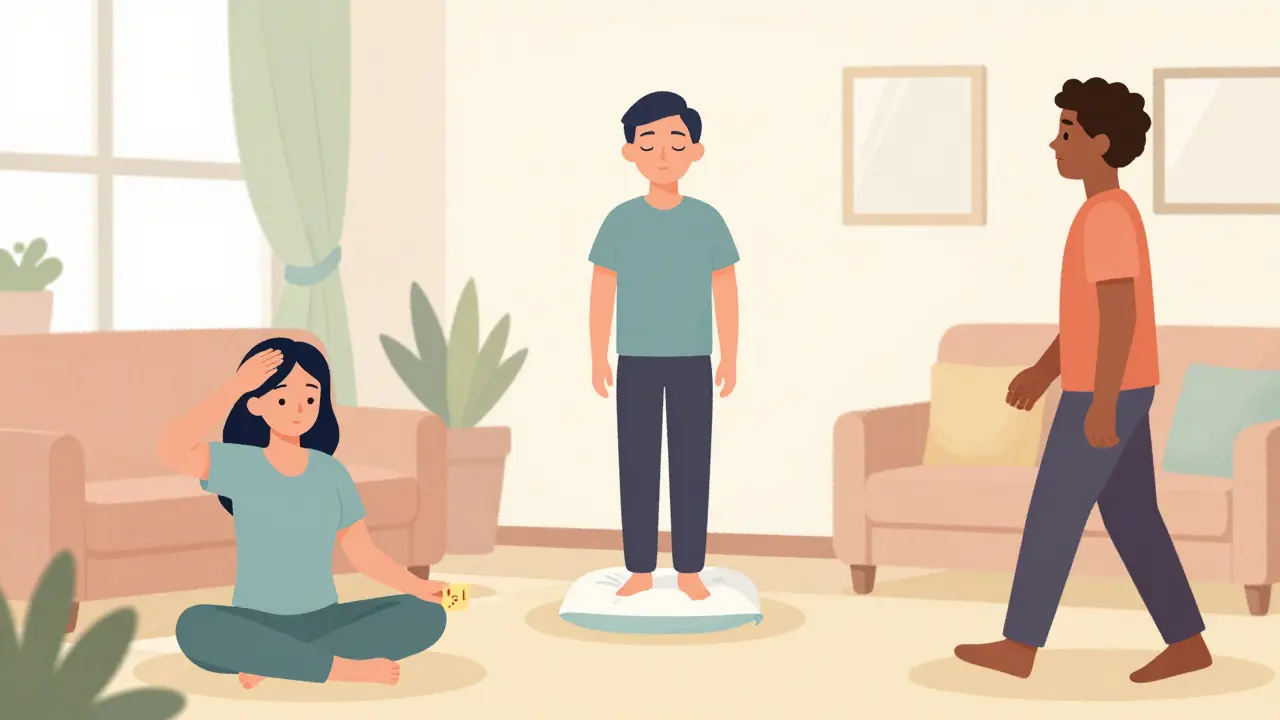
This fixes oscillopsia-the feeling that everything is bouncing when you move. Sit in a chair. Hold a card with a letter or small picture at eye level. Keep your eyes locked on it. Now slowly turn your head side to side, like you’re saying "no." Do this for 30 seconds. If you get dizzy, that’s okay. Stop, rest, then try again. Do this 3 times a day.
2. Balance Retraining
Stand near a wall or counter for support. Put your feet together. Close your eyes. Hold for 10 seconds. Once you can do that, try standing on one foot. Then, do it while holding a light object in each hand. Progress to standing on a pillow or folded towel. These reduce your dependence on vision for balance.
3. Walking with Head Turns
Walk slowly down a hallway. Every few steps, turn your head left and right while keeping your eyes fixed on a spot ahead. Add walking backward. Then walk while turning your head up and down. This trains your brain to keep balance while your head moves-exactly what you need to navigate a busy street or grocery store.
4. Habituation Exercises
These are the hardest but most powerful. Sit or stand and spin slowly in a chair for 15 seconds. Stop. Wait for dizziness to pass. Repeat 5 times. Or, lie down quickly and sit up again, keeping your eyes open. Do this 5 times daily. The goal isn’t to avoid dizziness-it’s to get used to it. Each time you do it, the reaction gets weaker.
5. Neck Mobility and Stretching
Stiff neck muscles can mess with your balance signals. Gently tilt your ear toward your shoulder. Hold for 15 seconds. Repeat on the other side. Roll your shoulders back and forth. Do this 3 times a day. It’s not just about flexibility-it’s about removing interference in the nerve pathways.
Who Benefits From Vestibular Therapy?
You might think VRT is only for older adults. It’s not. It helps anyone with a vestibular issue:
- Benign Paroxysmal Positional Vertigo (BPPV): The most common cause of dizziness. Affects 2.4% of people. VRT resolves it in 80% of cases.
- Vestibular neuritis: A viral infection that attacks the balance nerve. Recovery takes weeks-but VRT cuts recovery time in half.
- Meniere’s Disease: Causes spinning, hearing loss, and pressure in the ear. VRT doesn’t cure it, but it helps manage the dizziness.
- Post-concussion dizziness: After a head injury, balance systems often go offline. VRT is often the missing piece in recovery.
- Aging-related imbalance: 65% of adults over 65 report dizziness. 30% fall each year. VRT reduces fall risk by 53%.
Age doesn’t matter. Fitness level doesn’t matter. Even if you’ve had symptoms for years, your brain can still learn. The key? Consistency.
Real Results: What Patients Actually Experience
One patient in Wellington, 72, stopped going to the supermarket because she feared falling. After 6 weeks of daily VRT exercises, she walked to the store alone for the first time in 18 months. She didn’t just walk-she picked up groceries, turned corners, and stood in line without gripping her cart.
Another Reddit user, who had oscillopsia so bad he couldn’t read while walking, reported that after 12 weeks of VRT, he could read his phone on the bus without nausea. His falls dropped from 3-4 per week to zero.
SMART Sports Medicine found that 89% of patients regained the ability to do activities they’d avoided-cooking, driving, climbing stairs, even dancing. These aren’t outliers. They’re the norm.
And it’s not just about movement. People report sleeping better. Feeling less anxious. Regaining independence. That’s the real win.
How Long Does It Take to See Results?
Most people start noticing changes in 2-4 weeks. But full recovery? It takes 6-8 weeks of daily practice. The rule is simple: do the exercises several times a day, even if it’s just for 5 minutes each time.
Don’t wait for the dizziness to disappear before you start. That’s like waiting for your leg to heal before you walk after a broken bone. You need to move to heal.
Therapy usually starts with 1-2 sessions per week with a physical therapist. But the real work happens at home. Your therapist will give you a personalized plan. Stick to it. Skip a day? You’ll feel it. Do it every day? You’ll feel better.
And once you start improving? Don’t stop. Keep challenging yourself. Walk on grass. Go to a dimly lit room. Try turning your head while walking backward. The more you expose yourself to tricky situations, the more your brain adapts.

What Stops People From Getting Better?
The biggest barrier isn’t cost or access. It’s fear.
People avoid exercises because they make them dizzy. They think, "If it makes me sick, I shouldn’t do it." But that’s like avoiding stairs because you’re out of breath. You get stronger by doing the thing that scares you.
Other roadblocks:
- Not doing exercises often enough-once a day isn’t enough. Aim for 3-5 times daily.
- Doing them too fast-slow, controlled movements work best.
- Skipping the home program and only doing clinic visits.
- Expecting instant results. This isn’t a pill. It’s training.
Also, if you have other health problems-diabetes, arthritis, heart issues-VRT still works. You just adjust the intensity. Your therapist will tailor it.
Where to Get Started
Ask your doctor for a referral to a physical therapist trained in vestibular rehabilitation. Not all PTs have this specialty. Look for clinics that mention VRT, balance disorders, or dizziness treatment on their website.
Insurance usually covers it. In New Zealand, ACC may cover it if the issue stems from an accident. Medicare and private insurers in the U.S. typically cover it too.
If you can’t access a therapist right away, start with the basic exercises above. Do them daily. Track your progress. Note which movements trigger dizziness-and how long it takes to pass. That info is gold for your therapist later.
Why This Matters More Than Ever
By 2030, 1 in 5 people globally will be over 65. Falls are the leading cause of injury-related death in older adults. Every fall costs the healthcare system thousands. VRT cuts that risk by over half.
It’s not just about avoiding injury. It’s about staying independent. About not giving up on life because you’re afraid to walk to the mailbox. About reading a book on the train. About playing with your grandkids without holding onto furniture.
Vestibular rehabilitation isn’t a niche treatment. It’s a public health tool. And it works.
15 Comments
Write a comment