Risk Comparison Calculator
Calculated Impact
Visual Representation (per 100 people)
Red = Event occurred | Green = Event avoided by treatment
To get started, let's look at the quick breakdown of how these numbers work.
| Metric | What it tells you | Example | Common Use Case |
|---|---|---|---|
| Absolute Risk | The actual probability of an event happening. | 1 in 100 people (1%) | Personal health planning |
| Relative Risk | How much the risk changes compared to another group. | 50% lower risk than placebo | Pharmaceutical marketing |
What Exactly is Absolute Risk?
When we talk about Absolute Risk is the actual probability that a specific event-like a side effect or a disease-will occur in a given population, we are talking about raw numbers. It doesn't compare you to anyone else; it just looks at the total number of people who experienced an event divided by the total number of people in the study. For instance, if 100 people take a drug and 1 person develops a rash, the absolute risk is 1%.
This is the most honest way to look at a drug's safety profile because it gives you the real-world scale. If a drug has an absolute risk of 0.001% for a severe side effect, you can breathe easier knowing that the event is incredibly rare, regardless of how much the risk "increased" compared to a placebo.
The Logic Behind Relative Risk
Now, let's look at Relative Risk is a ratio that compares the risk of an event in one group to the risk in another group. Instead of looking at the total probability, it looks at the difference between two groups. This is often expressed as Relative Risk Reduction (RRR), which is a way of saying "by what percentage did the risk drop compared to the control group?"
Relative risk is actually very useful for scientists. It helps identify whether a drug is working across different populations. For example, if a drug consistently reduces the risk of a condition by 30% whether the baseline risk is high or low, that tells researchers the drug has a consistent biological effect. However, the problem starts when this number is used alone to communicate with patients. Because relative risk focuses on the ratio, it almost always produces a much larger, more impressive number than absolute risk.
Why These Numbers Can Be Misleading
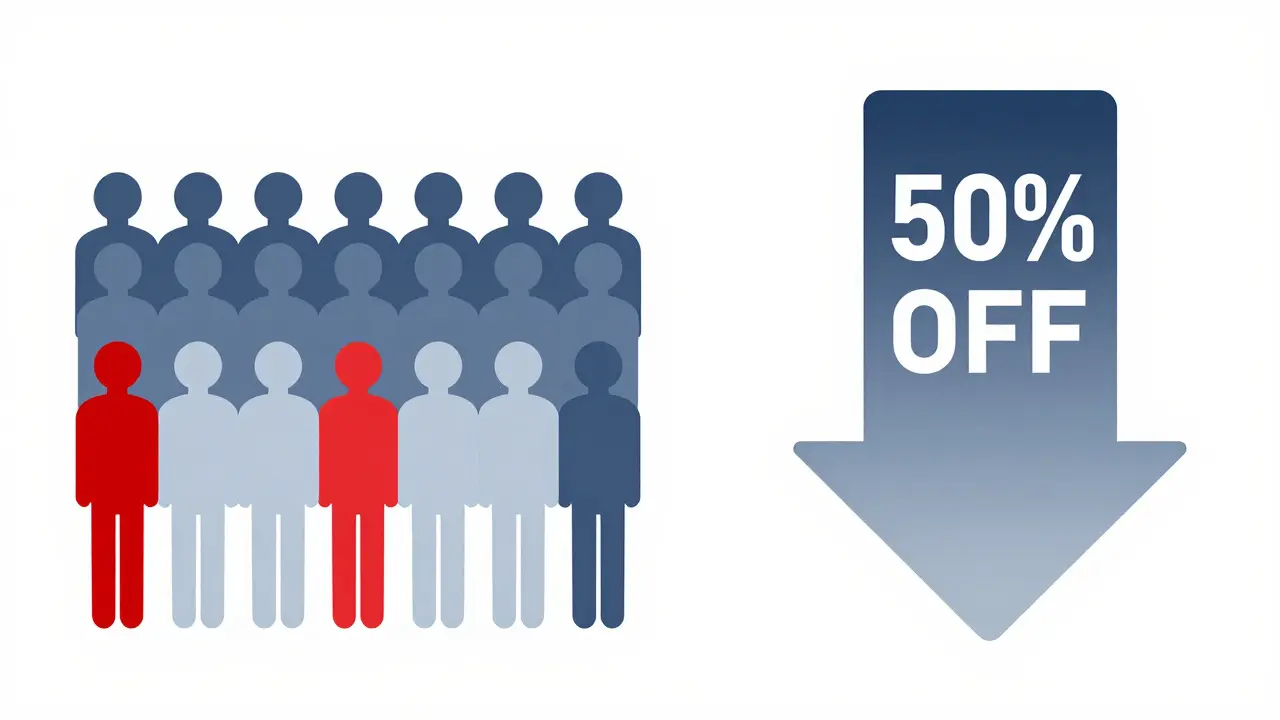
The discrepancy between these two metrics is where "statistical deception" often happens. Pharmaceutical companies have a massive incentive to highlight the relative risk because it makes the drug look more powerful. Let's use a real-world scenario: imagine a drug that reduces the risk of a heart attack from 2% to 1%.
- Absolute Risk Reduction (ARR): 2% minus 1% = 1 percentage point. (Very small)
- Relative Risk Reduction (RRR): (2% - 1%) / 2% = 50%. (Sounds huge!)
If an ad says "Cuts risk by 50%," it's technically true, but it hides the fact that 98% of people wouldn't have had a heart attack anyway. You are taking the risk of the drug's side effects to gain a 1% benefit. If the drug's side effect rate is 2%, you are actually increasing your overall risk of a health problem to get a tiny benefit. This is why you should always ask your doctor for the absolute numbers.
The Secret Metric: Number Needed to Treat (NNT)
If you're struggling to wrap your head around percentages, there's a much simpler tool called Number Needed to Treat (NNT). This is the number of people who need to take the medication for one person to experience the benefit. It's calculated by taking the inverse of the Absolute Risk Reduction (1 / ARR).
Going back to our 1% benefit example: 1 / 0.01 = 100. This means 100 people must take the drug for just one person to avoid a heart attack. The other 99 people get no benefit but are still exposed to the potential side effects. When you see an NNT of 10 or 20, the drug is quite effective. When the NNT is 100 or 1,000, you have to wonder if the risk of side effects is worth it.
How to Spot the Difference in Medical Reports
Whenever you're looking at a study or an advertisement, keep an eye out for specific phrasing. If you see the words "relative to the control group," you are looking at relative risk. If you see a mention of "percentage points," you are likely looking at absolute risk.
Here is a quick cheat sheet for interpreting these claims:
- "20% more likely to experience [side effect]" $ ightarrow$ Relative Risk. (Could mean the risk went from 0.1% to 0.12%)
- "A 2 percentage point increase in risk" $ ightarrow$ Absolute Risk. (Means the risk went from, say, 2% to 4%)
- "Cuts the risk in half" $ ightarrow$ Relative Risk. (Always ask: "Half of what?")
A great way to visualize this is by using a "risk ladder" or a pictogram. Imagine 100 stick figures. If the absolute risk is 2%, only two figures are colored red. If the risk is cut in half (relative risk 50%), only one figure is red. Seeing it this way makes it obvious that the change is small, even though the percentage sounds big.

Talking to Your Doctor About Your Risks
You don't need to be a mathematician to get the truth about your medication. The key is to ask the right questions. Instead of asking "Is this drug effective?", try these specific questions:
- "What is my baseline risk for this condition without the drug?"
- "What is the absolute risk reduction if I take this medication?"
- "How many people need to take this drug for one person to actually benefit?"
- "What is the absolute risk of the most common side effects compared to a placebo?"
By shifting the conversation toward absolute numbers, you strip away the marketing fluff and get to the actual clinical significance. If your doctor says a drug reduces a risk by 50%, but then admits the absolute risk only drops from 0.2% to 0.1%, you can make a much more informed decision about whether the side effects are a fair trade-off.
Why do pharmaceutical companies prefer relative risk?
Relative risk often yields much larger numbers, which makes a drug's benefits seem more dramatic. A 50% reduction sounds more impressive than a 1% absolute drop, making the product more attractive to both patients and prescribing physicians.
Is relative risk ever useful?
Yes. Relative risk is excellent for scientific research because it standardizes the effect of a treatment across different groups regardless of their starting risk. It helps researchers understand the potency of a drug's biological action.
What is the difference between a percent and a percentage point?
A percentage point is the simple arithmetic difference between two percentages. If a risk goes from 5% to 7%, it has increased by 2 percentage points (absolute), but it has increased by 40% (relative).
What does NNT stand for and why does it matter?
NNT stands for Number Needed to Treat. It tells you how many people must use a treatment for one person to benefit. A low NNT means the treatment is highly effective for most people; a high NNT suggests the benefit is rare.
Can I find absolute risk numbers in drug labels?
Many drug labels and clinical trial summaries provide these numbers, though they may be buried in tables. Look for "Event Rates" or "Incidence" in the clinical trial sections of the prescribing information.
Next Steps for Better Health Literacy
If you're currently taking a medication and aren't sure about the risks, start by looking up the CONSORT guidelines for the clinical trials associated with your drug. These guidelines require researchers to be more transparent about how they report risks. If you find a study, skip the "Abstract" (which often highlights relative risk) and go straight to the "Results" tables where the raw numbers are listed.
For those who want to dive deeper, practicing with a few clinical examples can help. Try to find a medical study online and calculate the ARR and NNT yourself. Once you see how a "massive" relative risk reduction can vanish when converted to absolute terms, you'll never look at a medical advertisement the same way again.
It is so obvious that they use these deceptive stats to keep us blind while the big pharma conglomerates pump us full of chemicals for profit
They dont want you knowing the absolute risk because then you'd actually realize how useless most of these pills are compared to the damage they do to your liver and brain!
I totally agree with the sentiment here, and it's actually quite fascinating if you look at the patterns of how this data is released to the public, because if you notice the timing of these studies, they always coincide with patent expirations to keep the money flowing into the same pockets, even though the biological efficacy is practically negligible in the real world for the average person who isnt a perfect lab specimen, which is just another layer of the game they play to keep us docile and dependent on a system that views us as revenue streams rather than human beings with unique genetic blueprints
Omg this is literally so scary 😱
Absolute poppycock that we even have to teach this in the modern age but here we are with the sheep blindly following the herd while the wolves in white coats fleece them for every single cent they have in their pockets without a shred of moral decency
Actually, if you read the fine print on the FDA labels, the absolute risk is always there, though most people are too lazy to look for it. I've spent years analyzing clinical trial data and it's basic arithmetic that anyone with a high school diploma should be able to perform without a guide
Ugh, imagine actually needing a tutorial on how to read a percentage... like, is it really that hard? 🙄 I can't even believe we're still talking about this in 2024 lol
oh sure because the pharmaceutical companies just accidentally forgot to mention the absolute risk in the brochure... totally a mistake and not a calculated move to trick old people into buying overpriced sugar pills that do nothing but give them a rash
this is such a helpful way to break it down!! i love how it empowers us to have better conversations with our doctors and really take charge of our own health journey
It's really important to remember that while the marketing can be misleading, these medications do save lives for many. The goal is just to find the right balance and a personalized approach for each patient through open communication.
The concept of Number Needed to Treat is an essential metric that provides a much clearer perspective on clinical utility. It is highly recommended that patients adopt this framework when evaluating new therapeutic interventions
Listen, we make the best meds in the world and if the marketing is a bit aggressive, it's because we're winning 🇺🇸 Just read the damn charts and stop whining about how the numbers are presented 🦅
i just think its interesting how we all get so stressed about these numbers when in the end we just want to feel better and be healthy and maybe the most important thing is just listening to our bodies and trusting the process even if the math is a bit confusing sometimes because everyone has such a different experience with medicine anyway
While the post attempts to simplify these concepts, it completely ignores the nuanced reality that most people are simply incapable of processing this data without being led by the nose, and frankly, the obsession with absolute risk is just another way for people to feel like they've "hacked" the system when they're actually just rearranging the deck chairs on the Titanic of their own declining health, which is just so predictably tragic and honestly quite boring if you've seen as many medical failures as I have in my time as a consultant for high-end wellness retreats where we deal with the fallout of this exact kind of pseudo-intellectual medical analysis every single day of the week