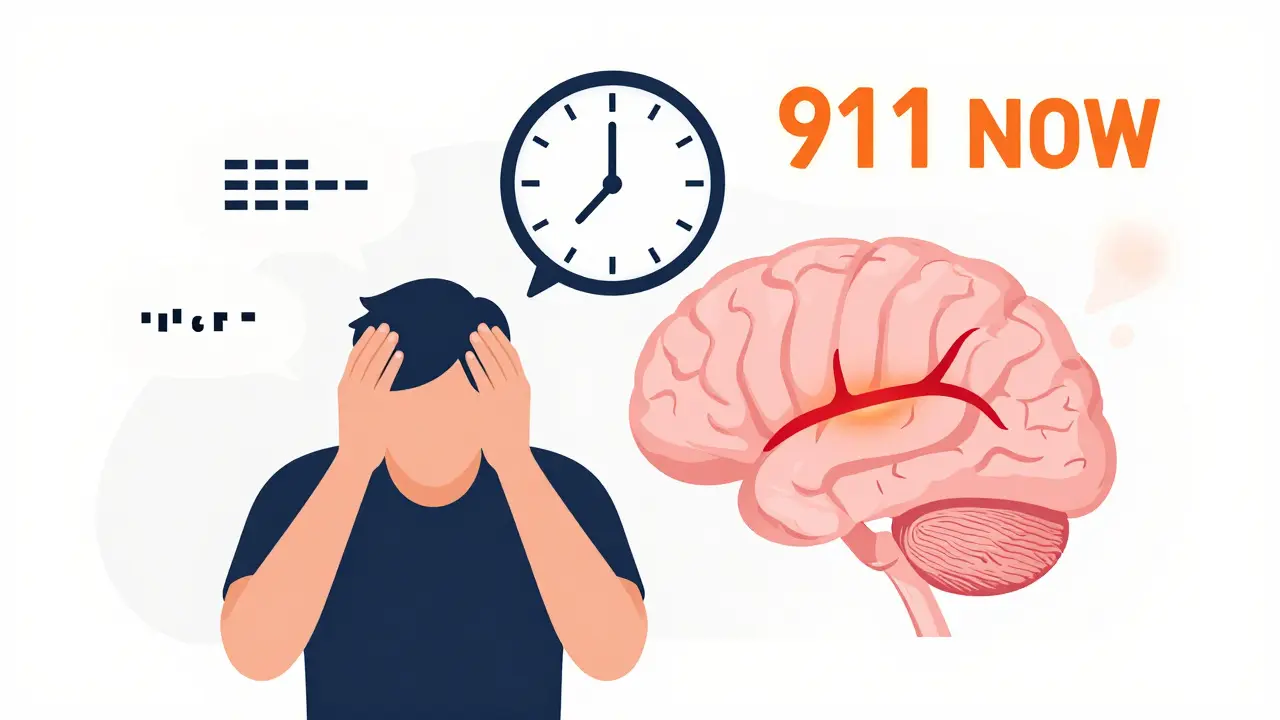
When someone suddenly loses balance, slurs their words, or can’t lift an arm, most people think it’s a stroke. But what if those symptoms disappear in 20 minutes? Many assume it’s nothing serious - TIA is often called a "mini-stroke," and that’s where the danger begins.
What Is a TIA - Really?
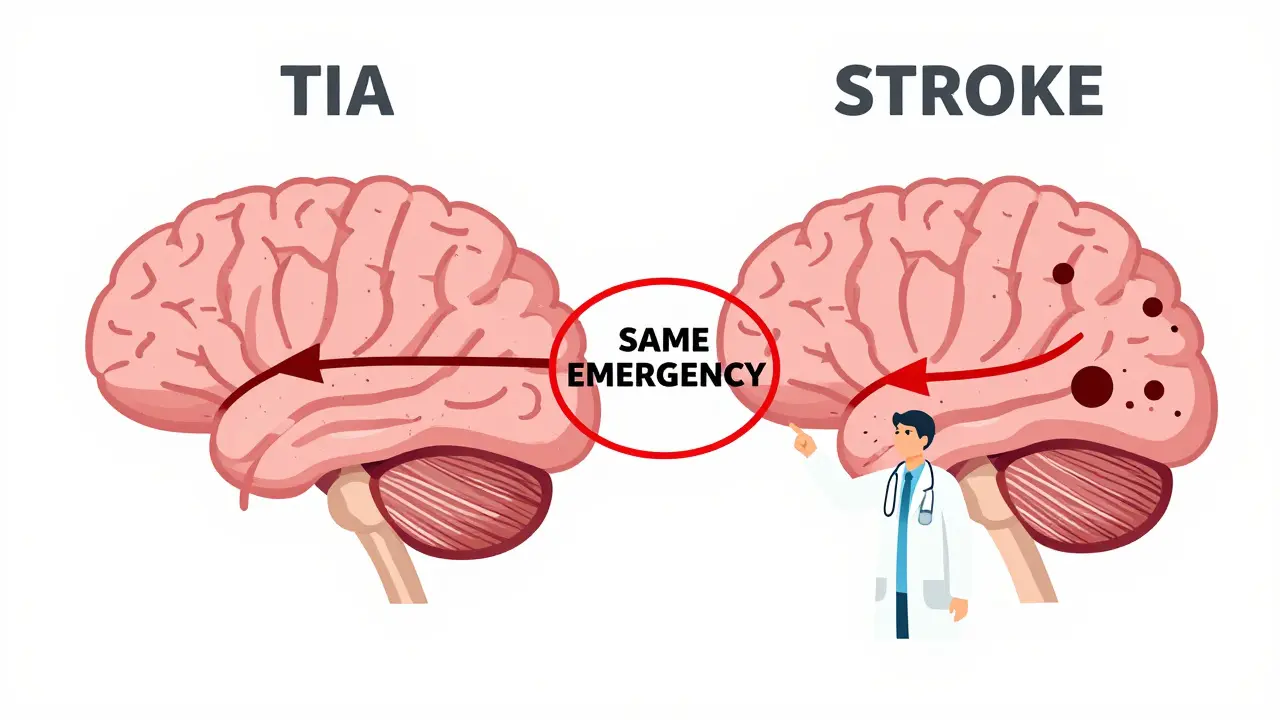
A Transient Ischemic Attack, or TIA, isn’t a warning. It’s a stroke that didn’t stick. The brain’s blood supply got blocked, neurons went quiet, and symptoms popped up - weakness, blurred vision, confusion. But because the blockage cleared fast, the brain bounced back. No permanent damage. Or so it seems.
Here’s the truth: 35% of people who think they had a TIA actually had a minor stroke. Advanced MRI scans show tiny areas of dead brain tissue - infarction - even when symptoms vanished. The old rule that TIA must resolve in 24 hours? Outdated. The American Heart Association dropped it in 2009. Now, if there’s no brain damage on imaging, it’s a TIA. If there is? It’s a stroke - even if the person feels fine.
Calling it a "mini-stroke" is misleading. It makes people think, "I’m fine now," and skip the hospital. That’s deadly. One in five people who have a TIA will have a full stroke within 90 days. Half of those strokes happen in the first two days.
How to Spot the Difference - And Why It Doesn’t Matter
Here’s the hard truth: you can’t tell TIA from stroke by symptoms alone. Both cause:
- Facial drooping - one side of the mouth sags
- Arm weakness - can’t raise one arm, or it drifts down
- Slurred speech - words sound thick, or the person can’t speak
- Sudden vision loss - in one or both eyes
- Dizziness or loss of balance - no cause, no vertigo history
- Severe headache - unlike any before, often with vomiting
The BE FAST mnemonic works for both:
- Balance: Sudden loss
- Eyes: Blurred, double, or lost vision
- Face: Drooping
- Arm: Weakness
- Speech: Slurred or strange
- Time: Call 911 - NOW
It doesn’t matter if the weakness fades. If it happened once, it can happen again - harder next time. The brain doesn’t care if symptoms lasted 10 minutes or 10 hours. What matters is whether brain tissue died. And you won’t know that without imaging.
The ABCD2 Score - What Your Doctor Actually Uses
Hospitals don’t guess. They use a simple tool called ABCD2 to measure stroke risk after a TIA:
- Age: 60 or older = 1 point
- Blood pressure: 140/90 or higher = 1 point
- Clinical features: Weakness on one side = 2 points; speech trouble without weakness = 1 point
- Duration: Symptoms over 60 minutes = 2 points; 10-59 minutes = 1 point
- Diabetes: Has it = 1 point
Add them up. Score of 4 or higher? High risk. You’re 8 times more likely to have a stroke in two days. That’s why guidelines say: if your score is 4+, you need to be in the hospital within 12 hours. Most people wait. That’s why 31% of TIA patients delay care beyond 24 hours - and why their stroke risk spikes.
What Happens in the ER - And Why Speed Saves Lives
When you walk into the emergency room with TIA symptoms - even if they’re gone - here’s what happens:
- Non-contrast CT scan: Rules out bleeding. Quick. Basic.
- MRI with diffusion-weighted imaging: The gold standard. Detects brain damage invisible to CT. 99% accurate.
- ABCD2 scoring: Done within 60 minutes of arrival.
- Immediate treatment: If high risk, you get aspirin (325 mg) and clopidogrel (300 mg loading dose) within 24 hours. This cuts stroke risk by 60%.
- Statins: Atorvastatin 80 mg daily - lowers cholesterol fast and stabilizes plaques.
- Blood pressure control: Target under 140/90.
Delaying care by even 24 hours doubles your stroke risk. A study at Massachusetts General Hospital showed patients seen the same day had a 1.2% stroke risk in 90 days. Those who waited? 10.3%.
Why You Should Never Say "It Wasn’t Serious"
People say, "I had a TIA. I didn’t need to go to the hospital. I felt fine after an hour." That’s the mindset that kills.
Here’s what really happens:
- 40% of "TIA" patients turn out to have had a minor stroke - brain damage that didn’t cause lasting symptoms.
- 48% of "TIA" patients show subtle brain injury on advanced MRI - damage you can’t feel, but that increases future stroke risk.
- 9-20% of TIA patients have a stroke within 90 days - the highest risk is in the first 48 hours.
And here’s the kicker: TIA is not a warning. Dr. Steven Levine from Northwell Health says it best: "TIA is not a ‘warning’ - it’s an actual stroke event that resolved spontaneously." That means your brain just barely escaped damage. It didn’t avoid a stroke. It survived one.
What Happens After You Leave the Hospital
TIA isn’t a one-and-done. It’s a red flag on your health report.
Long-term care includes:
- Aspirin or clopidogrel daily - for life
- High-intensity statin - atorvastatin 80 mg
- Blood pressure monitoring - aim for under 130/80
- Diabetes control - if you have it
- Smoking cessation - if you smoke
- Heart rhythm check - atrial fibrillation is a silent stroke risk
Without these steps, your risk stays high. The EXPRESS study proved: immediate treatment cuts 90-day stroke risk from 10.3% to 2.1%. That’s not luck. That’s medicine.
The Hidden Cost - And Why This Isn’t Just About You
A single stroke costs $21,000+ in the first year. TIA evaluation? Around $2,850. Preventing one stroke pays for 7 TIA visits.
And it’s not just money. In the U.S., 240,000 to 500,000 TIAs happen every year. Only 15-30% of people seek care. That’s a public health failure. Hospitals now get penalized if more than 20% of TIA patients have a stroke within 30 days. That’s why top centers use telemedicine clinics and AI tools to predict risk - and get patients seen in under an hour.
It’s not about being dramatic. It’s about being smart. Your brain doesn’t recover from strokes. It compensates. And that compensation has limits.
Is a TIA the same as a stroke?
No - but the difference is technical, not practical. A stroke causes permanent brain damage. A TIA doesn’t - or at least, that’s what imaging shows. But in reality, many "TIAs" are actually minor strokes. The key is: both need emergency care. You can’t tell them apart by symptoms. If you have stroke-like symptoms, call 911 - even if they go away.
Should I go to the hospital if my symptoms disappeared?
Yes - absolutely. The moment symptoms vanish, the clock starts ticking. The highest risk of a full stroke is within the first 48 hours. Waiting until the next day means you’re gambling with your brain. Emergency departments have protocols to evaluate you in under an hour. Don’t wait for a follow-up appointment. Call 911.
Can a TIA cause long-term damage?
Yes - even if you feel fine. Advanced MRI scans show that nearly half of people with TIA have tiny areas of brain injury that don’t cause obvious symptoms. These "covert" injuries increase your risk of future stroke and cognitive decline. TIA isn’t harmless. It’s a sign your brain is under attack.
What’s the ABCD2 score, and why does it matter?
The ABCD2 score is a tool doctors use to predict stroke risk after a TIA. It looks at your age, blood pressure, symptoms, how long they lasted, and whether you have diabetes. A score of 4 or higher means you’re at high risk - and need hospital evaluation within 12 hours. It’s not perfect, but it’s the best tool we have to decide who needs urgent care.
What should I do after a TIA?
Start treatment immediately: take aspirin and clopidogrel as prescribed, start a high-intensity statin (like atorvastatin 80 mg), control your blood pressure below 140/90, quit smoking if you smoke, and get checked for heart rhythm problems like atrial fibrillation. Follow up with a neurologist. This isn’t optional - it’s your best chance to avoid a life-changing stroke.
Is a TIA more dangerous than a stroke?
Not in terms of immediate damage - a stroke can be devastating. But a TIA is more dangerous because it’s ignored. Most people don’t treat it as an emergency. That’s why it’s the #1 predictor of a future stroke. A TIA is the brain’s last cry for help before a major event. If you ignore it, you’re choosing risk over safety.
Next Steps - Don’t Wait Until It’s Too Late
If you’ve ever had symptoms like this - even once - talk to your doctor. Get an MRI. Ask about your ABCD2 score. Start the medications. Stop ignoring "minor" episodes. Your brain doesn’t get a second chance. And the best time to act? Right now.
14 Comments
Write a comment