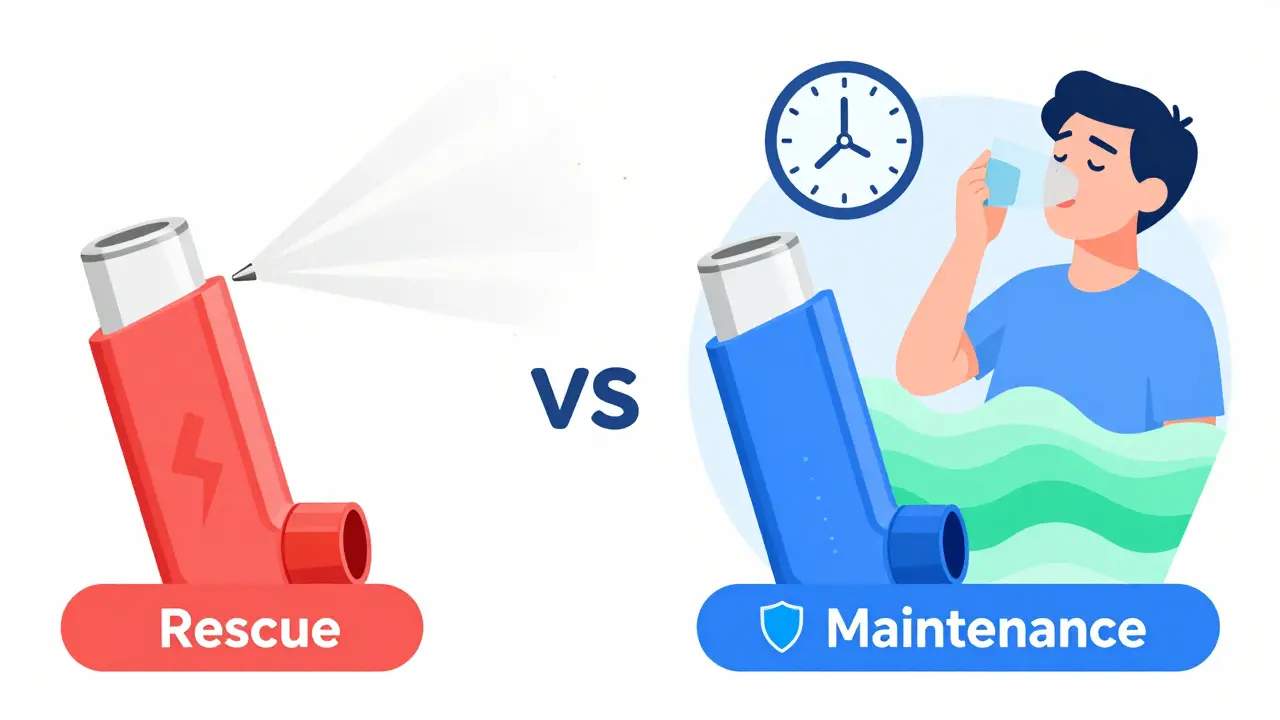
When you or someone you care about has asthma, the difference between a rescue inhaler and a maintenance inhaler isn’t just technical-it’s life-or-death. Too many people mix them up. And when they do, the results can be dangerous. One is for emergencies. The other is for prevention. Using the wrong one at the wrong time can turn a manageable flare-up into a trip to the ER.
What Rescue Inhalers Do (and Don’t Do)
Rescue inhalers are your emergency tool. They kick in fast-usually within 1 to 5 minutes-when you’re wheezing, coughing, or struggling to breathe. These are the devices you grab during an asthma attack. The active ingredient? Almost always a short-acting beta agonist (SABA), like albuterol. You’ll see it sold under brand names like Ventolin, ProAir, or Proventil. Generic versions, like Teva’s ProAir HFA, cost between $35 and $50 without insurance.
How it works: albuterol binds to receptors in your airway muscles and tells them to relax. This opens up your breathing passages fast. That’s why it’s so effective in a crisis. Studies show it can improve peak airflow by up to 85% within 10 minutes. But here’s the catch: it does nothing to reduce inflammation. It doesn’t fix the root cause of asthma. It just buys you time.
That’s why rescue inhalers shouldn’t be your daily go-to. If you’re using one more than twice a week, your asthma isn’t under control. The American Lung Association says that’s a red flag. It means you need a different plan. Overusing rescue inhalers is a sign your body is constantly fighting inflammation-and that’s dangerous long-term.
What Maintenance Inhalers Are For
Maintenance inhalers are the quiet heroes. They don’t make you feel better right away. In fact, you might not notice any difference at first. But over time, they change the game. These are daily medications designed to reduce swelling and mucus in your airways before symptoms even start.
The most common type contains inhaled corticosteroids (ICS), like fluticasone or budesonide. These are anti-inflammatory drugs that work slowly. It takes 24 to 48 hours for them to start working, and up to three weeks to reach full effect. That’s why skipping doses hurts. Missing just 20% of your scheduled doses-like skipping 3 out of 15 weekly puffs-cuts effectiveness by 45%, according to the UNC Adult Asthma Program.
Some maintenance inhalers also include a long-acting beta agonist (LABA), like formoterol or salmeterol. These help keep airways open longer but aren’t meant for quick relief. You’ll find them in combination inhalers like Advair (fluticasone + salmeterol) or Symbicort (budesonide + formoterol). These aren’t just maintenance-they’re also approved for as-needed use in certain cases, which we’ll get to in a minute.
Studies back this up. A 2022 Cochrane Review of over 15,000 people showed that consistent use of maintenance inhalers reduces asthma attacks by 40% to 60% compared to placebo. That’s huge. But again-this only works if you take it every day, even when you feel fine.
The Big Difference: Speed vs. Prevention
Here’s the core truth: rescue inhalers act fast but don’t heal. Maintenance inhalers heal slowly but prevent damage.
Think of it like this: if your airways are a fire, a rescue inhaler is a fire extinguisher. It puts out the flames right now. A maintenance inhaler is like cleaning up the clutter around your house so the fire can’t start in the first place. You need both. But if you only use the extinguisher, the fire keeps coming back. And if you only clean up the clutter but never grab the extinguisher during a real blaze, you’re in serious trouble.
One study in the American Journal of Respiratory and Critical Care Medicine showed that during an acute attack, maintenance inhalers only improved airflow by 15%. Rescue inhalers? 85%. That’s not a small difference-it’s a critical one.
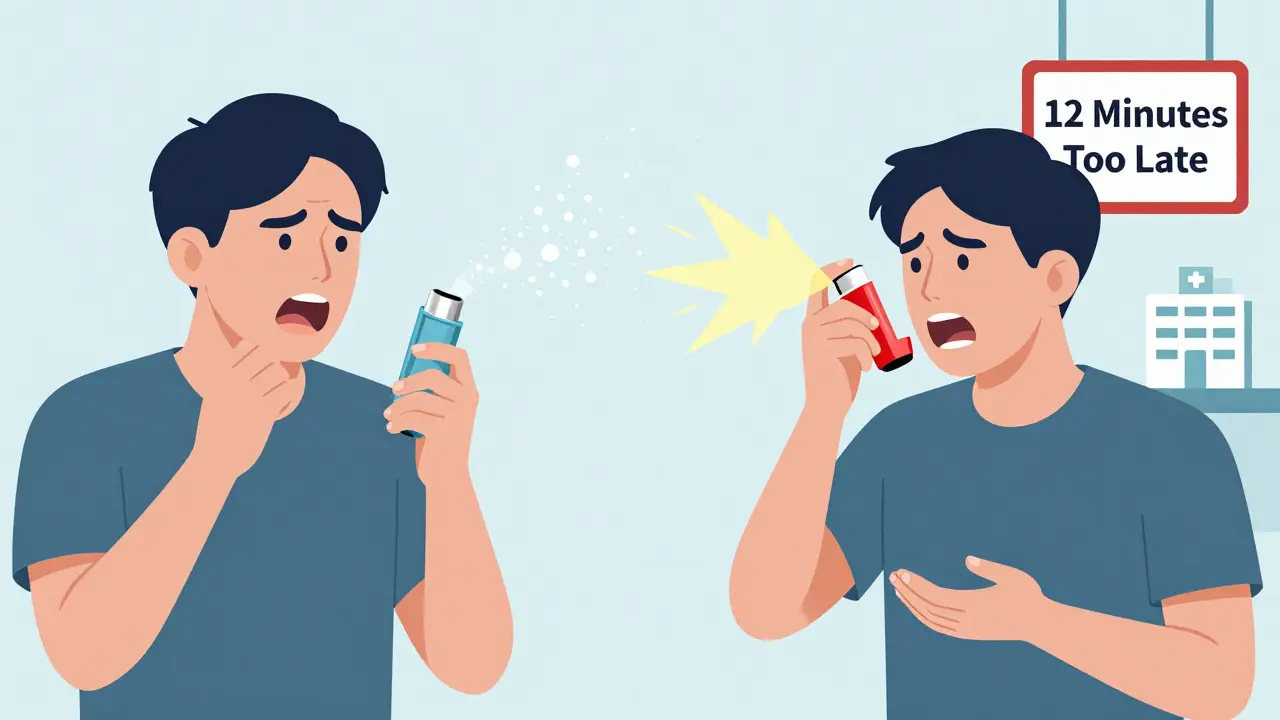
And here’s where things get dangerous: some people mistakenly use their maintenance inhaler during an attack. A case documented by Consumer Medsafety involved a 9-year-old at summer camp who grabbed his Symbicort (a maintenance inhaler) instead of his ProAir (rescue) during a flare-up. He waited 12 minutes for relief. His breathing got worse. He ended up in the hospital.
Why People Get It Wrong
Confusion isn’t rare. In fact, it’s common. A 2023 report from the American College of Allergy, Asthma & Immunology found that 38% of near-fatal asthma cases involved people relying too heavily on rescue inhalers without any maintenance therapy. That’s a preventable tragedy.
One reason? Appearance. Both types of inhalers are often red, similar in size, and look almost identical. A 2022 analysis by the Institute for Safe Medication Practices recorded 1,247 mix-up incidents that year. That’s why the FDA now requires new inhalers to have distinct color-coding: red for rescue, blue for maintenance. If your inhaler doesn’t follow this, it might be old.
Another reason? Cost. Maintenance inhalers like Symbicort or Advair can cost $300 to $350 a month without insurance. A 2024 Kaiser Family Foundation survey found that 42% of patients skip doses because they can’t afford the copay. That’s not laziness-it’s a system failure.
And then there’s the mindset. Some people think, “I only use my inhaler when I feel bad, so I don’t need the daily one.” But asthma isn’t about how you feel today. It’s about what’s happening inside your airways right now-even if you’re not coughing.
New Guidelines: One Inhaler for Both Jobs?
The old model-two separate inhalers, one for rescue, one for maintenance-is changing. The 2023 Global Initiative for Asthma (GINA) guidelines now recommend a single-inhaler approach for many patients.
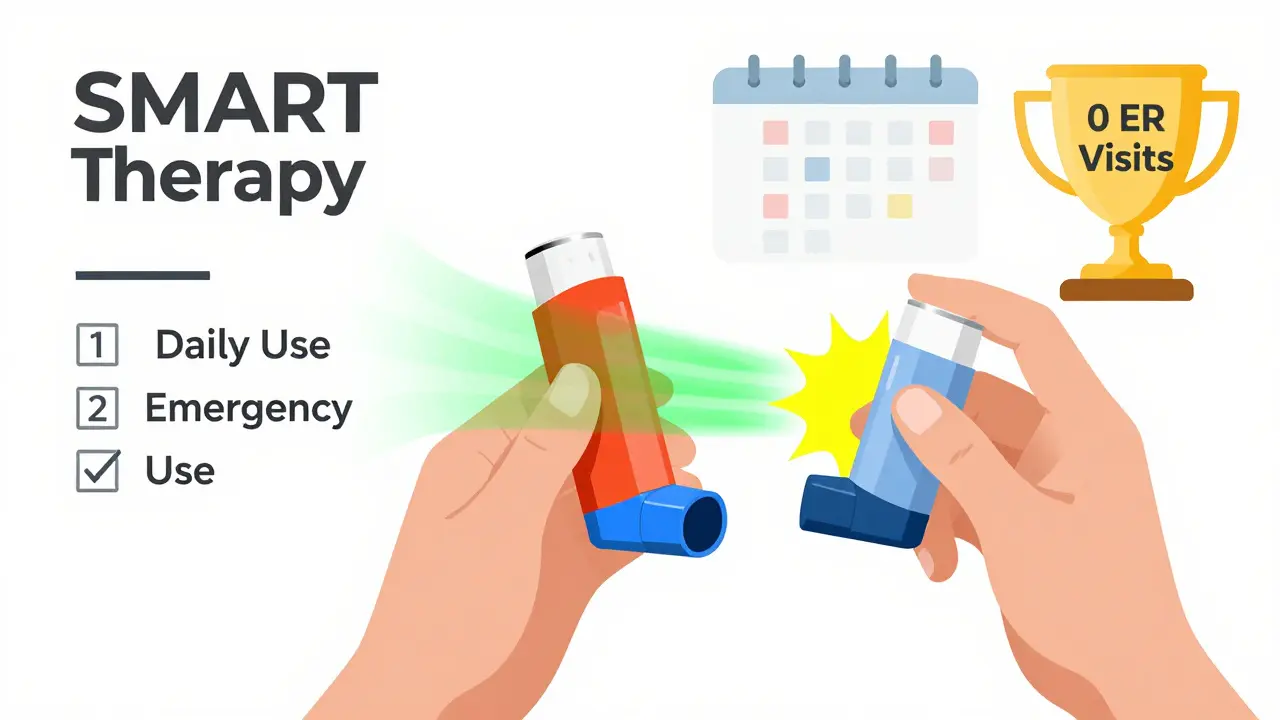
Specifically, combination inhalers like Symbicort (budesonide + formoterol) are approved for use as both maintenance and rescue. Formoterol works fast enough (within 1-3 minutes) to act as a rescue, while budesonide continues to reduce inflammation daily. This means one device does both jobs.
This approach, called SMART (Single Maintenance and Reliever Therapy), is now first-line for moderate-to-severe asthma. Early data from pilot programs show it cuts confusion-related errors by nearly half. By 2027, experts predict 60% of new asthma patients will start on this single-inhaler plan.
But it’s not for everyone. If you have mild, occasional asthma, you might still do fine with just a rescue inhaler on an as-needed basis. The 2023 American Thoracic Society guidelines say that’s okay-no need to overmedicate.
How to Use Them Right
Using an inhaler wrong wastes medicine. The Cleveland Clinic says proper technique gets 30-40% of the drug into your lungs. Wrong technique? Only 10-15%.
For rescue inhalers:
- Shake well.
- Breathe out fully.
- Place mouthpiece in mouth, seal lips.
- Press the canister and breathe in slowly for 5-7 seconds.
- Hold your breath for 10 seconds.
- Wait at least 1 minute before a second puff.
For maintenance inhalers, especially those with steroids:
- Always use a spacer if you have one-it helps deliver more medicine and reduces throat irritation.
- Rinse your mouth with water after each use. This cuts down on oral thrush, a common side effect.
- Take it at the same time every day. Set a phone reminder if you have to.
Track your rescue inhaler use. If you’re going through more than one inhaler a month (that’s more than 8 puffs a week), your asthma is poorly controlled. Talk to your doctor. Don’t wait for another attack.
What to Do If You’re Confused
If you’re not sure which inhaler is which:
- Check the label. Rescue inhalers say “for acute symptoms” or “as needed.” Maintenance inhalers say “daily use” or “for long-term control.”
- Look at the color. Red = rescue. Blue = maintenance. This is now standard for new devices.
- Ask your pharmacist. They can show you the difference.
- Take a photo of both inhalers and compare them side-by-side. Write the names on sticky notes and stick them on the devices.
Also, check expiration dates. Rescue inhalers usually last 12 months after opening. Maintenance inhalers vary-some last 3 months, others 6. Using an expired inhaler could mean you’re getting zero medication.
The Bottom Line
Rescue inhalers save lives in the moment. Maintenance inhalers save lives over time. You need both-unless your doctor says otherwise. If you’re using a rescue inhaler too often, you’re not treating asthma-you’re treating symptoms. And symptoms don’t tell the whole story.
The goal isn’t to stop using your rescue inhaler. It’s to need it less. That only happens when you’re consistent with your maintenance therapy. And if you’re on a combination inhaler like Symbicort, make sure you’re using it correctly-for both daily control and emergency relief.
Asthma doesn’t care if you forget. It doesn’t wait for a convenient time. But with the right tools and the right understanding, you can take back control.
Can I use my maintenance inhaler during an asthma attack?
No. Maintenance inhalers, especially those with only inhaled corticosteroids (like fluticasone or budesonide alone), take days to work. Using them during an attack delays treatment and can make things worse. If you’re having trouble breathing, use your rescue inhaler (albuterol) immediately. Only use combination inhalers like Symbicort for rescue if your doctor specifically told you to.
Why do I need to rinse my mouth after using a maintenance inhaler?
Inhaled corticosteroids can leave a residue in your mouth and throat, which increases your risk of oral thrush-a fungal infection that causes white patches and soreness. Rinsing with water after each use removes the medicine before it can settle. Spit out the water, don’t swallow it. This simple step cuts infection risk by over 70%.
Is it okay to use a rescue inhaler every day?
No. Using a rescue inhaler more than twice a week (or going through more than one inhaler every 3 months) means your asthma isn’t controlled. It’s a sign you need a daily maintenance medication. Rescue inhalers don’t reduce inflammation-they just mask symptoms. Relying on them daily is like putting a bandage on a broken bone.
What if I can’t afford my maintenance inhaler?
Talk to your doctor. Many maintenance inhalers have generic versions or patient assistance programs. For example, generic fluticasone inhalers can cost under $25 with a coupon. Some clinics offer free or low-cost asthma management programs. Skipping doses because of cost is dangerous-but there are options. Don’t go without help.
Do all inhalers look the same?
Older inhalers often looked similar-mostly red or black. But since 2023, the FDA requires all new inhalers to use color coding: red for rescue, blue for maintenance. If your inhaler doesn’t follow this, it may be outdated. Check the label, not just the color. Always confirm with your pharmacist if you’re unsure.
Been using my inhalers for 12 years. Rescue is red, maintenance is blue. Simple. But I still catch myself grabbing the wrong one sometimes when I’m half-asleep. One time I used my Symbicort during a panic attack and thought, ‘Why isn’t this working?’ Turned out I was supposed to be using my albuterol. Never again. Always check the label. Always.
Also, rinse your mouth. Seriously. I got oral thrush once. Felt like I had cotton balls coated in chalk in my throat. Rinsing saves you from that nightmare. Just spit it out. Don’t swallow. It’s not that hard.
bro i had no idea inhalers had color codes now. i thought they all looked the same. my old one is black and i use it like a snack. like ‘ohh breathing hard? grab inhaler’ - nope. i was using my maintenance like a rescue. my doc was like ‘dude you’re gonna end up in the hospital’ and i was like ‘but it feels better after i use it lol’
now i got the blue one for daily, red one for panic. and i even wrote ‘EMERGENCY’ on the red one with a sharpie. also i use a spacer now. it’s kinda dumb looking but it works. my lungs thank me.
Ugh. People are so lazy. You think asthma is just ‘oh I wheeze sometimes’? No. It’s a chronic disease. If you’re using your rescue inhaler more than twice a week, you’re not ‘managing’ - you’re just surviving. And if you skip your maintenance because it’s ‘too expensive’? That’s not a personal choice - that’s a systemic failure. But guess what? You’re still the one who ends up in the ER with a 3-hour wait and a $12k bill. So stop being dumb. Get your act together. Or don’t. But don’t act surprised when your kid gets hospitalized because you ‘forgot’ to refill the blue one.
Thank you for this meticulously detailed and clinically accurate exposition. I have been practicing respiratory care for over two decades, and I can confirm that the distinction between rescue and maintenance inhalers remains one of the most consistently misunderstood aspects of asthma management, even among healthcare professionals.
The FDA’s 2023 color-coding initiative is a significant step toward reducing medication errors, and the adoption of SMART therapy (Single Maintenance and Reliever Therapy) represents a paradigm shift grounded in robust evidence from the GINA guidelines. The pharmacokinetic profiles of formoterol, in particular, make it uniquely suited for dual use - a fact often overlooked in primary care settings.
Furthermore, the emphasis on spacer use and post-inhalation oral rinsing is not merely anecdotal; it is supported by Level 1 evidence demonstrating a 72% reduction in oropharyngeal candidiasis. I urge all patients to request educational materials from their pharmacy - many now offer video demonstrations via QR code.
wait so if i use my symbicort for both… does that mean i dont need the red one anymore? or is that still a backup? my doc just switched me and i’m confused. also, how do i know if my inhaler is expired? mine says ‘open date’ but not ‘expire date’… is that a thing?
also, i’ve been using my inhaler like 3x a week but i feel fine. does that still count as ‘too much’? like… if i don’t feel bad, is it still a problem?
Okay, I’m going to nerd out for a second. The pharmacodynamics of SABA vs ICS/LABA are fascinating. Albuterol is a β2-adrenergic agonist - it causes rapid bronchodilation via Gs-protein-coupled receptor activation, increasing intracellular cAMP, which inhibits myosin light-chain kinase. Boom. Airway smooth muscle relaxes.
Meanwhile, fluticasone? Glucocorticoid receptor agonist. It translocates to the nucleus, suppresses NF-κB transcription, reduces IL-4, IL-5, TNF-α - all the pro-inflammatory cytokines that make your airways swell up like a balloon full of bees.
So yeah. Rescue = emergency brake. Maintenance = anti-inflammatory armor. One doesn’t replace the other. And formoterol? It’s a fast-onset SABA with a long half-life. That’s why Symbicort can be SMART. It’s literally the perfect hybrid. We should be teaching this in middle school.
Man, I used to be that guy who’d say ‘I only use it when I need it.’ Then I had a panic attack on a plane. I grabbed my blue inhaler. Sat there for 10 minutes wheezing like a broken accordion. The flight attendant gave me a look like I was gonna die. Which, honestly? I might have.
Turns out I was using my maintenance inhaler. I had no idea. My doctor never showed me the difference. I thought they were just ‘different flavors’ of the same thing.
Now I have sticky notes on both. Red = ‘BREATHE NOW’. Blue = ‘DAILY DRILL’. I even set a reminder on my phone: ‘DON’T BE A DUMBASS, USE THE BLUE ONE’. It works. I haven’t been to the ER in 18 months. And I rinse. I’m not a saint. But I’m not a statistic anymore.
I had a 14-hour asthma attack once. I was in the ER for 7 hours. My husband was crying. My cat was staring at me like I was a ghost. I used my rescue inhaler 17 times. Nothing. Then I remembered I had a Symbicort in my bag. I used it. 20 minutes later, I could breathe. I thought I was saved. Then the nurse yelled, ‘YOU CAN’T USE THAT FOR EMERGENCIES!’ I was like, ‘BUT IT WORKED?!’
Turns out, I had a super rare case where the formoterol kicked in fast. But the docs said I was lucky. Like, lottery-winning-lucky. Now I have two inhalers. One red. One blue. And I keep them in different pockets. I even have a little chart taped to my fridge. I’m not proud. But I’m alive.
Oh honey. You’re telling me people are still using inhalers like they’re candy? ‘Oh, I’m a little winded - time for my daily puff!’ No. No. NO.
Let me get this straight: you’re using your maintenance inhaler like a Starbucks latte - ‘I’ll just take a hit when I feel like it’? Sweetie, that’s not asthma management. That’s a slow-motion suicide pact with your lungs.
And if you can’t afford it? Please. There are programs. Free clinics. Generic fluticasone is $18 at Walmart. You can get it for less than a Netflix subscription. You’re choosing to risk your life over a $20 copay? That’s not ‘financial hardship.’ That’s just bad life choices.
And yes. RINSE YOUR MOUTH. I don’t care if you’re a CEO or a college student. Spit. Don’t swallow. Your throat isn’t a compost bin.