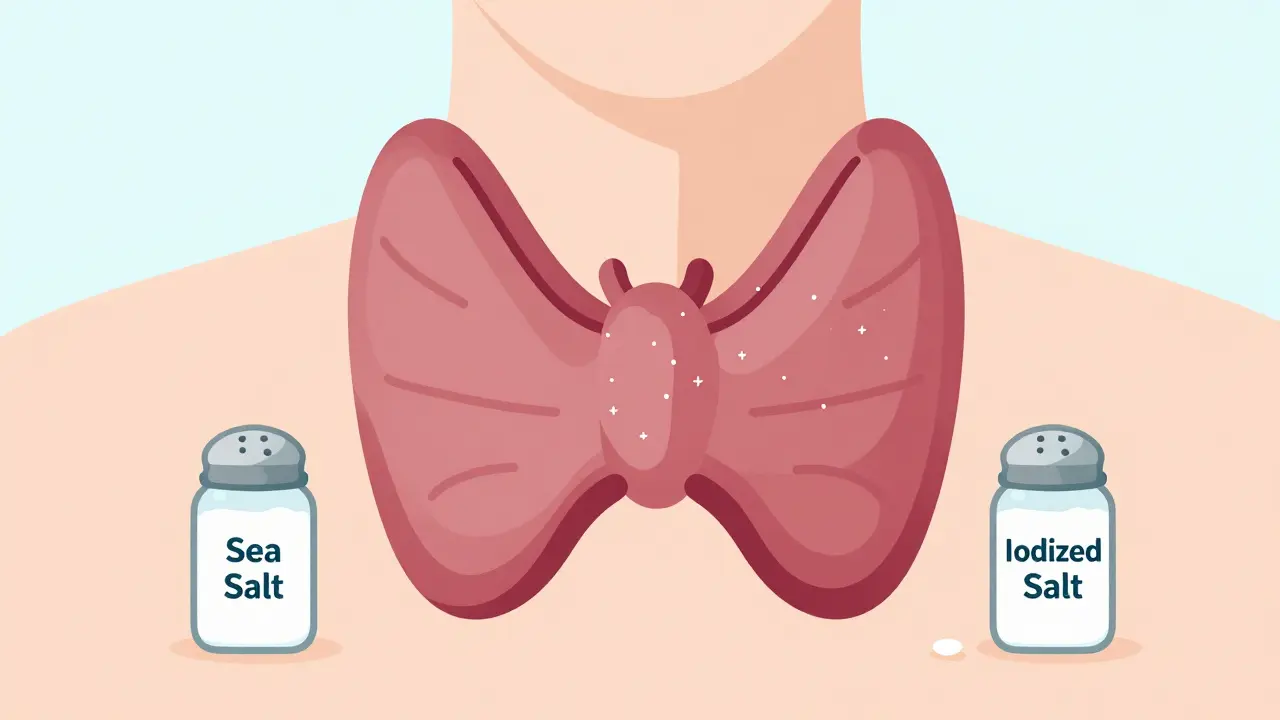
A goiter isn’t just a bump on the neck-it’s a sign your thyroid is working overtime, often because it’s starving for iodine. The thyroid, a small butterfly-shaped gland at the base of your throat, normally weighs about 15 to 20 grams. When it swells to 50 grams or more, it becomes visible and sometimes painful. You might notice it when buttoning your shirt, or feel pressure when swallowing food. In severe cases, it can make breathing hard or change your voice. And while it sounds old-fashioned, goiter is still very much a modern health issue-especially where diets lack iodine.
Why Does the Thyroid Swell?
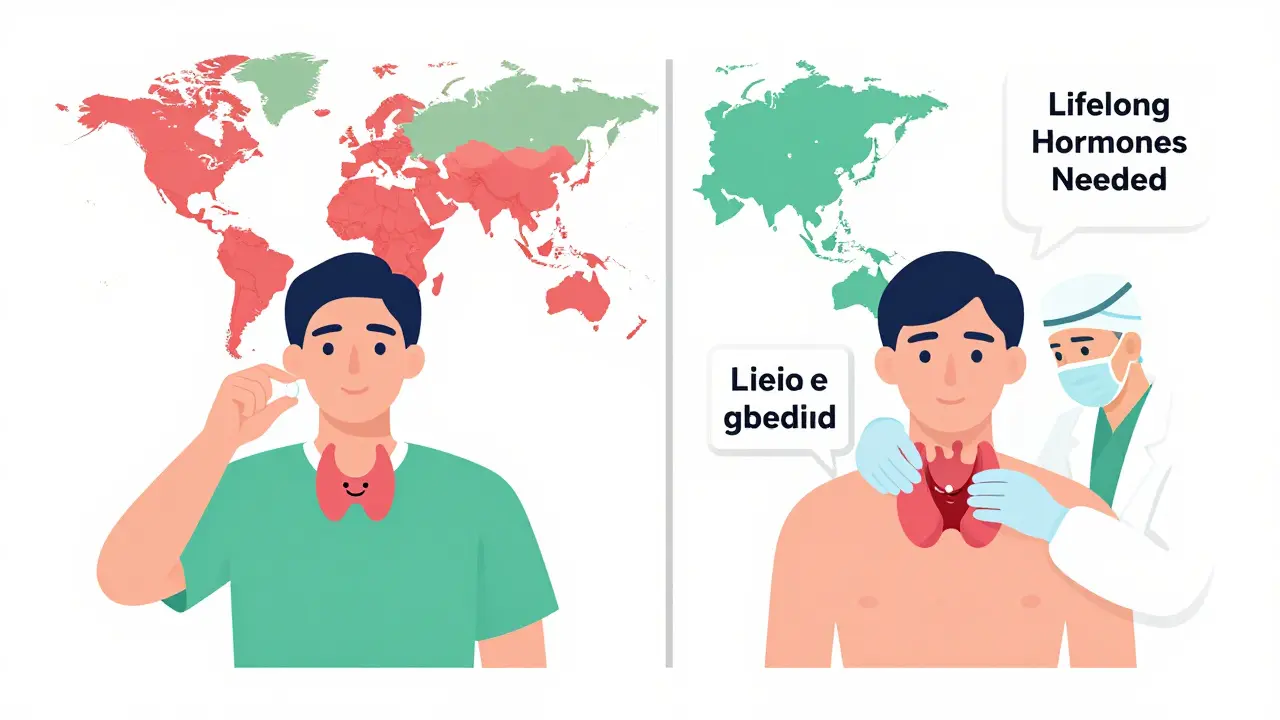
The thyroid needs iodine to make its two main hormones: T3 and T4. These hormones control your metabolism, energy, temperature, and even your heart rate. When iodine is scarce, the thyroid doesn’t get the signal to stop growing. So it keeps trying to trap more iodine from the blood-by expanding. This is called a goiter. In places without iodized salt, like parts of Africa, South Asia, and mountainous regions of Latin America, iodine deficiency causes about 90% of goiters. The World Health Organization estimates 1.9 billion people still live in areas where this is a real risk.
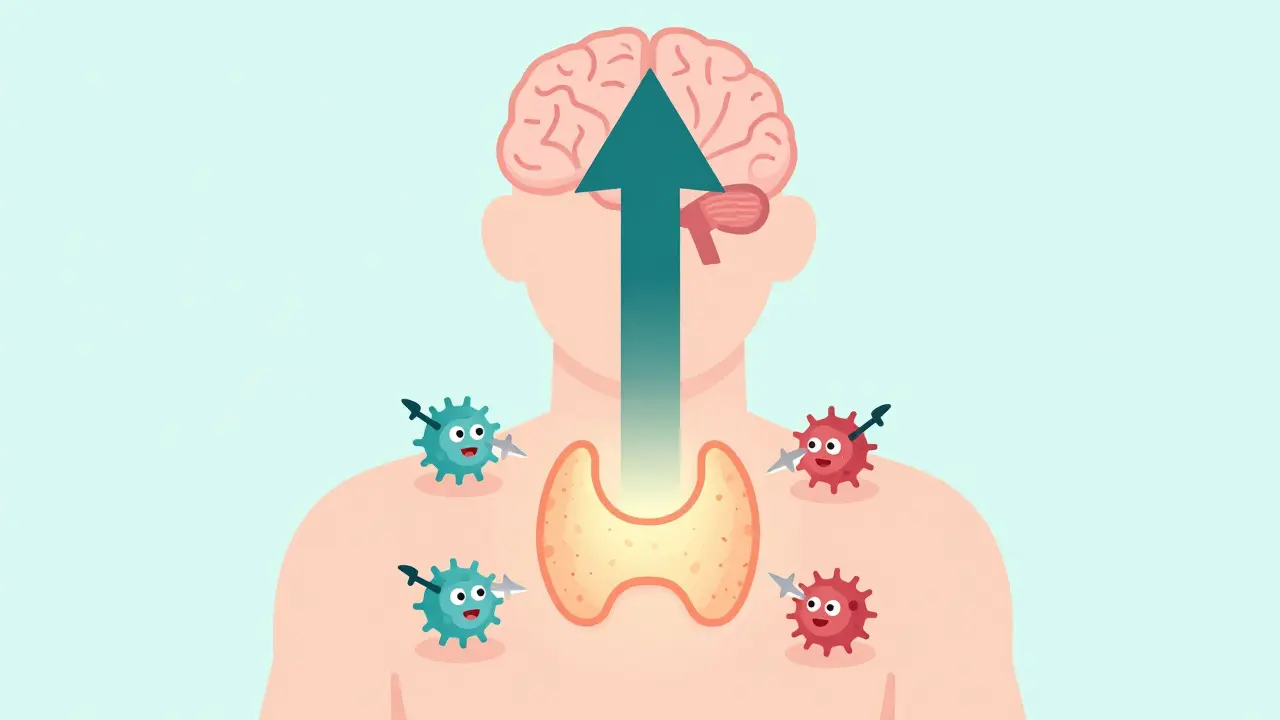
But in the U.S., Canada, and Western Europe, iodized salt has been around since the 1920s. So why do we still see goiters here? Because other problems take over. The most common cause now is Hashimoto’s thyroiditis-an autoimmune disease where your immune system attacks your own thyroid. It’s like your body mistakes the gland for an invader. Over time, the gland gets inflamed, scarred, and enlarged. Women are three times more likely than men to develop this, especially after age 40. Another cause is Graves’ disease, which overstimulates the thyroid and leads to a toxic goiter-often with weight loss, rapid heartbeat, and bulging eyes.
How Much Iodine Do You Really Need?
The American Thyroid Association says adults need 150 micrograms (mcg) of iodine every day. Pregnant women need 220 mcg. Breastfeeding mothers? 290 mcg. That’s not much-but it’s essential. One gram of iodized salt contains about 45 mcg of iodine. So if you use half a teaspoon (about 3 grams) of iodized salt per day, you’re getting close to your daily dose. But here’s the catch: many people don’t use iodized salt. They use sea salt, Himalayan salt, or kosher salt-none of which are reliably iodized. Even if you eat seafood or dairy, your intake can still fall short, especially if you’re vegan or avoid dairy.
Supplements help. For someone with a simple iodine-deficient goiter, taking 150 mcg of potassium iodide daily can shrink the gland by 30 to 40% in six to twelve months. The NIH has tracked this in multiple studies. It’s not magic-it’s biology. The thyroid stops overworking once it gets enough iodine. But supplements won’t fix autoimmune goiters. In fact, giving iodine to someone with Hashimoto’s can sometimes make things worse by triggering more immune attacks. That’s why you can’t just pop a pill and expect it to cure everything.
Diagnosis: How Do You Know It’s a Goiter?
Most people notice the swelling first. But doctors don’t rely on sight alone. They’ll feel your neck, check your pulse for signs of overactivity, and order blood tests. TSH (thyroid-stimulating hormone) is the first clue. If it’s high, your thyroid isn’t making enough hormone-likely hypothyroidism. If it’s low, you might be hyperthyroid. Then comes the ultrasound. A normal thyroid volume is under 18 mL in men and 15 mL in women. Anything above 25 mL is considered enlarged. A thyroid scan can show if the goiter is “hot” (overactive) or “cold” (underactive). Cold nodules carry a small risk of cancer, so they’re biopsied.
Don’t assume every neck lump is a goiter. Lymph nodes, cysts, or even tumors can look similar. That’s why self-diagnosis is dangerous. If you notice a persistent lump, see a doctor. Early detection means simpler treatment.
Treatment: What Actually Works?
Treatment depends on the cause-and how big the goiter is.
- Iodine-deficient goiter: 150 mcg of iodine daily. Within a year, 70-85% of cases shrink significantly or disappear. No surgery needed.
- Hashimoto’s goiter: Levothyroxine (synthetic T4) is the standard. Doses are based on body weight-about 1.6 mcg per kg. It restores hormone levels, but the gland only shrinks by 10-20% because scar tissue doesn’t reverse easily.
- Graves’ disease: Medications like methimazole (5-30 mg daily) block hormone production. In 12-18 months, the goiter shrinks by 40-60%. Some people eventually need radioactive iodine or surgery.
- Large or compressive goiters: If the gland is over 80-100 mL or pressing on your windpipe, surgery is often the best option. A total thyroidectomy removes 30-40 grams of tissue. But it’s not risk-free: voice changes happen in 15% of cases, and low calcium levels (from damaged parathyroid glands) occur in 8%.
- Radioactive iodine: Used mostly for toxic goiters. A single pill delivers 5-15 mCi of radiation that kills overactive thyroid cells. Within six months, the gland shrinks by half. But 75-80% of patients end up hypothyroid for life-meaning they’ll need levothyroxine forever.
What doesn’t work? Selenium supplements. A 2021 Cochrane Review looked at 12 studies and found no clear benefit for reducing goiter size. Some European doctors still recommend it for Hashimoto’s patients, but the evidence is weak. Don’t waste money on it unless your doctor has a specific reason.
Who’s at Risk?
Women over 40 are the most vulnerable group. One in 13 women in the U.S. has a goiter. Men? About one in 40. Why? Hormones. Estrogen seems to make the immune system more likely to attack the thyroid. Also, pregnancy and breastfeeding increase iodine needs dramatically. Many women don’t take prenatal vitamins with iodine, or skip them altogether. That’s a hidden risk.
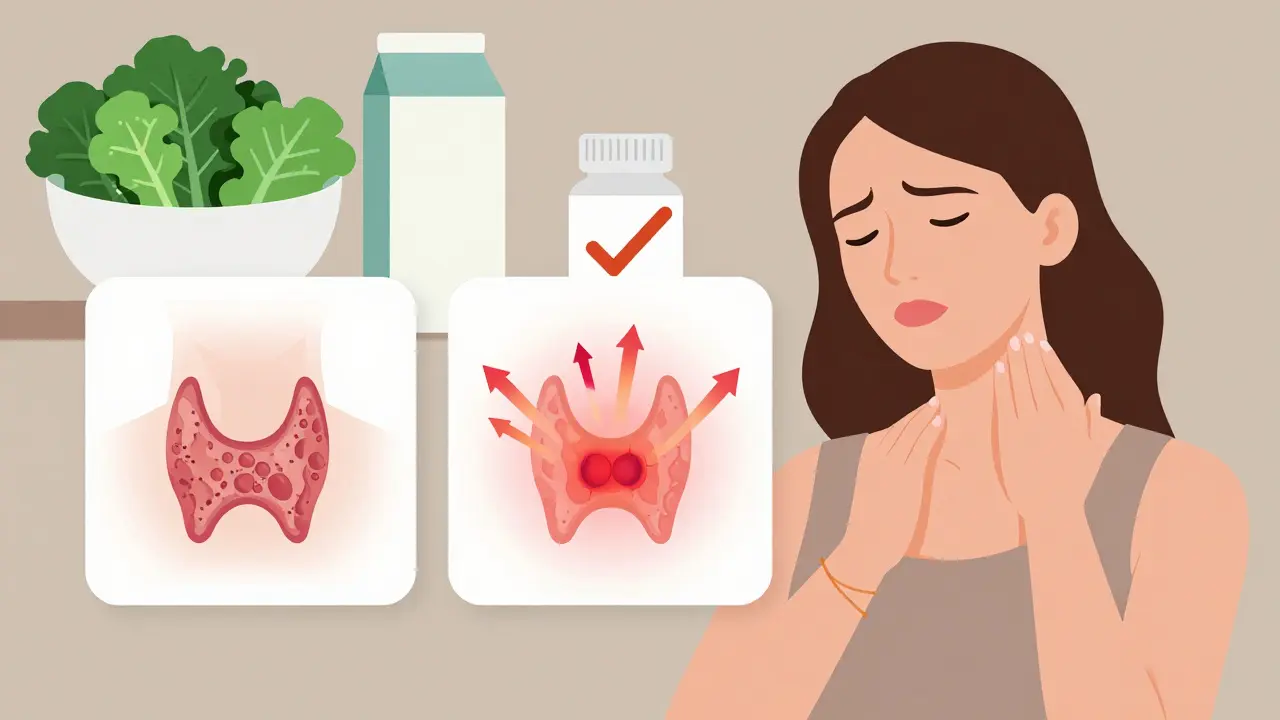
People who eat a lot of raw cruciferous vegetables-like kale, broccoli, or cabbage-may also be at higher risk if their iodine intake is low. These foods contain goitrogens, compounds that interfere with iodine uptake. Cooking them reduces this effect. But if you’re already low on iodine, eating raw kale daily might push you over the edge.
And don’t forget geography. If you grew up in a mountainous region far from the sea-like the Himalayas, Andes, or Alps-your family’s diet may have always been low in iodine. Even if you moved to a city now, your body’s iodine stores might still be depleted.
What About Prevention?
The best way to prevent goiter is simple: use iodized salt. It’s cheap, safe, and effective. The FDA now requires iodine content to be listed on salt packaging, so you can check. If you don’t use salt, get iodine from other sources: dairy, eggs, seafood (especially cod and shrimp), and fortified cereals. Pregnant women should take a prenatal vitamin with at least 150 mcg of iodine-check the label. Not all do.
Public health programs have made huge progress. Since the 1990s, universal salt iodization has cut global goiter rates by half. But in 2021, nearly 2 billion people still didn’t get enough iodine. That’s why WHO recommends 20-40 parts per million of iodine in salt. In New Zealand, where I live, iodized salt has been mandatory in bread since 2009. That’s helped reduce goiter rates here too.
Prognosis: Can You Get Better?
If your goiter is from iodine deficiency, the outlook is excellent. Most people return to normal within a year. No scars. No meds. Just a little iodine.
But if it’s autoimmune? That’s a lifelong game. Hashimoto’s doesn’t go away. The gland may shrink a little, but it’s often permanently damaged. About 60% of people with Hashimoto’s eventually develop atrophic thyroiditis-the gland shrinks and stops working entirely. That’s when you need levothyroxine for life. It’s manageable, but it’s not a cure.
Surgery and radioactive iodine fix the size problem but create new ones: lifelong hormone replacement, possible voice changes, or low calcium. Patient reviews show 78% are happy with iodine treatment-but only 42% are satisfied with surgical outcomes. That’s because the risks are real and lasting.
What’s Next?
Researchers are digging deeper. The NIH’s TRIPOD study, launched in 2023, is tracking 5,000 people across 10 countries to find genetic links to goiter. Early results point to 37 genes that affect thyroid size. That could lead to personalized prevention someday.
Meanwhile, the global market for thyroid treatments is growing fast-projected to hit $6.3 billion by 2027. Levothyroxine alone is prescribed 120 million times a year in the U.S. That’s how common thyroid problems have become.
So if you’ve got a neck lump, don’t ignore it. Don’t guess. Get tested. Blood work, ultrasound, and a good doctor can tell you if it’s iodine-or something else. And if it’s iodine? Fixing it might be as simple as switching your salt.
The thyroid's compensatory hyperplasia in iodine deficiency is a classic example of negative feedback dysregulation. TSH upregulation drives follicular cell proliferation via the MAPK and PI3K pathways. When serum iodide falls below 100 ng/mL, thyroglobulin iodination becomes rate-limiting, triggering goiterogenesis. The 150 mcg RDA is conservative-some studies suggest 200 mcg may be optimal for thyroid peroxidase saturation. But the real issue is bioavailability: organic iodine from kelp is 3x more bioavailable than inorganic potassium iodide.
Also, bromate and perchlorate in water inhibit sodium-iodide symporter (NIS) activity. That’s why urban populations with high processed food intake often have subclinical deficiency despite iodized salt use.
LOL so now salt is the government’s mind control chip?? 🤡
Next they’ll say your thyroid is a secret CIA drone 🚁
Meanwhile, my Himalayan salt crystal is literally glowing with ancient energy 💎✨
And I’m not taking any pills from Big Pharma… my crystals say I’m fine 😇
Ugh, I can’t believe people still don’t know iodized salt fixes this. This isn’t rocket science. We’ve known since the 1920s. If you’re still getting goiters in America, you’re either lazy or dumb. You think you’re fancy with your fancy sea salt? Congrats, you’re a walking thyroid disaster. I’m from the Midwest-we used iodized salt in everything. No drama. No ‘superfood’ nonsense. Just salt. That’s why we don’t have this problem. You want to be healthy? Stop being a hipster and use the salt your grandparents used.
And stop blaming kale. I eat kale daily and I’ve got a thyroid like a Swiss watch. It’s not the veg, it’s your ignorance.
Wait, so if you’re vegan and don’t use iodized salt, you’re basically at risk even if you eat seaweed? I thought nori was enough…
Also, does anyone know if kelp supplements are reliable? I saw one that had 500mcg per pill-way over the RDA. Is that safe? I don’t want to accidentally trigger Hashimoto’s. My aunt had that and it was rough. She’s on levothyroxine now and still gets fatigue. Ugh. Also, typo: I think you meant ‘20-40 ppm’ not ‘20-40 parts per million’? Or is that the same? I’m confused 😅
How quaint. You treat thyroid disease like a plumbing issue-just add iodine and it flows again. But this isn’t 1923. We live in a world of endocrine disruptors, glyphosate-laced bread, and estrogen-mimicking plastics. Your ‘simple fix’ ignores the entire ecological collapse of modern nutrition. You think your iodized salt is a solution? It’s a Band-Aid on a hemorrhaging artery.
And let’s not pretend Hashimoto’s is just ‘autoimmune.’ It’s your body screaming that your immune system has been poisoned by processed food, fluoride, and corporate greed. The thyroid doesn’t ‘shrink’ because you take a pill. It’s a silent martyr. You don’t fix it-you mourn it.
Okay but let’s be real-this whole iodine thing is a distraction. Who really controls the salt supply? Big Pharma? The WHO? The UN? They want us dependent on iodized salt so they can sell us levothyroxine later. It’s a two-step scam: first, they make you deficient by removing iodine from natural sources (sea salt, fish, etc.), then they sell you the ‘fix’-and the lifelong meds.
And don’t get me started on radioactive iodine. That’s not treatment-that’s chemical castration of your thyroid. They don’t care if you’re hypothyroid for life. They get paid monthly. I’ve seen the reports. The thyroid is the last organ they’ll let you keep. They want you on hormones forever. It’s profit, not medicine.
And don’t tell me about ‘studies.’ The same people who said smoking was safe ran those studies too. I trust my gut. My gut says: stop eating salt. Eat sea vegetables. Go raw. Live free. Your thyroid will thank you… if you’re brave enough to resist the system.
It is fascinating how the biological response to iodine scarcity mirrors the social response to scarcity in general-expansion, adaptation, and eventual exhaustion. The thyroid, like a community under resource stress, attempts to compensate by increasing its surface area, its activity, its reach. But compensation without restoration leads not to health, but to fragility.
Perhaps the deeper lesson here is not about iodine, but about systems: when a system is deprived of its essential inputs, it does not fail immediately-it distorts. It grows. It becomes visible. Only then do we notice. And by then, the cost of repair is higher.
What if we applied this insight to education, to healthcare, to food systems? We wait for the goiter to appear before we ask: why was the iodine missing in the first place?
In Japan, we eat seaweed daily. No goiters. No supplements. Just real food. Salt is just salt. The answer is in the ocean, not the pharmacy.
Simple.
Wait, so if I use kosher salt and eat a lot of eggs and dairy, am I covered? I’m trying to be mindful but also not overthink everything. My mom had Hashimoto’s and she’s on levothyroxine and she’s fine, but she’s also super stressed and eats a ton of raw kale. Should I be worried? I’m 32, female, no kids yet. Should I be taking iodine just in case? I don’t want to mess with my hormones. Also, what’s the deal with selenium? I saw a friend take it and said it helped her fatigue. But you said it doesn’t work? Confused 😅
So let me get this straight-you’re telling me I need to eat salt to not have a big neck? Bro. I’m not eating salt. I’m not doing it. I’m a whole foods guy. I eat avocado, I drink water, I meditate. My thyroid is chill. I don’t need your salt. I got vibes.
Also I think the government is lying. I saw a guy on YouTube with a goiter and he said he only ate organic kale for a year. Coincidence? I think not.
Just sayin’
Just wanted to say thank you for this post. I’ve had Hashimoto’s for 8 years and no one ever explains it like this. I didn’t know iodine could make it worse. I was taking kelp supplements thinking I was helping. My doctor never told me that. I’ve been on levothyroxine since diagnosis and I’m doing okay, but the fatigue… it never goes away completely. I wish more people knew how common this is. Women, especially, need to get tested. Don’t wait until you can’t button your shirt. Get your TSH checked. It’s a simple blood test. And if you’re pregnant-please, please, check the label on your prenatal. Most don’t have enough iodine. I didn’t and I regret it. You’re not alone. 💛
Thyroid volume thresholds: 18 mL male, 15 mL female. Diagnostic criteria established. Iodine supplementation contraindicated in autoimmune etiology. Surgical indication: >80 mL or compressive symptoms. Radioactive iodine: 5–15 mCi. Levothyroxine dosing: 1.6 mcg/kg. All evidence-based. No further commentary required.