Imagine walking into a pharmacy to pick up a life-saving medication, only to be told the pharmacist has no idea when the next shipment will arrive. This isn't a rare occurrence; it's a systemic failure. While we often think of medicine as a high-tech, streamlined industry, the reality is that the generic drug shortages we see today are the result of a fragile house of cards. When one piece falls-whether it's a factory shutdown in India or a shipping delay in China-millions of patients are left without critical treatments.
What Exactly Is a Drug Shortage?
Before we dig into the "why," we need to define what we're talking about. According to the U.S. Food and Drug Administration the federal agency responsible for protecting public health by ensuring the safety and efficacy of drugs, a shortage happens when the supply of a medically necessary drug drops below the level needed for the healthcare system. It's not just a "low stock" warning; it's a period where demand simply exceeds what is available.
The scale of this is staggering. Research shows that about 95% of all shortage reports involve generic drugs. Why? Because generics are treated as commodities. When profit margins shrink, the willingness to maintain a robust supply chain vanishes. We've seen this intensify since 2011, with a massive spike during the 2020-2021 period as the global pandemic exposed every crack in the system.
The Manufacturing Nightmare: Where Things Go Wrong
If you look at the data, manufacturing and quality issues are the biggest culprits, causing roughly 62% of all shortages. It sounds simple, but the technical failures are diverse. We're talking about things like facility contamination, where a single batch of medicine is ruined by a rogue microbe, or equipment failures that shut down a production line for months.
One of the most dangerous trends is the lack of "buffer room." To keep costs low, many companies operate with almost zero excess manufacturing capacity. If a machine breaks, there is no backup line to take over. This "just-in-time" approach works for electronics, but it's lethal for medicine. When a facility is forced to halt production for corrective actions to meet safety standards, the supply simply vanishes from the market overnight.
| Vulnerability | Direct Impact | Patient Outcome |
|---|---|---|
| Facility Contamination | Immediate production halt | Treatment delays / Therapy substitution |
| Zero Excess Capacity | No backup for equipment failure | Prolonged market absence of drug |
| Sole-Sourcing | Single point of failure | Total unavailability if one plant closes |
The Danger of Geographic Concentration
Where is your medicine actually made? For most generics, the answer is far from home. A huge vulnerability is the concentration of Active Pharmaceutical Ingredient the biologically active component of a drug that produces the intended effects (API) production. Roughly 80% of these APIs are manufactured in China and India.
When you concentrate production in two regions, any local disruption-be it a natural disaster, a political shift, or a pandemic-creates a global ripple effect. If a port in Shanghai shuts down or a factory in Hyderabad fails an inspection, the entire North American supply chain feels the pinch. This lack of diversification means we are essentially relying on a few global hubs to keep our hospitals running. When one in five shortage reports is linked to a sole-sourced drug, it's clear that redundancy is non-existent.
The Economics of "Race to the Bottom"
We have to talk about money. Generic drugs are designed to be cheap, but the market has become *too* efficient at driving prices down. Manufacturers face intense price competition and profit margins that often dip below 15%, compared to the 30-40% seen with branded drugs. This creates a "race to the bottom."
When margins are that thin, companies can't afford to invest in upgrading old equipment or expanding their facilities. In fact, it becomes more profitable to simply stop making a low-margin drug altogether. The Association for Accessible Medicines a trade association representing generic pharmaceutical manufacturers has noted thousands of product discontinuations since 2010. If the profit isn't there, the drug disappears, regardless of how many patients need it to survive.
Adding to this are Pharmacy Benefit Managers third-party administrators of prescription drug programs that negotiate prices between insurers and pharmacies (PBMs). These middlemen control a massive chunk of prescription spending. By squeezing manufacturers for the lowest possible price to win contracts, they unintentionally push those manufacturers toward financial instability. It's a paradox: the push for cheaper drugs is actually making them harder to find.
Why Some Countries Handle It Better
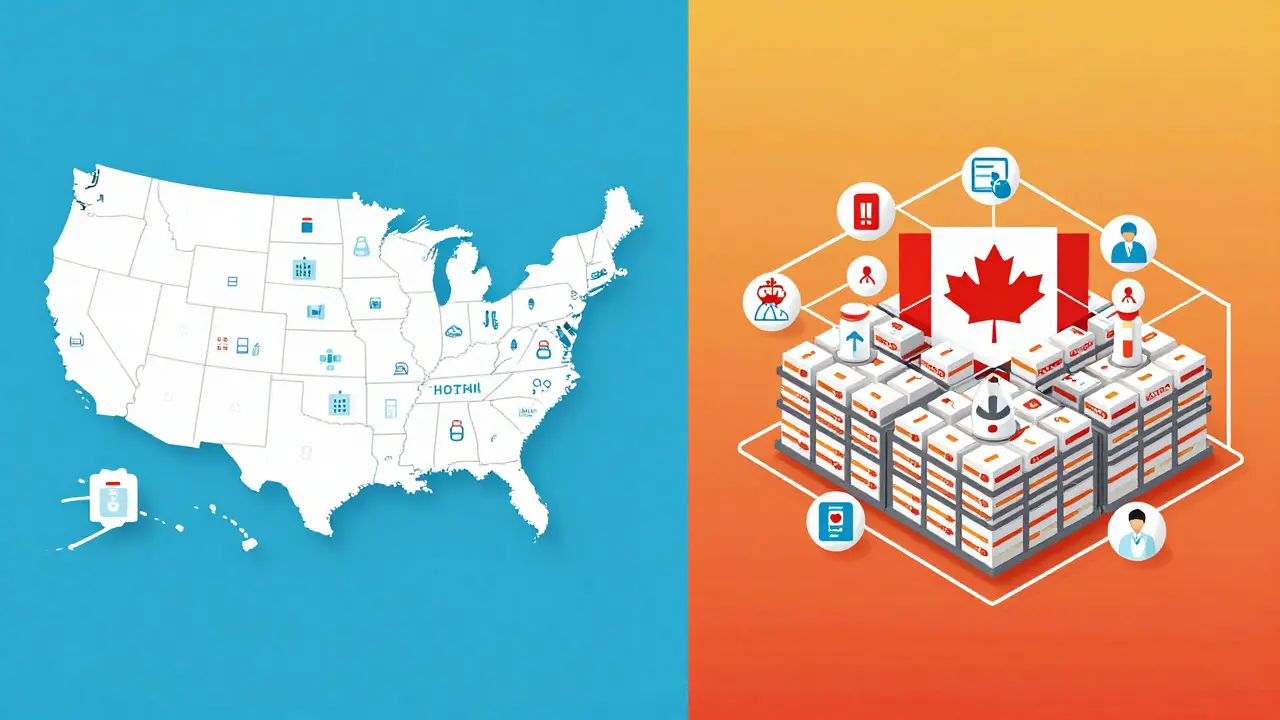
It's interesting to compare the U.S. to Canada. Both countries face the same global supply chain issues, yet Canada often shows more resilience. Why? It comes down to cooperation. Canada has a more centralized approach where regulatory agencies, public payers, and wholesalers actually talk to each other and coordinate.
A huge difference is the stockpile. The U.S. keeps reserves for catastrophic events-think bioterrorism or a massive war. Canada, however, uses strategic pharmaceutical stockpiles specifically to manage day-to-day drug shortages. By having a safety net of essential medications, they can buffer the shock when a manufacturer goes offline. The U.S. system, by contrast, is far more fragmented, leaving individual hospitals to scramble and ration supplies when a shortage hits.
The Real-World Impact on Patients and Doctors
This isn't just a logistics problem; it's a clinical crisis. When a generic antibiotic or chemotherapy agent disappears, doctors are forced to make high-stakes decisions. They have to substitute therapies, which might be less effective or have more side effects. In some cases, they have to delay treatments entirely.
Hospital pharmacists are feeling the brunt of this. Some report spending up to 75% more time managing shortages than they did a few decades ago. They spend their days hunting for alternatives or calling different wholesalers to find a single vial of a necessary drug. The worst part? A quarter of shortage reports don't even list a reason for the shortage, showing a complete lack of transparency in the system.
Looking Forward: Can We Fix the Chain?
Solving this requires more than just "better planning." We need structural changes. There are moves in the right direction, such as the RAPID Reserve Act, which aims to create strategic reserves for critical generics and incentivize domestic manufacturing. The goal is to bring some of that API production back to shore so we aren't entirely dependent on a few overseas factories.
We also need to change how we value generics. If we continue to treat life-saving medicine as a low-cost commodity with no margin for error, we will continue to see gaps in care. Incentivizing the production of low-profit drugs and increasing transparency among PBMs and manufacturers are the only ways to move away from a "shortage-prone" system toward one that actually prioritizes patient health over the lowest possible bid.
Why are generic drugs more prone to shortages than brand-name drugs?
Generic drugs have much lower profit margins, often below 15%. This makes them less attractive to manufacturers and leaves little room for investing in backup capacity or facility upgrades. If production costs rise or a factory fails, companies may find it financially unviable to fix the issue or keep the drug on the market, leading to a shortage.
What role do China and India play in drug shortages?
A vast majority (around 80%) of Active Pharmaceutical Ingredients (APIs) are produced in China and India. Because the supply chain is so geographically concentrated, any local disruption in these countries-such as regulatory shutdowns, natural disasters, or political instability-can cause a global shortage of the finished medications that rely on those ingredients.
What are PBMs and how do they affect drug availability?
Pharmacy Benefit Managers (PBMs) are middlemen who manage prescription drug programs for insurers. Because they control a huge portion of drug spending, they have immense power to negotiate prices. When PBMs push for extremely low prices to reduce costs, they shrink the profit margins of generic manufacturers, making the supply chain more fragile and prone to collapse.
How does the U.S. approach to drug stockpiling differ from Canada's?
The U.S. strategic stockpile is primarily designed for emergency scenarios like mass casualties or terrorism. Canada, however, maintains stockpiles specifically intended to mitigate routine pharmaceutical shortages, allowing them to provide a buffer when the commercial supply chain fails.
What happens when a doctor cannot find the prescribed generic drug?
Clinicians are often forced to use "therapeutic substitution," meaning they prescribe a different drug in the same class. While often effective, this can lead to different side effects, the need for new dosage adjustments, or, in severe cases, the delaying of critical treatments like chemotherapy.
Living in India, it's wild to see how much we're blamed for this. Like yeah, the factories are here, but the demand from the West is what pushes these places to the brink. We're basically the world's pharmacy and everyone just complains when the lights go out for a second.
Oh please, the audacity of some people to act like this is just 'bad luck' with shipping. It's sheer incompetence at the highest level of corporate greed! It's honestly tragic that we've let the entire healthcare infrastructure become a bargain bin at a discount store. The level of systemic failure here is just... chef's kiss... absolutely pathetic.
That bit about Canada is so interesting! :) I wonder if they have different laws about how much profit companies can make on generics there? It would be great to see the US adopt a similar stockpile system for everyday use. :)
The reliance on just two countries for APIs is a textbook case of a single point of failure. It's logically unsound to build a global health system on such a concentrated geographic base, regardless of the cost benefits.
We really need to focus on the human cost here. When a doctor has to switch a patient's med because of a shortage, it's not just a 'substitution.' For some people, that means a complete relapse or severe adverse reactions. We have to demand better transparency from these PBMs now.
It might be helpful for those unfamiliar with the term to look into how 'just-in-time' manufacturing works in other sectors to understand why it fails so spectacularly in medicine.
pbm's are just legalized theft lol who even cares that they squeeze margins when the whole system is rigged anyway just let it burn
Honestly, it's just basic economics that some of you seem to be struggling with. If there's no profit, there's no product. It's almost cute that people think 'patient health' can override a balance sheet in a capitalist society. The reality is simply that some of us are more valuable to the market than others, and the supply chain reflects that perfectly. You can't expect a luxury-grade supply chain on a generic-grade budget. It's just laughable to think otherwise. Maybe if the regulations weren't so stifling, companies would actually bother to innovate their facilities instead of just shutting down. But sure, let's keep pretending that a few government reserves will magically fix a broken market. It's a fantasy.
The vertical integration failures here are staggering. We're seeing a total lack of risk mitigation in the API procurement phase. The operational asymmetry between the demand signal and the manufacturing lead time is creating a volatility that the current PBM-driven pricing models simply cannot absorb without triggering a systemic collapse of the low-margin generic stratum.
The RAPID Reserve Act provides a concrete legislative framework that could potentially mitigate these vulnerabilities. By decoupling a portion of the supply from the immediate profit-driven market, the government can ensure a baseline of availability for essential medications.
I totally agree with the point about Canada! It just seems so much more sensible to actually communicate and keep a little bit of extra stock on hand for the common stuff.
The sheer audacity of this 'race to the bottom' is a testament to the decay of industrial standards! It is an absolute travesty that the sanctity of human life is being auctioned off to the lowest bidder in a grotesque display of corporate nihilism!
It is truly heart-rending to consider the global disparities in medication access. We must strive for a world where the geography of one's birth does not dictate the stability of their healthcare. The synergy between international regulatory bodies is the only path toward a sustainable future for all humanity.