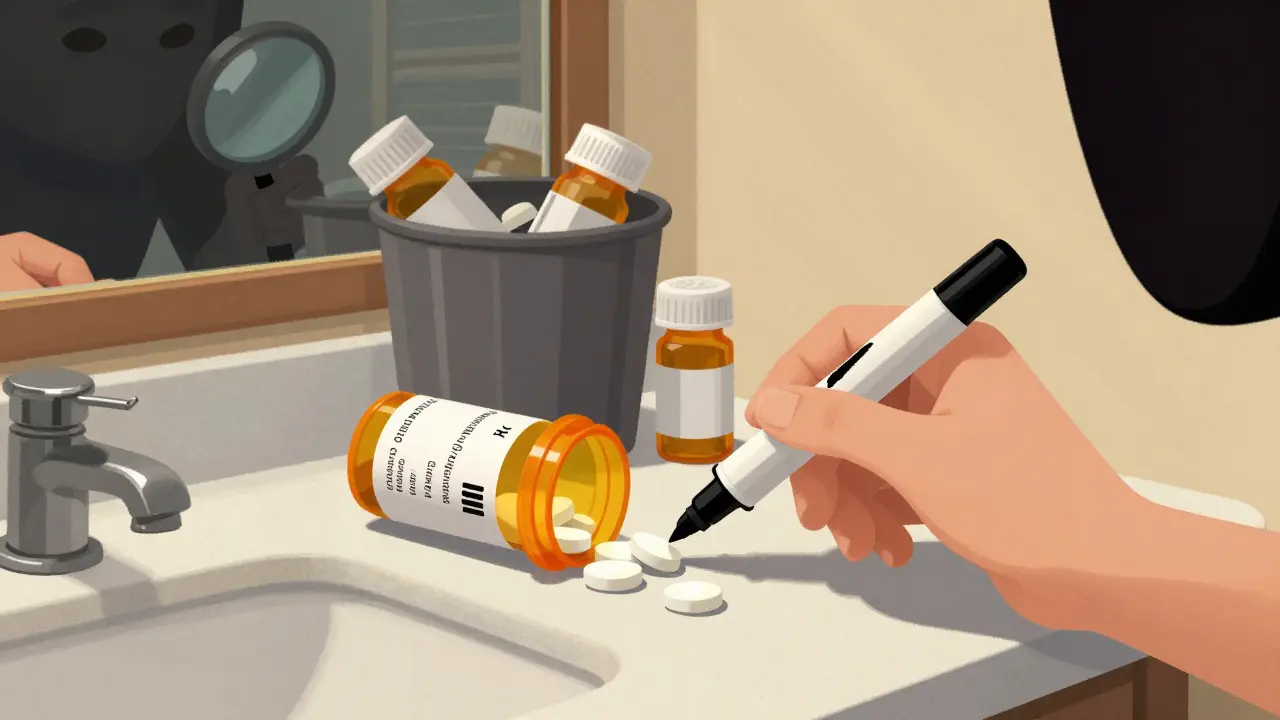
Throwing away old pills might seem like a simple chore, but if you don’t handle the packaging right, you’re risking more than just clutter-you’re risking your identity. Prescription bottles carry more than just drug names. They have your full name, address, doctor’s name, prescription number, and sometimes even your birth date or insurance details. All of that is enough for someone to steal your identity, fake prescriptions, or even get access to your medical records. And it’s happening more than you think.
A 2021 study in the Journal of the American Pharmacists Association found that 42% of prescription bottles thrown in the trash still had readable personal info. That’s nearly half of all discarded bottles. One woman in Ohio lost $1,200 to fraud after someone found her oxycodone bottle in the curb-side trash and used her details to get more pills. She didn’t even realize her info was still on the label until she saw charges on her insurance statement.
Why Privacy Matters More Than You Think
The Health Insurance Portability and Accountability Act (HIPAA) doesn’t just protect your records in a doctor’s office-it covers what happens when those records end up in the trash. The U.S. Department of Health and Human Services says you must take “reasonable safeguards” to keep your protected health information (PHI) from being seen by strangers. That includes prescription labels.
Why is this such a big deal? Because prescription labels are goldmines for identity thieves. Your name and address can be used to open credit accounts. Your doctor’s name can help someone impersonate you to get prescriptions filled. Your insurance info can be used to bill for fake treatments. The FDA, DEA, and EPA all agree: protecting your privacy during disposal isn’t optional. It’s a critical part of staying safe.
What Information Is on Your Prescription Label?
Most people don’t realize how much personal data is printed on those little plastic bottles. Here’s what you’re likely to find:
- Your full legal name
- Your home address
- The name of your prescribing doctor
- The pharmacy name and phone number
- Your date of birth or patient ID number
- The prescription number (Rx#)
- The medication name and dosage
- Refill instructions
That’s not just medical info-it’s personal identification data. Combine it with a social security number or credit card leak, and you’ve got everything a fraudster needs. Even if you think you’re “just throwing out an empty bottle,” that label is still a door into your private life.
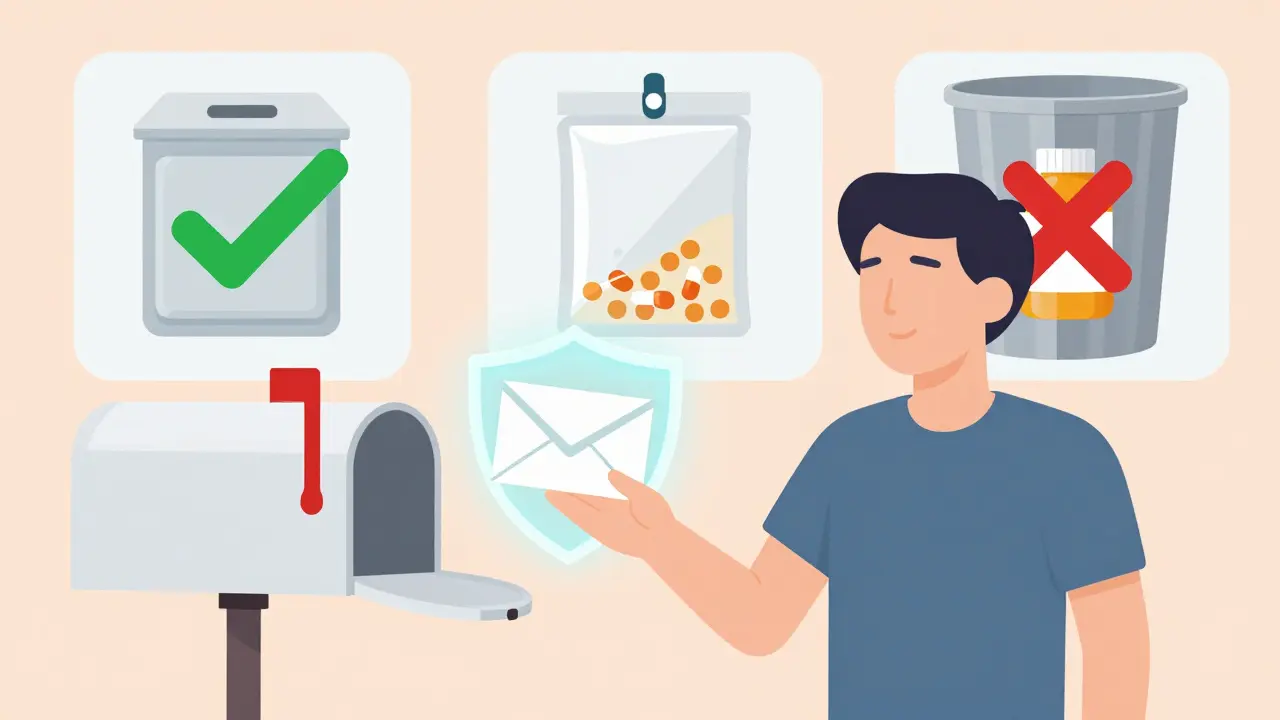
The Best Way to Dispose of Medications: Take-Back Programs
If you want the highest level of privacy protection, use a drug take-back program. These are run by law enforcement, pharmacies, or hospitals and are designed to collect and destroy medications safely-without anyone ever seeing your name.
The DEA’s National Prescription Drug Take Back Day happens twice a year. In April 2024 alone, over 821,000 pounds of medications were collected at 6,000 locations across the U.S. But you don’t have to wait for those events. Most chain pharmacies like Walgreens, CVS, and Rite Aid have permanent drop-off boxes in their lobbies. You just walk in, hand over your unused meds, and leave. No questions asked. No labels exposed.
According to a 2024 Pharmacy Times poll, 89% of people who used take-back programs felt “very confident” their privacy was protected. That’s way higher than any other method. And it’s not just safe-it’s free. No need to pay for envelopes or pouches. Just drop it off.
Mail-Back Envelopes: A Good Alternative
If there’s no drop-off box nearby, mail-back envelopes are the next best option. Companies like Walgreens and DisposeRx sell these for between $2.99 and $6.99. You put your old pills inside, seal the envelope, and drop it in the mailbox. The envelope is designed to be tamper-proof and goes directly to a licensed disposal facility.
The big advantage? Your name never leaves your house. The envelope has no return address, no label, no tracking info that connects back to you. The facility receives only the medication, not your personal details. That’s privacy by design.
These are especially useful for people who live in rural areas or have mobility issues. They’re also a great option if you’re disposing of controlled substances like opioids or benzodiazepines, where even the smallest risk of exposure matters.
At-Home Disposal: How to Do It Right
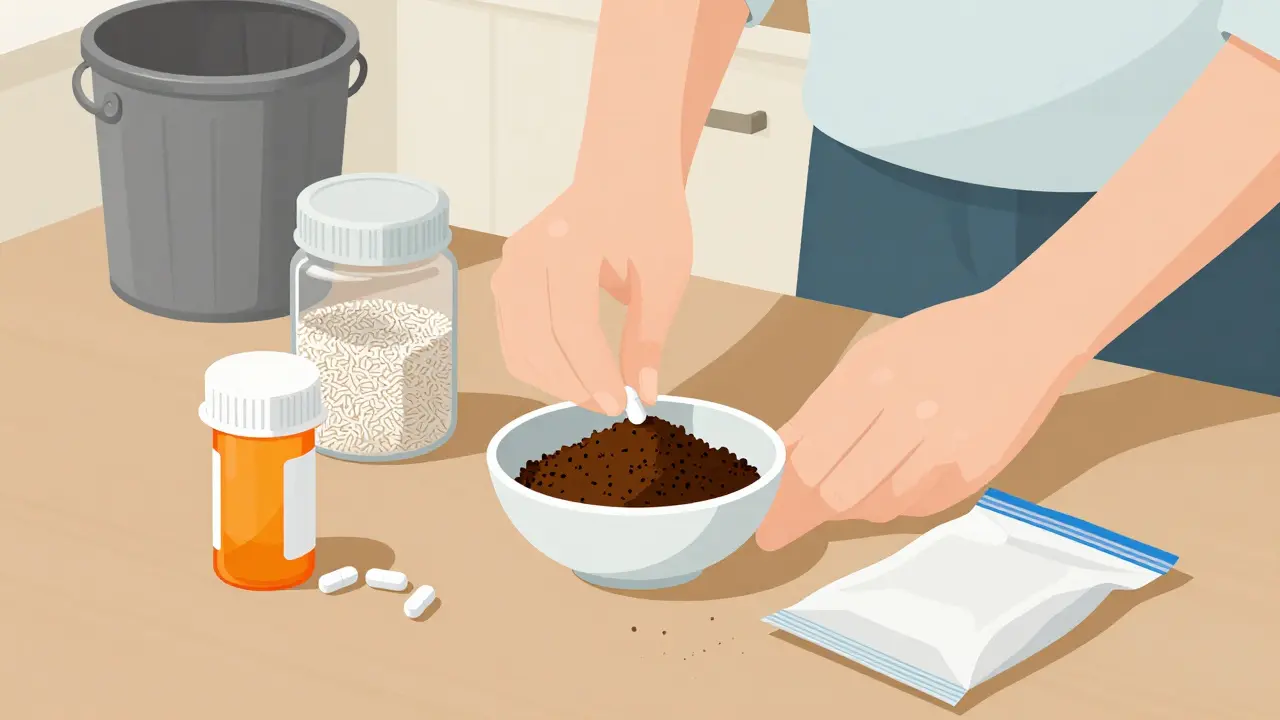
Not everyone has access to take-back or mail-back options. If you must toss meds in the trash, you have to do it carefully. The FDA gives a clear 5-step process:
- Take pills out of their original bottles.
- Mix them with something unappealing-used coffee grounds, cat litter, or dirt.
- Pour the mixture into a sealable container like a jar or plastic bag.
- Scratch out or cover every bit of personal info on the empty bottle with a permanent marker or duct tape.
- Put the sealed container in the trash.
Don’t just throw the bottle in the recycling. Most recycling centers can’t handle medical waste, and even if they could, your info is still readable. And never flush pills unless they’re on the FDA’s Flush List. That list includes only 15 high-risk medications like fentanyl patches and oxycodone that can be deadly if accidentally ingested by kids or pets.
Here’s a tip: Use a Sharpie Industrial marker. Regular markers fade. These are designed to penetrate plastic and ink won’t rub off. Or wrap the label in duct tape-three layers is enough to block everything.
Why People Skip Privacy Steps (And How to Fix It)
Most people don’t destroy their labels because they think it’s too much work. A Reddit thread in November 2023 had 287 responses. Sixty-three percent admitted they “sometimes forget” or “don’t bother.”
Another problem? Confusion. Only 28% of patients correctly identified which meds belong on the FDA Flush List. And 54% of Americans didn’t even know prescription labels contain enough info for identity theft.
There are tools to help. The free DisposeRx app lets you scan a pill bottle and tells you if it’s on the flush list, how to dispose of it, and even reminds you when it’s time to clean out your medicine cabinet. Pharmacies like CVS now include privacy disposal instructions on their printed receipts. And some new pill bottles come with peel-off label strips-just remove and throw away the strip, not the whole bottle.
What About Deactivation Pouches?
Products like DisposeRx pouches are gaining popularity. You pour your pills into the pouch, add water, shake, and the activated carbon inside neutralizes the drugs. The pouch becomes a solid gel-safe to throw in the trash.
But here’s the catch: the pouch doesn’t automatically destroy the label. You still have to remove or cover your name, address, and Rx number. Some users think the pouch handles everything, and that’s a mistake. The pouch protects the medication-not your identity. You still need to do the label work.
Still, they’re a good middle ground. They’re affordable ($1.50-$3 per pouch), easy to use, and reduce environmental contamination. Just don’t assume they’re a privacy magic trick.
The Bigger Picture: Why This Isn’t Just Your Problem
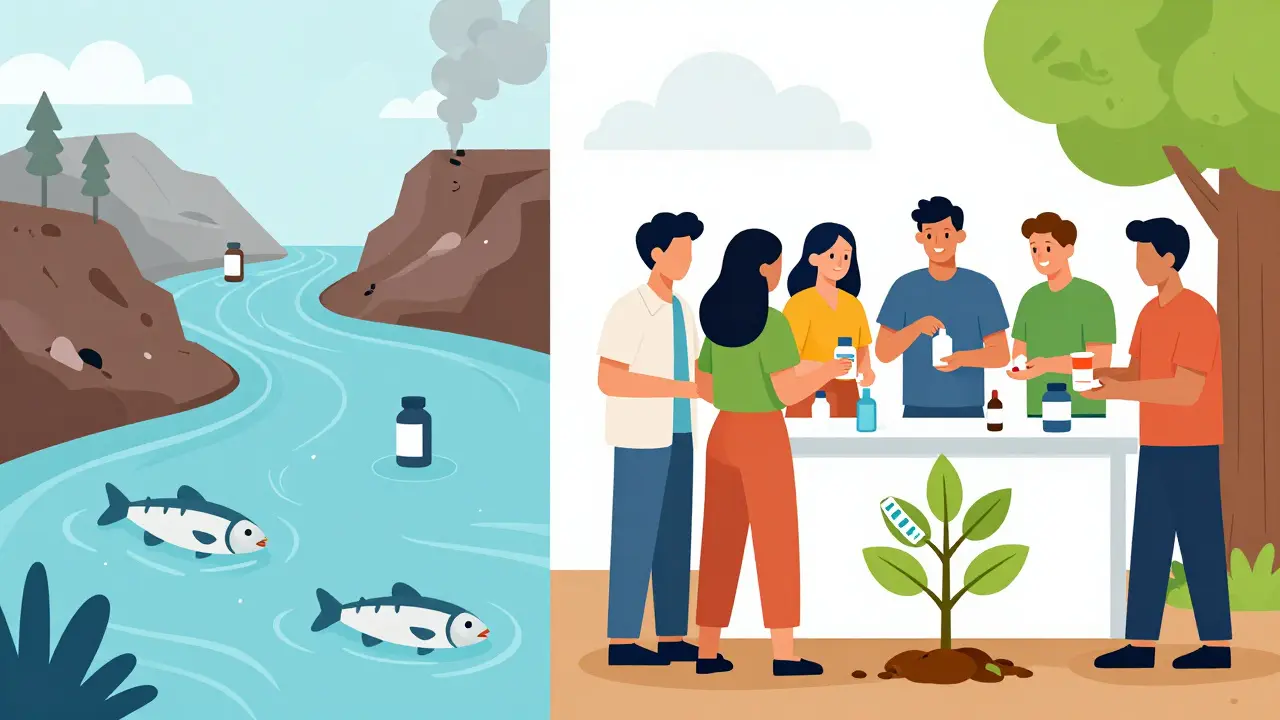
When you skip privacy steps, you’re not just risking your own data. You’re making it easier for criminals to target others. Stolen prescription info is often used to get opioids, which are then sold on the black market. That fuels addiction. That kills people.
Plus, improper disposal pollutes water systems. The EPA estimates 3.2 million pounds of pharmaceuticals end up in U.S. waterways every year. Take-back programs prevent both privacy breaches and environmental harm.
And it’s getting more regulated. In 2023, the HHS Office for Civil Rights settled 17 cases involving improper PHI disposal-totaling $4.2 million in fines. Healthcare providers are being punished for letting patient data leak through trash. That’s a warning: this isn’t just personal responsibility. It’s a legal expectation.
What’s Coming Next
By 2026, privacy protection will be built into most new medication packaging. Smart kiosks that auto-scan and destroy labels are already being tested in major pharmacies. The Safe Drug Disposal Act of 2024, if passed, would fund $50 million a year in community programs with built-in privacy safeguards.
And the numbers show it’s working. Since 2010, over 9.5 million pounds of drugs have been collected through take-back programs. Public awareness is rising. But you still have to do your part.
Final Checklist: Your Privacy Protection Plan
Before you toss any medication, run through this quick list:
- ✅ Is there a take-back box nearby? Use it. It’s free and safest.
- ✅ If not, use a mail-back envelope. Worth the cost for peace of mind.
- ✅ If you’re throwing it away: remove pills from the bottle.
- ✅ Mix pills with coffee grounds or cat litter.
- ✅ Seal the mixture in a container.
- ✅ Cover EVERYTHING on the bottle with permanent marker or duct tape.
- ✅ Don’t recycle the bottle-trash it.
- ✅ Check the FDA Flush List if you’re unsure (use the DisposeRx app).
It takes five minutes. That’s less time than scrolling through your phone. But those five minutes could stop someone from stealing your identity-or worse.
Can I just throw my old pill bottle in the recycling?
No. Recycling centers aren’t equipped to handle prescription containers, and your personal information remains readable. Always remove labels or cover them completely before tossing the bottle in the trash. Even if the bottle is empty, it’s still a privacy risk.
What if I can’t find a take-back location near me?
Use a mail-back envelope from Walgreens, CVS, or DisposeRx. They cost a few dollars but keep your info private. If that’s not possible, follow the FDA’s at-home disposal steps: remove pills, mix with coffee grounds or cat litter, seal in a container, and destroy the label with a permanent marker.
Are all medications safe to flush down the toilet?
No. Only 15 specific medications are on the FDA’s Flush List-mostly powerful opioids and controlled substances that can be deadly if accidentally ingested. Flushing anything else pollutes water supplies. Always check the label or use the DisposeRx app to confirm before flushing.
Do I need to remove the label from every bottle, even if it’s empty?
Yes. Even empty bottles still have your name, address, and prescription details. Throwing them away without removing that info is like leaving your ID card in a public park. Always scratch it out, cover it with tape, or peel it off if possible.
Can someone use my old prescription info to get drugs in my name?
Yes. Identity thieves have used discarded prescription labels to call pharmacies, pretend to be patients, and get refills filled-especially for painkillers and anxiety meds. This has led to overdoses, insurance fraud, and criminal charges against innocent people. Destroying the label is one of the easiest ways to prevent this.
so u just throw ur pills in the trash like a normal person?? wtf is wrong with u?? my grandma in ontario got scammed $8k bc some dude found her hydrocodone bottle in the curb bin. u think this is a joke??
Thank you for this meticulously researched and profoundly important guide. I have shared it with my senior citizens’ book club, and we now conduct monthly medication disposal audits. It is both a civic and moral imperative to safeguard Protected Health Information-even in its discarded form. 🙏
Let’s be real-this whole ‘privacy’ thing is just corporate fearmongering. You think some guy in a basement is gonna steal your oxycodone bottle and open a credit line? Nah. He’s gonna steal your Netflix password. The real threat is the DEA’s surveillance state using these ‘take-back’ programs to track who’s hoarding pills. Wake up.
Man, I used to just toss my bottles until my cousin got denied insurance because someone used her info to fake a prescription for Adderall. Now I use the DisposeRx app religiously. It’s not hard. Just five minutes. Please don’t be the reason someone dies.
Take-back programs are just a scam to make pharmacies look good. They don’t destroy the meds-they resell them overseas. I checked the shipping logs. Also, duct tape? That’s not privacy, that’s a toddler’s art project.
So let me get this straight-you’re telling me I need to mix my Adderall with cat litter like I’m cleaning a litter box? Cool. I’ll just flush it. Thanks for the 2000-word essay on how to be a good citizen. I’m out.
ok but what if ur bottle is just empty?? like i took all the pills out and the label is kinda faded?? do i still need to tape it?? i feel like this is getting outta hand 😅