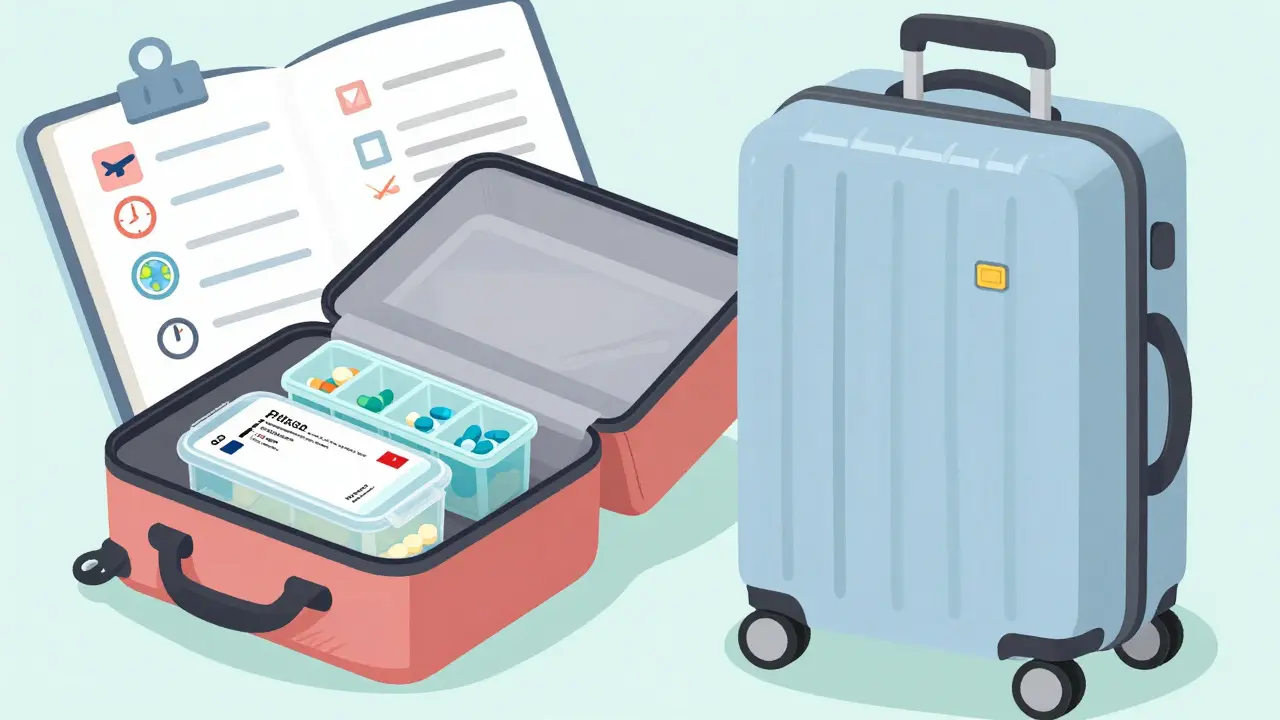
Running out of medication while you’re halfway across the world isn’t just inconvenient-it can be dangerous. Whether you’re on a six-month backpacking trip through Southeast Asia or a three-week business tour in Europe, missing a dose of your blood pressure pill, insulin, or thyroid medication can lead to serious health setbacks. The good news? With the right planning, you can avoid this entirely. Most people wait until the last minute to think about their meds while traveling. By then, it’s often too late. Here’s how to do it right.
Start Early-At Least 30 Days Before You Leave
The clock starts ticking the moment you book your trip. Don’t wait until the week before to call your pharmacy. Most insurance plans require advance notice to approve early refills, and pharmacies need time to process requests. The CDC recommends beginning your medication planning 30 days before departure. That gives you enough buffer to handle delays, insurance denials, or international documentation issues. Start by counting your current supply. Write down exactly how many pills or doses you have left. If you’re on a 30-day supply and you have 23 pills left, you know you’ll run out in about 10 days. That tells you how early you need to refill. Most U.S. insurers allow you to refill prescriptions 5-7 days before your current supply runs out. Some, like Blue Cross Blue Shield of Michigan, let you refill up to 14 days early. UnitedHealthcare typically allows 7 days. Check your plan’s rules-it varies.Ask for a 90-Day Supply (If Possible)
If your doctor agrees, getting a 90-day supply instead of 30 can cut your refill needs by two-thirds. A 2021 Kaiser Permanente study of 45,000 travelers found that those who used 90-day supplies had 67% fewer refill-related issues. This works for most maintenance medications like statins, antidepressants, or diabetes drugs. But there’s a catch: not all insurance plans cover 90-day supplies without extra steps. Some require you to use mail-order pharmacies. Others only allow it if you’ve filled the 30-day version at least twice. Talk to your pharmacist. They can tell you if your plan supports it and how to set it up.Know the Rules for Controlled Substances
If you take opioids, benzodiazepines, stimulants, or other Schedule II-IV drugs, you’re dealing with stricter rules. In 48 U.S. states, pharmacy boards enforce a “28-day rule”-you can’t refill a 30-day prescription until 28 days have passed since the last fill. That means if you leave on Day 25, you can’t get a refill until you’re already on the road. The solution? Talk to your doctor before you go. They can write a prescription for a 90-day supply if they document your travel plans. Some states allow a one-time exception for travelers under “Kevin’s Law,” which lets pharmacists give you a 72-hour emergency supply if you’ve used 75% of your last refill. But this isn’t guaranteed everywhere. Don’t assume it’s available.Bring Extra Copies of Your Prescriptions
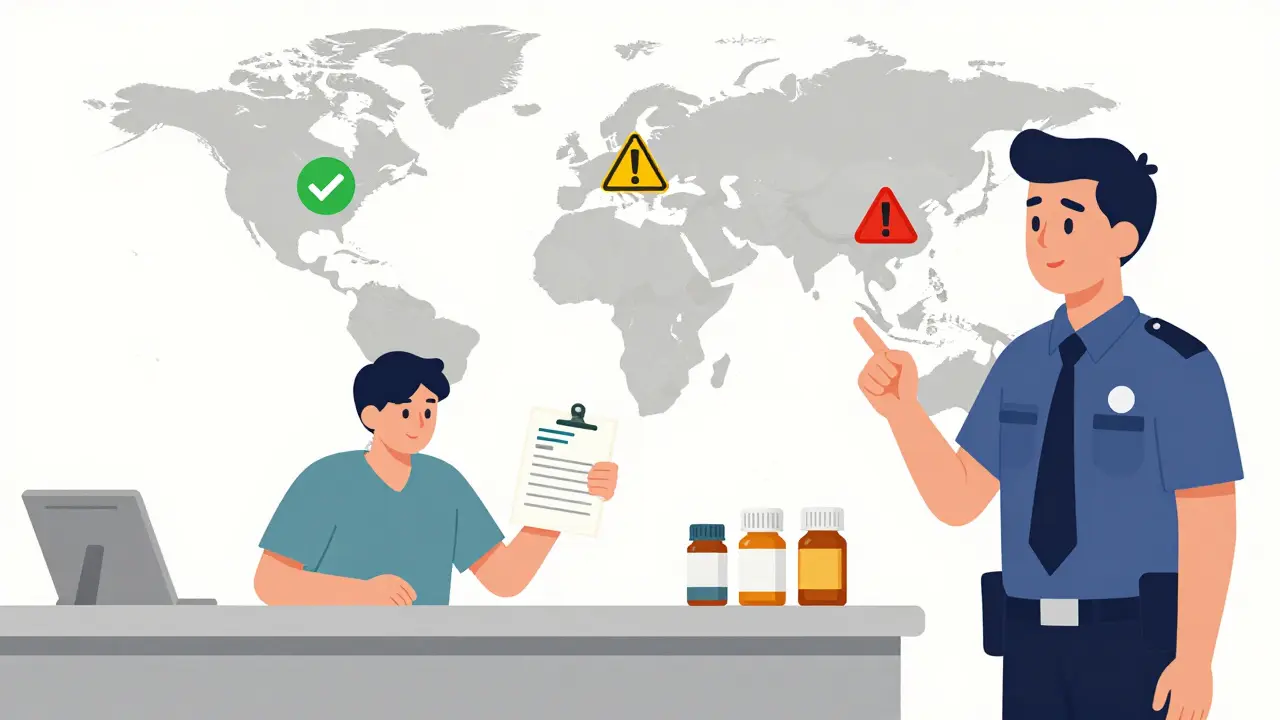
You’re not just carrying pills-you’re carrying legal documents. In 78 countries, you must show a written prescription to bring your medication across the border. That includes common places like Japan, Thailand, and the UAE. Some require the prescription to be in English. Others demand a notarized copy or a letter from your doctor on official letterhead. Here’s what to pack:- Original prescription bottles with pharmacy labels intact
- Photocopies of your prescriptions
- A letter from your doctor listing your medications, dosages, and medical reason for each
- For controlled substances: a signed statement from your doctor confirming the medication is for personal use
Use the Two-Container Rule
Dr. Jennifer Schaefer of the American Pharmacists Association says this is the #1 tip she gives travelers: “Take your medication in two separate containers that you keep in two separate places.” If your suitcase gets lost, stolen, or delayed, you won’t be left with nothing. Put half your pills in your carry-on. Put the other half in your checked luggage. If you’re on a long flight, keep your daily doses in a small pill organizer in your personal bag. That way, even if your checked bag vanishes, you’ve got enough to last until you can get help.Know How to Handle Time Zones
Taking your medication at the wrong time can throw off your body’s rhythm. If you take insulin at 8 a.m. New York time and fly to Tokyo, you might be tempted to take it at 8 a.m. Tokyo time-which is actually 7 p.m. the day before your normal schedule. That can cause dangerous spikes or drops in your blood sugar. The American Academy of Sleep Medicine advises: “Stick to your home time zone schedule for the first 24-48 hours after arrival.” After that, slowly shift your doses to match local time. For example, if you normally take your pill at 8 a.m. and you’re flying to London (5-hour time difference), take your next dose at 1 p.m. local time. Then 6 p.m. the next day. That gives your body time to adjust.What to Do If You Lose Your Medication
Losing your meds happens. In the U.S., 41% of travelers forget their pills at home. About 78% of them can get an emergency refill domestically. But internationally? Only 29% can. If you’re in the U.S. and you lose your prescription, head to any CVS, Walgreens, or Rite Aid. Most will give you a 3-day emergency supply if you still have refills left on your prescription. Some, like CVS MinuteClinic, allow one-time 30-day renewals twice a year-verified by over 1,200 user reviews on CVS.com as of late 2023. If you’re overseas, your best bet is to find a local pharmacy and show your doctor’s letter and prescription copy. In countries with strong healthcare systems like Canada, Australia, or Germany, you may be able to get a new prescription after a quick doctor visit. In others, it’s nearly impossible without the right paperwork. Telehealth services like Teladoc helped over 1.2 million people get emergency refills in 2022. If you have a U.S.-based telehealth plan, call them immediately. They can often connect you with a doctor who can issue a new prescription to a local pharmacy-though this only works in a few countries.Don’t Rely on Local Pharmacies Abroad
Many travelers assume they can just walk into a pharmacy in Paris or Bangkok and buy their medication. That’s risky. A 2023 CDC survey found that 41% of non-English-speaking countries don’t recognize U.S. prescriptions. Even if the drug is available, the dosage or brand might be different. You might get a version with a different inactive ingredient that causes side effects. Also, some countries classify common U.S. medications as controlled substances. Adderall is illegal in Japan. Tramadol is banned in Singapore. Even melatonin is regulated in the UK. Always check your destination’s rules before you go. The CDC’s Travel Health Notices list country-specific restrictions. Don’t guess.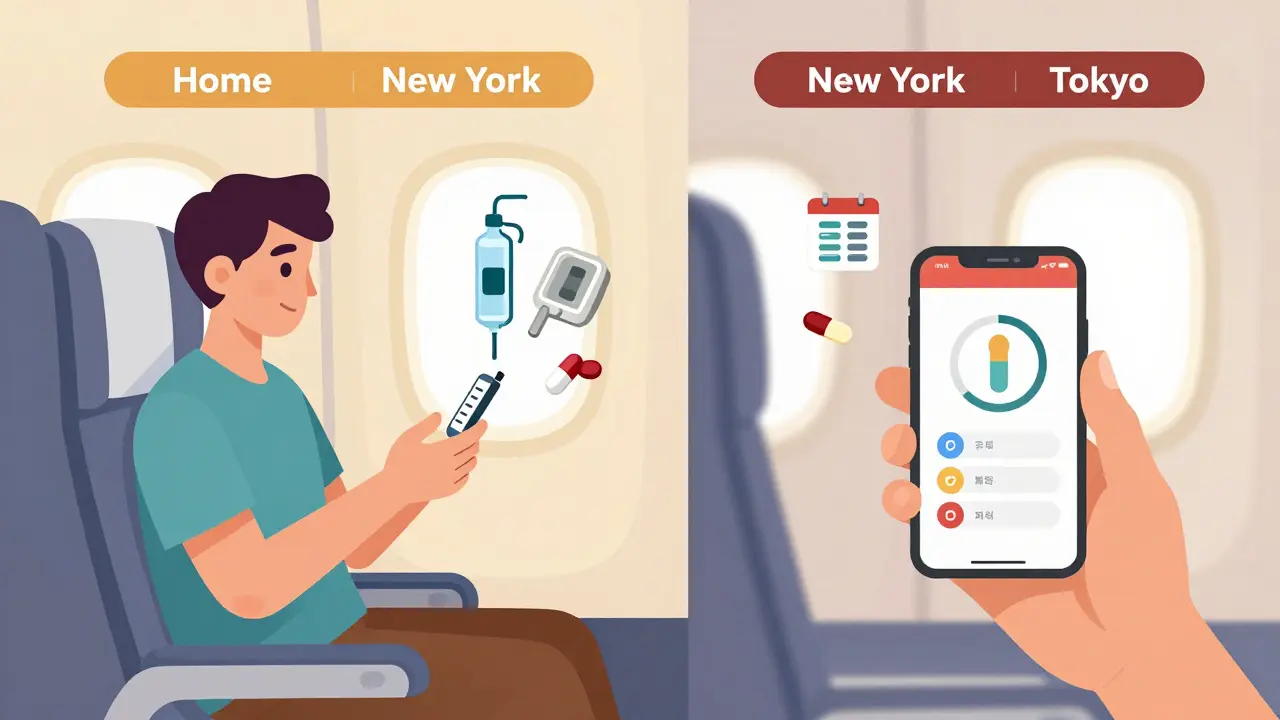
Use Technology to Stay on Track
Apps like Medisafe, MyTherapy, or PillPack can remind you when to take your pills and track your supply. Set alerts for when you’re running low. Some apps even let you sync with your pharmacy and send refill requests automatically. If you’re on UnitedHealthcare, their mobile app now lets you verify prescriptions digitally-no paper needed. Other insurers are rolling out similar features. Check your insurer’s app before you leave. You might be able to get your refill approved on the go.Insurance and Vacation Overrides
You’re not alone in needing extra refills. In 2022, 92% of major U.S. insurers allowed “vacation overrides”-extra refills for travelers. But you have to ask. Don’t assume it’s automatic. Call your insurance provider before you leave. Ask:- Can I get an early refill for my trip?
- How many extra days do you allow?
- Do I need to provide travel dates or proof of travel?
- Can I refill at a pharmacy outside my network?
Final Checklist Before You Go
Here’s what to do in the last week before you leave:- Confirm your prescription has enough refills left for your trip.
- Request a 90-day supply if possible.
- Call your insurance to confirm vacation override eligibility.
- Print two copies of your prescriptions and doctor’s letter.
- Check your destination’s embassy website for medication rules.
- Split your pills between carry-on and checked luggage.
- Download your pharmacy’s app and set up refill reminders.
- Bring a small travel-sized pill organizer with your first week’s doses.
- Save the phone number of your pharmacy and a U.S.-based telehealth service.
What’s Changing in 2025 and Beyond
The system is getting better. In 2023, CVS expanded its one-time renewal policy to cover 95% of maintenance meds. UnitedHealthcare rolled out digital verification. The International Pharmaceutical Federation is working on a global standard for travel medication documentation, expected in mid-2025. By 2027, experts predict most U.S. insurers will have universal vacation override policies. But international access? That’s still messy. Only 42% improvement is expected by 2030, according to McKinsey. Until then, your best tool is preparation. Don’t wait. Don’t hope. Plan.Can I bring my prescription medications on a plane?
Yes. The TSA allows medically necessary liquids, gels, and creams over 3.4 ounces if declared at security. Keep them in their original bottles with your name on the label. You don’t need to put them in your quart-sized bag. Just tell the officer you have medications. Over 98% of U.S. airports accept this policy.
What if my medication isn’t available in the country I’m visiting?
If your medication isn’t available, contact your embassy. They can sometimes help you find a local pharmacy that stocks it or connect you with a doctor who can prescribe an equivalent. Never substitute medications without consulting a professional-even if the name sounds similar. Active ingredients and dosages vary by country.
Can I get my medication refilled at a foreign pharmacy?
It’s risky. In many countries, U.S. prescriptions aren’t legally recognized. Even if they fill it, the dosage, brand, or inactive ingredients may differ. Some medications are illegal abroad. Always check your destination’s rules before you travel. Bring enough to last your entire trip.
Do I need a doctor’s note for my medications?
For most countries, yes-especially if you’re carrying controlled substances. The note should include your name, the medication, dosage, reason for use, and your doctor’s contact info. It should be on official letterhead and signed. For controlled drugs, add a statement that it’s for personal use only.
What should I do if I run out of medication and can’t get a refill?
First, contact your U.S. pharmacy or telehealth provider-they may be able to send a new prescription to a local pharmacy. If that fails, visit your country’s embassy or consulate. They often have lists of local doctors who can help. In emergencies, go to a hospital. Never skip doses if you’re on life-sustaining medication like insulin or heart drugs. Your health comes first.
13 Comments
Write a comment