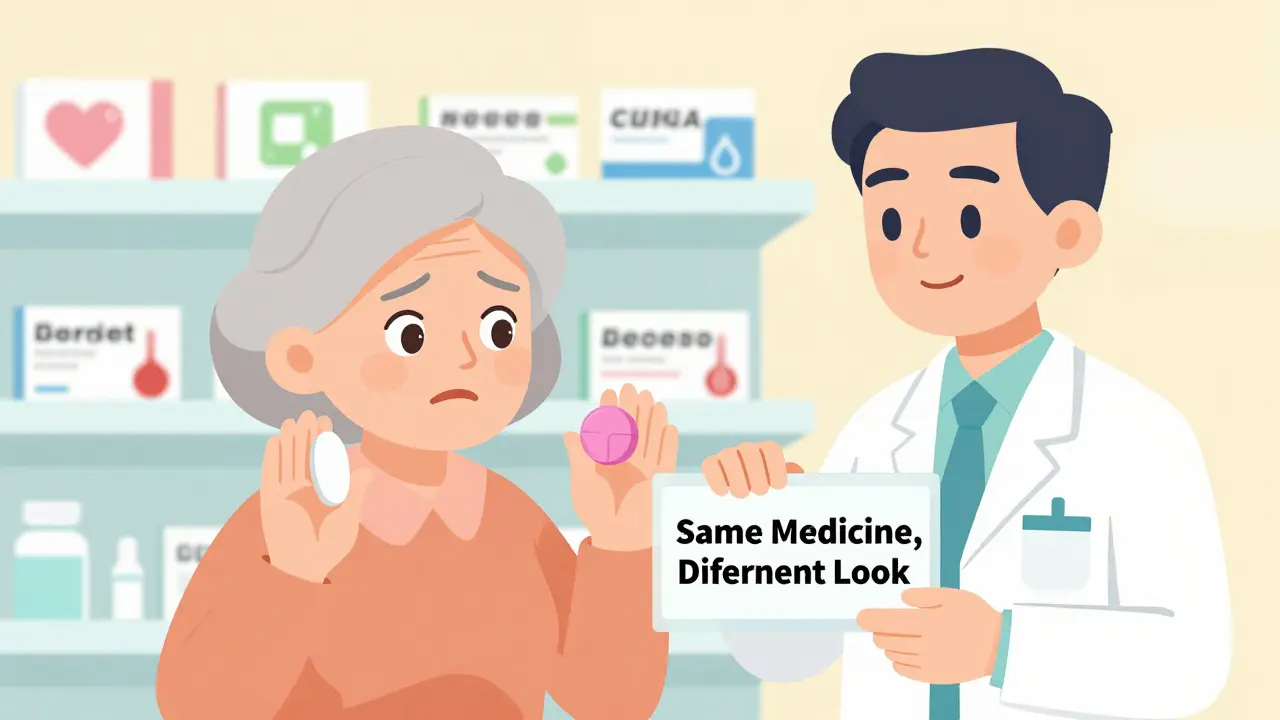
Every year, millions of people switch from brand-name drugs to generics to save money. But what happens when they don’t understand that the pill they’re holding is the same medicine, just in a different shape or color? This isn’t just a small mix-up-it’s a safety issue. Health literacy-the ability to find, understand, and use health information-is the missing link between prescribing generics and patients taking them correctly.
Why Generics Look Different (And Why That Matters)
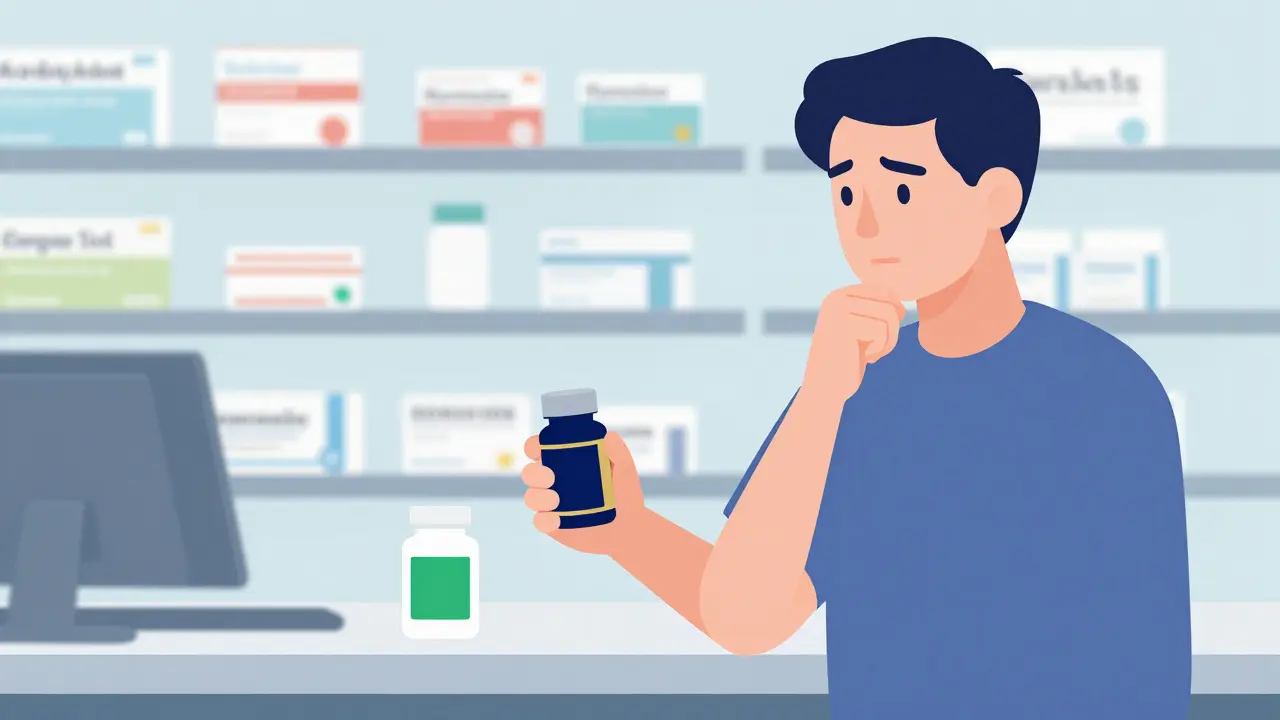
Generic medications are legally required to contain the same active ingredients as their brand-name counterparts. They work the same way. They’re just cheaper. But here’s the problem: they don’t look the same. A pill that was once a white oval might become a pink round tablet. The packaging changes. The label wording shifts. For someone with low health literacy, this isn’t just confusing-it’s alarming. A 2016 study found that 42% of patients didn’t believe generic drugs were as effective as brand-name ones. That’s not because generics are weaker. It’s because they look different. And when patients don’t understand why the pill changed, they stop taking it. One patient with type 2 diabetes told a forum: “I didn’t take my metformin for three days because it looked wrong. I ended up in the ER.” That story isn’t rare. In the U.S., 80 million adults have basic or below-basic health literacy. That means they struggle to read medication labels, understand instructions, or recognize that a change in pill appearance doesn’t mean a change in treatment. For older adults managing five or six medications, this visual inconsistency is a daily risk. A JAMA study found a 23% increase in non-adherence when patients received a visually different generic version of their heart medication.The Hidden Cost of Confusion
Medication errors tied to generic confusion aren’t just inconvenient-they’re dangerous. Between 2015 and 2020, over 1,200 reported errors came from patients mixing up different versions of the same generic drug. That’s 17% of all generic-related errors. Some of these errors led to hospitalizations, overdose, or treatment failure. The financial cost is just as heavy. A 2022 IQVIA report showed that patients who didn’t understand generics had 18% lower adherence rates. That meant higher emergency room visits, more doctor appointments, and $1,247 more in annual healthcare costs per person. Meanwhile, patients who understood their meds stayed on treatment, avoided complications, and saved money. The problem is especially sharp for Medicare beneficiaries with low education levels. In 2022, 63% of those with less than a high school diploma said they were confused when their generic medication changed. That’s not laziness. It’s a system failure.What Patients Need to Know
There are six critical things every patient should understand about their medication-especially when switching to a generic:- The name: What’s the brand name? What’s the generic name? Are they the same drug?
- The purpose: Why are you taking it? For blood pressure? Diabetes? Depression?
- The dose: How many pills? How often? At what time?
- The storage: Should it be kept in the fridge? Away from light? In a childproof container?
- The side effects: What’s normal? What’s a warning sign?
- When to call: What symptoms mean you need to contact your doctor or pharmacist?
What’s Being Done to Fix It
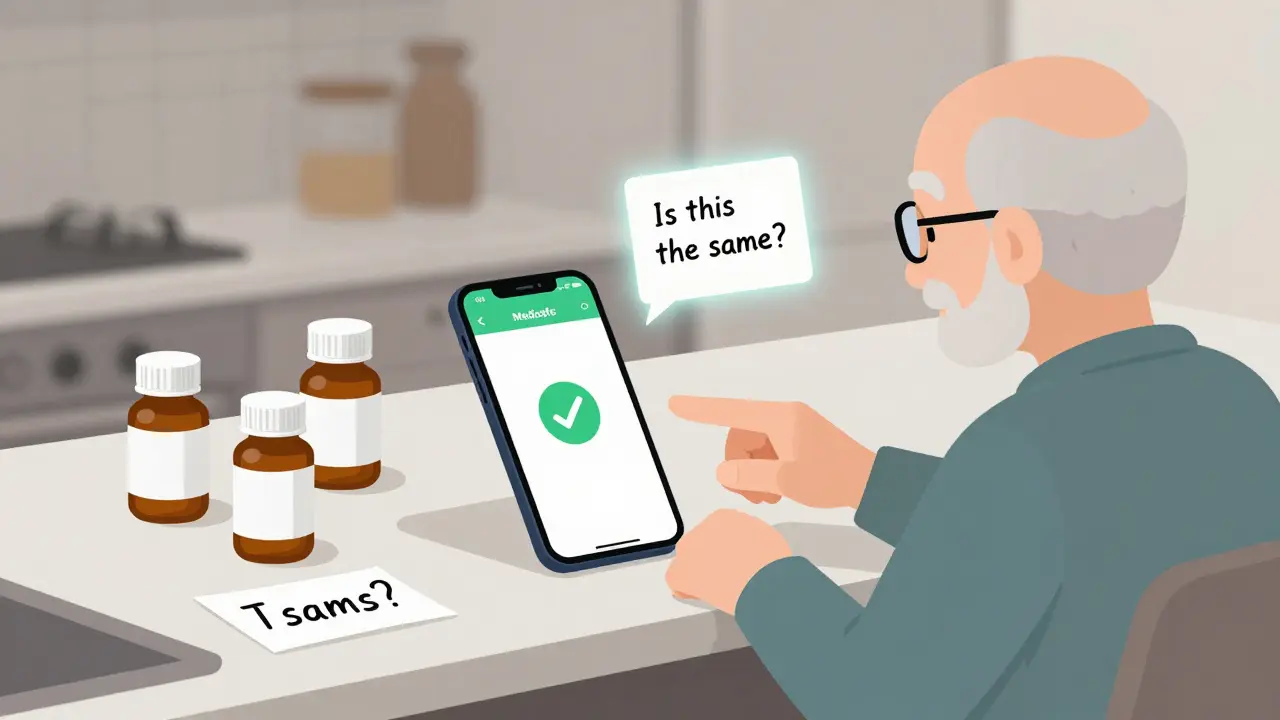
Some real solutions are already working. The Ask Me 3 program trains doctors and pharmacists to ask three simple questions: What is my main problem? What do I need to do? Why is it important? Hospitals using this saw a 31% drop in generic-related errors. Simple. Direct. Effective. Another tool: the Brown Bag Medication Review. Patients bring all their pills-bottles, boxes, blister packs-to their appointment. Pharmacists or nurses sort them, compare names, check doses, and explain what’s what. In a Johns Hopkins study, this cut medication discrepancies by 44%. Digital tools are helping too. The Medisafe app lets users take a photo of their pill. Its AI recognizes the shape, color, and imprint, then confirms whether it’s the right generic. In a 2022 trial, users improved their understanding by 37%. For someone who can’t read or has poor vision, that’s life-changing. The CDC’s Universal Precautions approach-used in over 90% of U.S. community health centers-treats every patient as if they might struggle with health info. That means using clear language, pictures, and verbal checks. One evaluation found it reduced confusion about generics by 52%.Global Shifts and New Rules
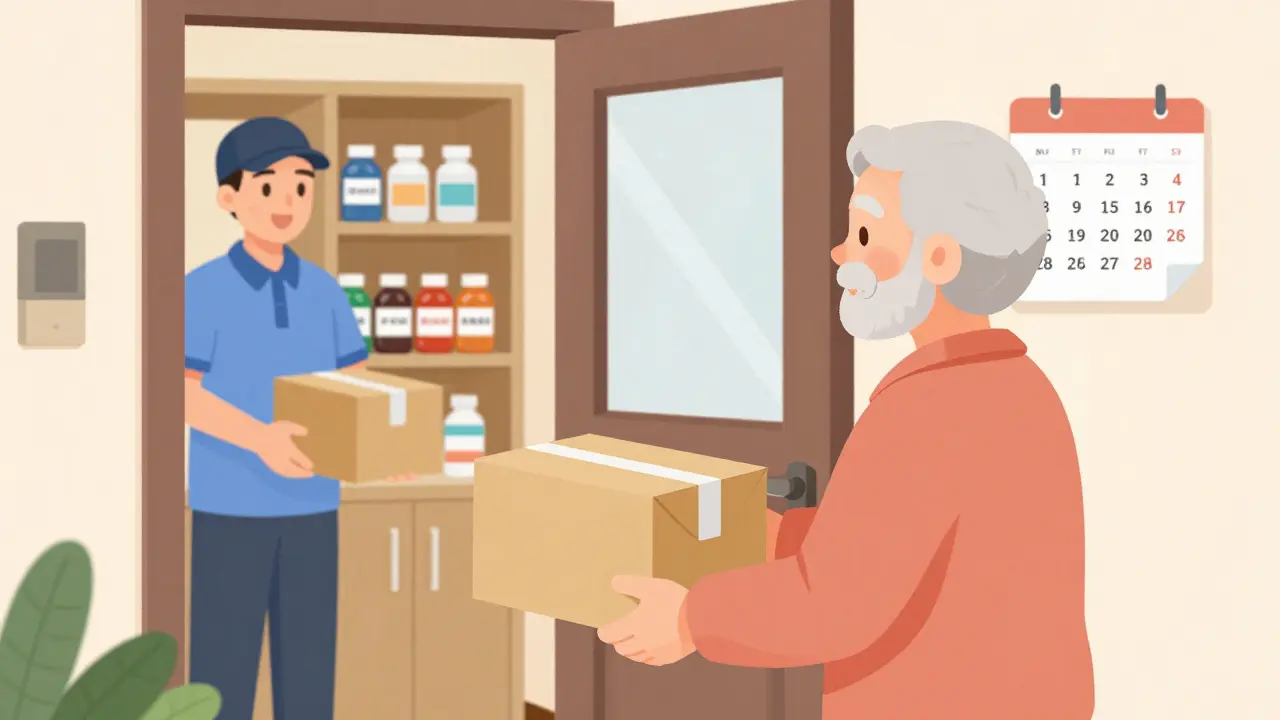
It’s not just happening in the U.S. The European Union required standardized pill appearance for generics in 2021. The result? A 27% drop in medication errors across Germany and France. Australia introduced color-coding by drug class-blue for blood pressure, green for diabetes-and saw errors fall by 33%. The FDA is now proposing similar color-coding in the U.S. The WHO has called for global standardization. In 15 low- and middle-income countries, pilot programs that kept pill shapes and colors consistent improved correct medication use by 41%. Even pharmaceutical companies are stepping up. The Association for Accessible Medicines runs the “Know Your Generics” campaign, reaching 12 million people yearly. The FDA spent $4.7 million in 2023 on plain-language labeling projects-a 200% increase since 2019.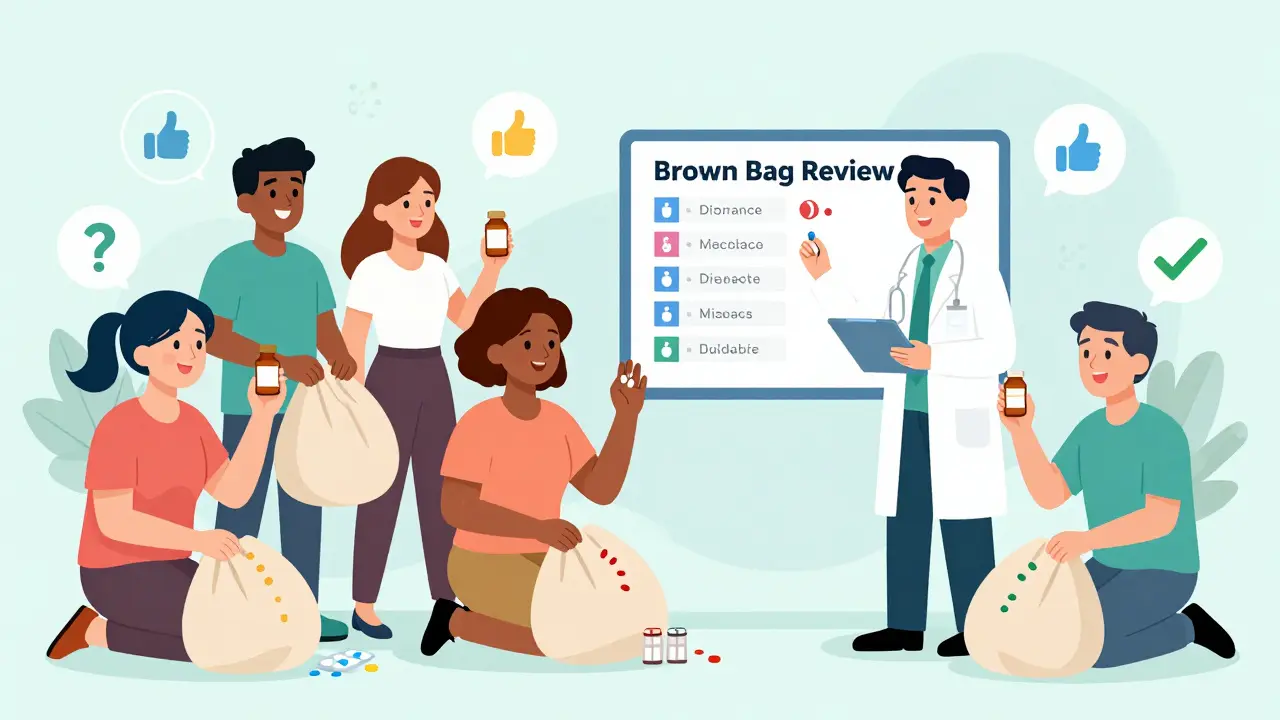
What You Can Do Today
If you or someone you care about takes generics:- Always ask: “Is this the same medicine I was taking before?”
- Check the pill with a trusted app like Medisafe or Drugs.com.
- Bring all your pills to every appointment-even the empty bottles.
- Don’t assume a change means a problem. Ask your pharmacist: “Why does it look different?”
- Use a pill organizer with clear labels. Write the drug name on the compartment.
It’s Not About Intelligence
This isn’t about being smart or dumb. It’s about design. It’s about systems that assume everyone reads labels the same way. It’s about assuming that if you’ve taken a white oval pill for years, you’ll recognize a pink round one as the same drug. When we design health systems around the most literate, we leave millions behind. But when we design for the person who struggles to read, who’s tired, who’s elderly, who’s overwhelmed-we make medicine safer for everyone. The fix isn’t complicated. It’s clear language. Consistent visuals. Better training. And asking patients: “Do you understand?” not “Do you have questions?” The tools exist. The data is clear. The cost of doing nothing is too high.Are generic medications as effective as brand-name drugs?
Yes. Generic medications must meet the same FDA standards as brand-name drugs. They contain the same active ingredients, work the same way, and have the same strength and dosage. The only differences are in inactive ingredients (like color, shape, or filler), packaging, and price. Studies consistently show generics are just as safe and effective.
Why do generic pills look different each time I refill?
Different manufacturers make the same generic drug. Each one uses its own color, shape, and imprint to distinguish their product. This is legal and common. But it causes confusion, especially for people taking multiple medications or with low health literacy. Some countries are now standardizing appearance to reduce this problem.
What should I do if my generic medication looks different?
Don’t stop taking it. Call your pharmacist and ask: “Is this the same medicine I was taking?” They can confirm it’s the same active ingredient and explain why it looks different. You can also check the pill using a trusted app like Medisafe or Drugs.com. Never guess-always ask.
Can low health literacy lead to dangerous mistakes with generics?
Yes. People with low health literacy are 2.5 times more likely to take the wrong dose. Many stop taking their medication when it looks different, thinking it’s a new drug or a mistake. This leads to uncontrolled conditions like high blood pressure or diabetes, which can result in hospital visits or long-term damage. The issue is systemic-not personal.
What resources are available to help me understand my generics?
Ask your pharmacist for a printed handout in plain language. Use apps like Medisafe or MyTherapy that let you scan pills and get clear info. Many pharmacies offer free “brown bag” reviews where you bring all your meds and get them checked. The CDC’s Universal Precautions approach ensures clinics use simple language and visuals with everyone-no matter their literacy level.
Generics are just as effective. End of story. The FDA doesn’t play games. If you’re too lazy to read the label or ask your pharmacist, that’s on you. Stop blaming the system for your own ignorance. This isn’t rocket science-it’s basic responsibility.
You call this a system failure? Nah. It’s a failure of personal accountability. People let their meds change shape and just… stop? That’s not confusion. That’s cowardice. You don’t get to quit your treatment because the pill looks different. You get a new pill, you get a new life. Or you don’t. Your call.
And don’t give me that ‘low health literacy’ crap. I’ve seen grandmas on Medicaid read prescriptions better than college grads. You want to survive? Learn. Or die. Simple.
Stop treating people like children. They’re not. They’re just choosing to be lazy. The system works. People just refuse to engage with it. That’s the real crisis.
I’ve been on generics for 12 years. Never had an issue. Never needed an app. Just looked at the damn bottle. Read the name. Checked the dose. Done. If you can’t do that, maybe you shouldn’t be managing your own meds.
And don’t get me started on the ‘brown bag’ thing. That’s not a solution-it’s a bandaid on a gunshot wound. Fix the root: make people responsible. Not more apps. Not more pamphlets. Just… be adults.
Every time I see someone panic because their metformin turned pink, I want to scream. It’s not a new drug. It’s the same damn thing. You’re not being poisoned. You’re being inconvenienced. Grow up.
And the WHO pushing color-coding? That’s not progress. That’s infantilization. We’re turning healthcare into a cartoon. Next thing you know, they’ll put smiley faces on insulin pens.
People don’t need hand-holding. They need a kick in the ass. And maybe a dictionary.
I’ve worked in a pharmacy for 17 years. I’ve seen it all. The person who cried because their blood pressure pill went from blue to yellow. The man who threw away his entire month’s supply because the shape changed. The grandma who didn’t take her diabetes meds for a week because ‘it didn’t look right.’
We don’t need more apps. We need more humans. A simple ‘Hi, this is the same medicine, just a different look’ goes further than any pamphlet. A five-minute chat. A hand on the shoulder. A ‘I get it. This is weird. Let me show you.’
It’s not about literacy. It’s about trust. If you feel like the system is lying to you, you’ll stop taking the meds. And that’s not your fault. It’s ours.
My favorite moment? A guy came in with 14 bottles. Didn’t know what half of them were. We sat for 45 minutes. He left with a list, a smile, and a promise to come back next week. He’s been stable for two years now.
It’s not complicated. Just… be kind. Ask. Listen. Don’t assume. People are scared. Not stupid.
Just want to say: I used to be the guy who stopped taking his meds when they looked different. 😔
Then my pharmacist sat down with me. Showed me the active ingredient. Said, ‘This is still the same drug. Just a new paint job.’
Now I use Medisafe. Scan the pill. Breathe. Take it. No panic.
It’s not about being smart. It’s about being shown the way. Thank you, pharmacist. You saved my life.
Y’all are overthinking this 😅
I just look at the name. If it says ‘Metformin’? I take it. Doesn’t matter if it’s pink, blue, or neon green 🤷♂️
My grandma does the same. She says, ‘If it’s got the same letters, it’s the same medicine.’
Simple. Done. No apps needed. Just common sense.
Also-pharmacists are superheroes. Talk to them. They know everything. 😊
What’s fascinating is how this mirrors other areas-like food labels or tax forms. We assume everyone reads the same way. But people don’t. Some are visually oriented. Some need to hear it. Some need to hold the pill. We design for the average, but the average doesn’t exist.
One size fits none. We need multimodal info: voice, image, text, tactile. Not just ‘read this tiny font.’
And the fact that 80 million adults struggle with health literacy? That’s not a personal failure. That’s a societal one. We’ve built a system that excludes people by design.
But here’s the good news: we know how to fix it. We’ve done it before. We just need the will.
As a nurse practitioner, I’ve seen the consequences of this confusion firsthand. A patient stopped her anticoagulant because the pill was now oval instead of round. She had a stroke two weeks later.
It wasn’t negligence. It was ignorance-because no one took the time to explain.
We now use the Ask Me 3 framework in every visit. We don’t ask ‘Do you have questions?’ We ask ‘Can you tell me what you’re taking and why?’
It’s not about dumbing things down. It’s about lifting understanding up.
And yes-it works. Adherence improved by 38% in our clinic. Lives saved. Costs cut.
It’s not magic. It’s methodology. And it’s free.
They say ‘don’t stop taking your meds’ like it’s so easy. What if you’re 78 and your vision is going? What if you can’t read the tiny print? What if you’re on six pills and they all look like M&M’s now?
You think ‘just ask your pharmacist’? Try calling one at 7 AM when you’re dizzy and your hands shake. Try calling when you don’t have a phone. Or when you’re too scared to ask because you’ve been made to feel stupid before.
This isn’t about laziness. It’s about being forgotten.
And the ‘brown bag’? That’s a Band-Aid. We need to redesign the entire packaging system. Standardize. Color-code. Use Braille. Add QR codes that read aloud.
Stop blaming patients. Fix the damn system.
Let’s examine the data. The 23% increase in non-adherence? Correlation ≠ causation. Did the change in pill appearance cause non-adherence-or did it expose pre-existing non-adherence?
And the $1,247 per person cost increase? That’s an aggregate. What’s the marginal cost? What’s the counterfactual? Did those patients have comorbidities? Were they non-compliant before?
The entire narrative is emotionally manipulative. It assumes the patient is a victim. But patients are agents. They make choices. And choices have consequences.
Instead of redesigning pills, why not redesign the patient? Educate. Train. Empower. Not coddle.
This isn’t a design problem. It’s a behavioral one. And behavior is shaped by incentives-not color.
OMG I JUST HAD THIS HAPPEN TO MY MOM 😭
She stopped her heart med for 5 days because it went from white to purple and she thought it was a mistake and she was gonna die and then she cried for 2 hours and I had to drive 45 minutes to get her a new prescription and now she’s terrified of every refill and I just…
WHY DOES THIS KEEP HAPPENING
WE NEED TO FIX THIS
MY MOM IS 71 AND SHE’S NOT STUPID SHE’S JUST SCARED
PLEASE SOMEONE DO SOMETHING
The entire healthcare system is a charade. Generics are not equal. They are not tested rigorously. The FDA approval is a rubber stamp. The active ingredient may be identical but the bioavailability varies. You think it’s the same? You’re being lied to.
And now they want to color-code pills? What’s next? QR codes on insulin? A lullaby app for diabetics?
This is not progress. This is surrender. We are infantilizing an entire population because we refuse to demand responsibility.
Stop giving them apps. Give them consequences. If you don’t take your meds, you don’t get free care. Simple. Clean. Fair.
And if you can’t read? Learn. Or die. That’s life.
Think about it-why do generics look different? Because Big Pharma wants you to think they’re different. They want you to panic. They want you to go back to the expensive brand. It’s not an accident. It’s a business model.
And the FDA? They’re in bed with the manufacturers. Color-coding? Too late. They already sold the system.
There’s a reason why Europe standardized. They saw the scam. Here? We’re still playing along.
And don’t get me started on Medisafe. That app? It’s a data harvest. They track every pill you take. Who owns that data? Who sells it? Who uses it to deny you insurance?
This isn’t about health literacy. It’s about control.
Question everything. Especially the solutions.
so i took my generic lisinopril and it looked different and i was like wait is this the same thing and then i checked the bottle and it said lisinopril so i took it and i lived and now i just dont care anymore
also my pharmacist is the best and he always says hey this is the same thing dont worry
maybe we should just trust people more
or at least trust pharmacists
also i have a dog named buster
As someone from India, where generics are the backbone of healthcare access, I have witnessed both the brilliance and the brutality of this system.
In rural clinics, patients receive identical pills for years-same color, same shape, same imprint. No confusion. No fear. Why? Because the system is standardized.
Here in the U.S., we prioritize market competition over patient safety. We allow 12 different manufacturers to make the same drug, each with a unique design. This is not innovation. It is chaos.
Health literacy is not the problem. The lack of standardization is.
When we design for the most vulnerable-not the most literate-we design for everyone.
Europe and Australia are leading. The U.S. is lagging-not because of ignorance, but because of policy inertia.
It is not a technical challenge. It is a moral one.
Just wanted to say: I replied to Janelle’s comment because she gets it. We need more humans in healthcare, not more apps.
And Robert Bliss? You’re right. It’s not about being smart. It’s about being heard.
Thanks, y’all. This thread gave me hope.