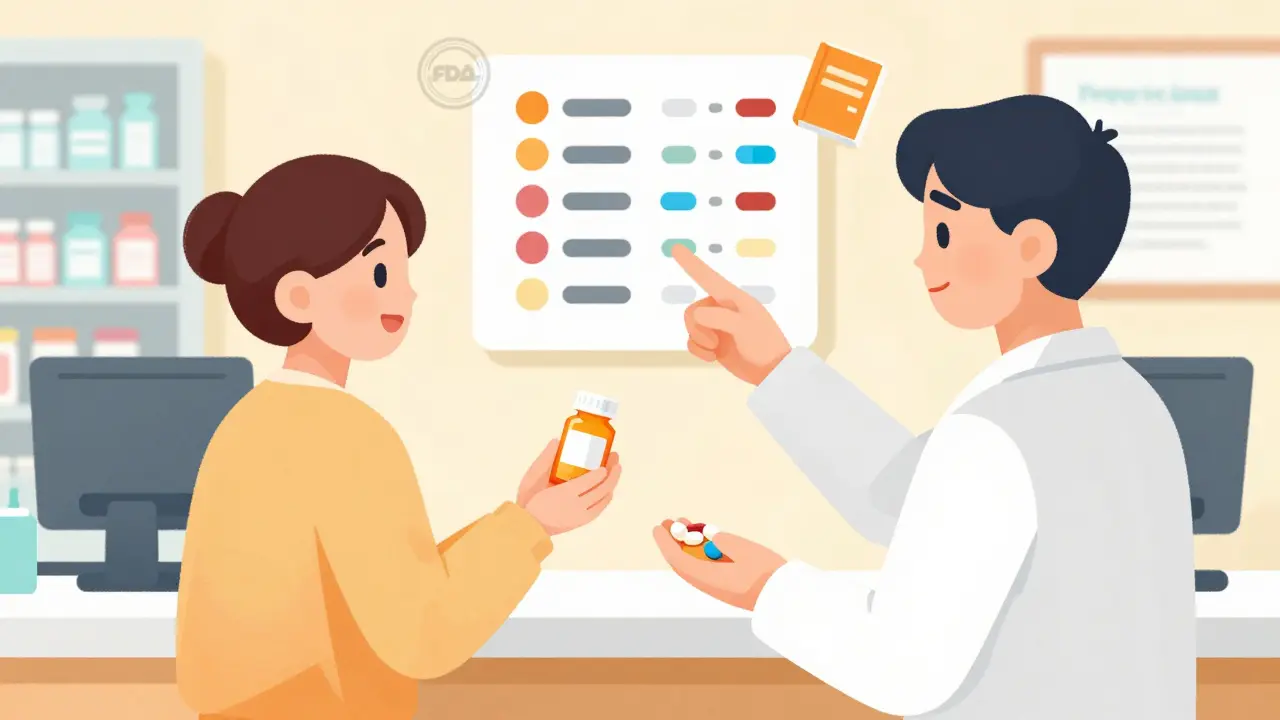
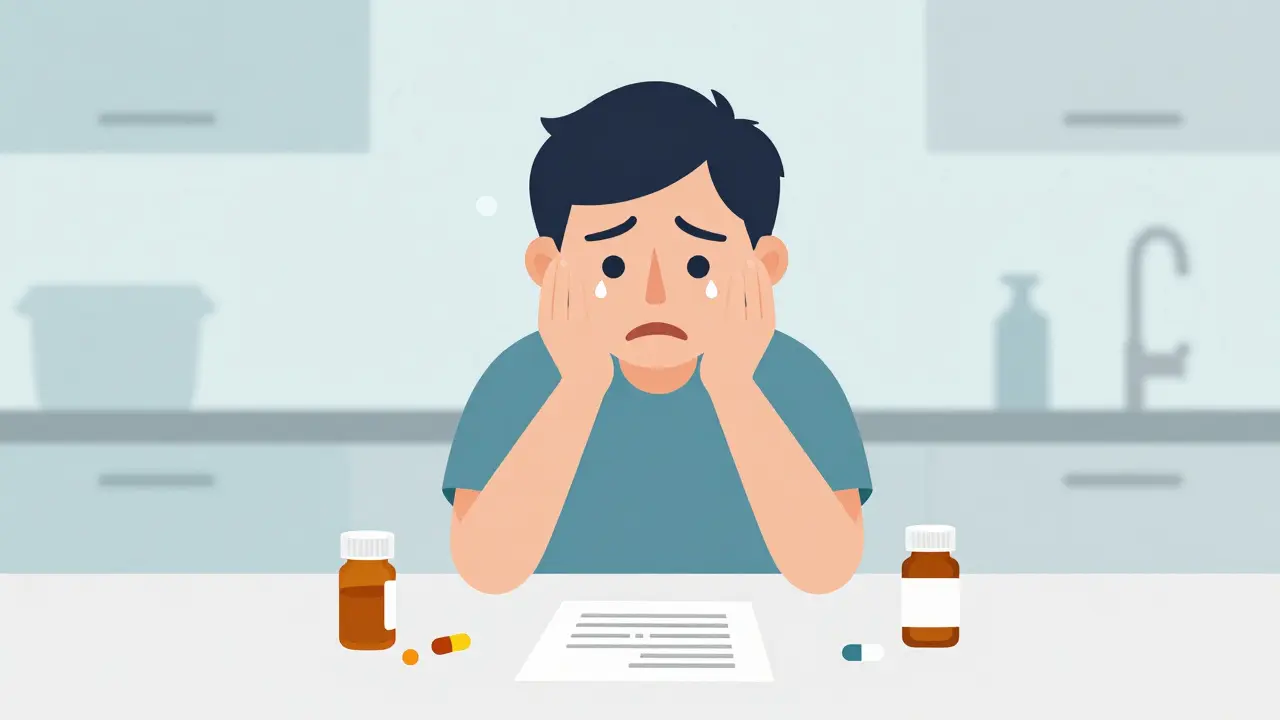
When you pick up a prescription and see a pill that looks completely different from what you’ve been taking, it’s natural to pause. Generic medications are not a trick. They’re not cheaper because they’re weaker. They’re cheaper because the patent expired-and the science hasn’t changed.
But here’s the problem: most people don’t know that. A 2019 survey found that 31% of patients were confused when their medication changed appearance. Nearly one in five admitted they stopped taking it because it looked different. That’s not just confusion-it’s a public health risk. And it’s exactly why pharmacy counseling matters.
What pharmacy counseling actually means
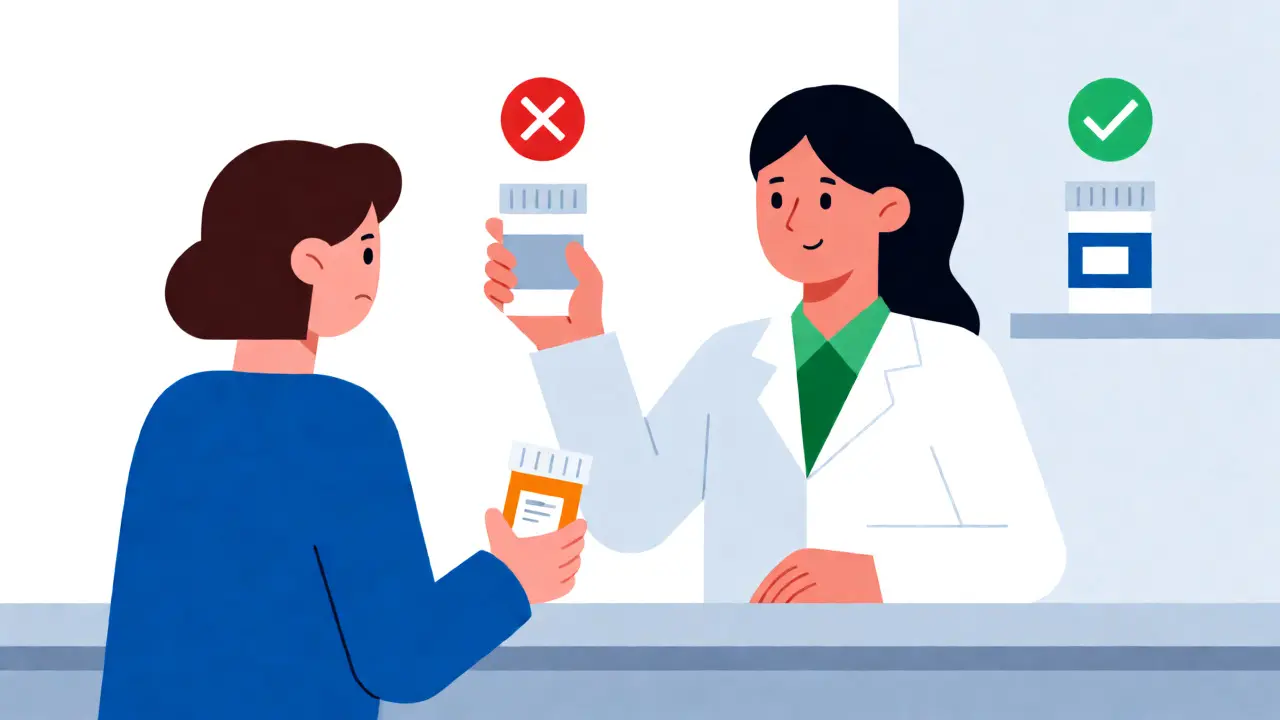
Pharmacy counseling isn’t just handing you a bottle and saying, "Take one daily." It’s a legal requirement under the Omnibus Budget Reconciliation Act of 1990 (OBRA '90). If you’re on Medicaid, your pharmacist must talk to you about your meds. That includes generics.
The goal? Make sure you understand what you’re taking, why it’s different, and that it’s safe. Pharmacists are trained to explain three key things: the difference between brand and generic names, how the drug works in your body, and what side effects to watch for. But with generics, there’s an extra layer: debunking myths.
Why generics are just as effective
The FDA doesn’t approve a generic drug unless it’s identical in active ingredient, strength, dosage form, and route of administration to the brand-name version. That’s not a suggestion-it’s a rule. And it’s backed by strict testing.
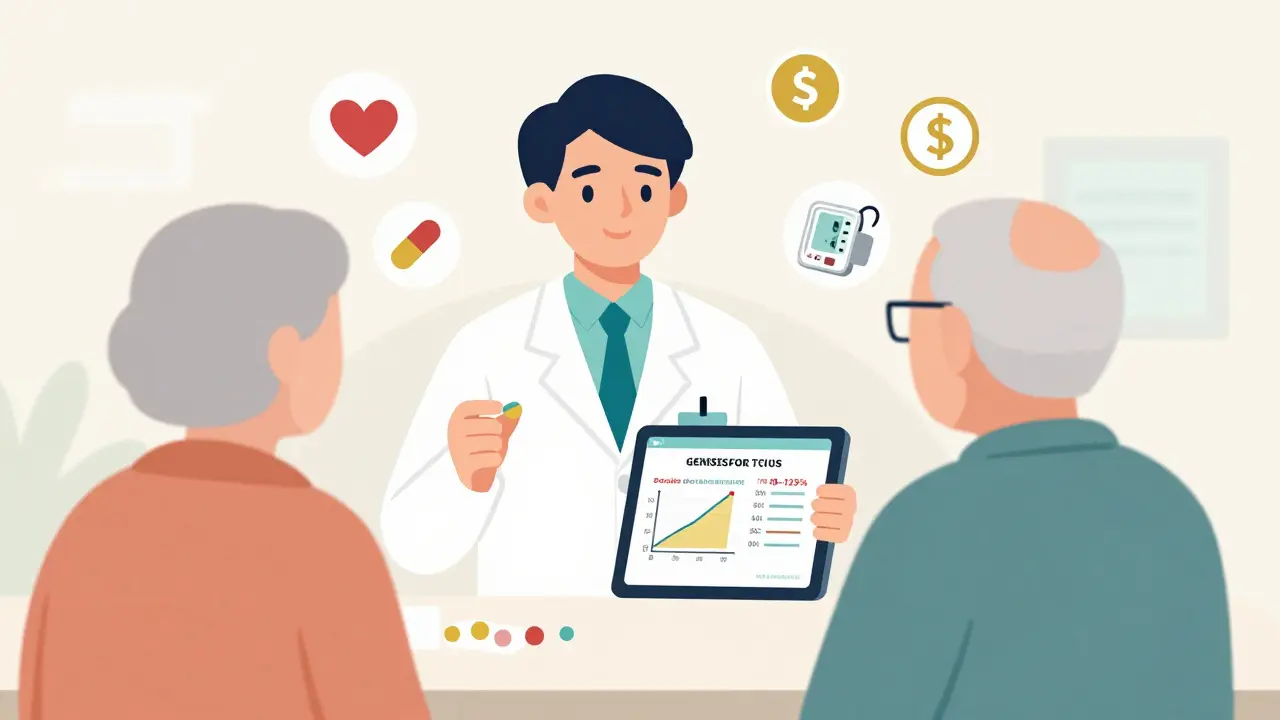
Every generic must prove it’s bioequivalent. That means it delivers the same amount of medicine into your bloodstream at the same rate as the brand. The FDA requires this to happen within a 90% confidence interval of 80-125%. In plain terms: if the brand gets 100 units into your blood, the generic will get between 80 and 125. That’s not a wide gap-it’s tight enough to ensure the same effect.
And it works. A 2018 study of 12.7 million people found that switching to generics improved medication adherence by 8.2% for chronic conditions like high blood pressure and diabetes. Why? Because people could afford to keep taking them.
What you need to ask when you get a generic
Don’t just take the bottle. Ask these five questions:
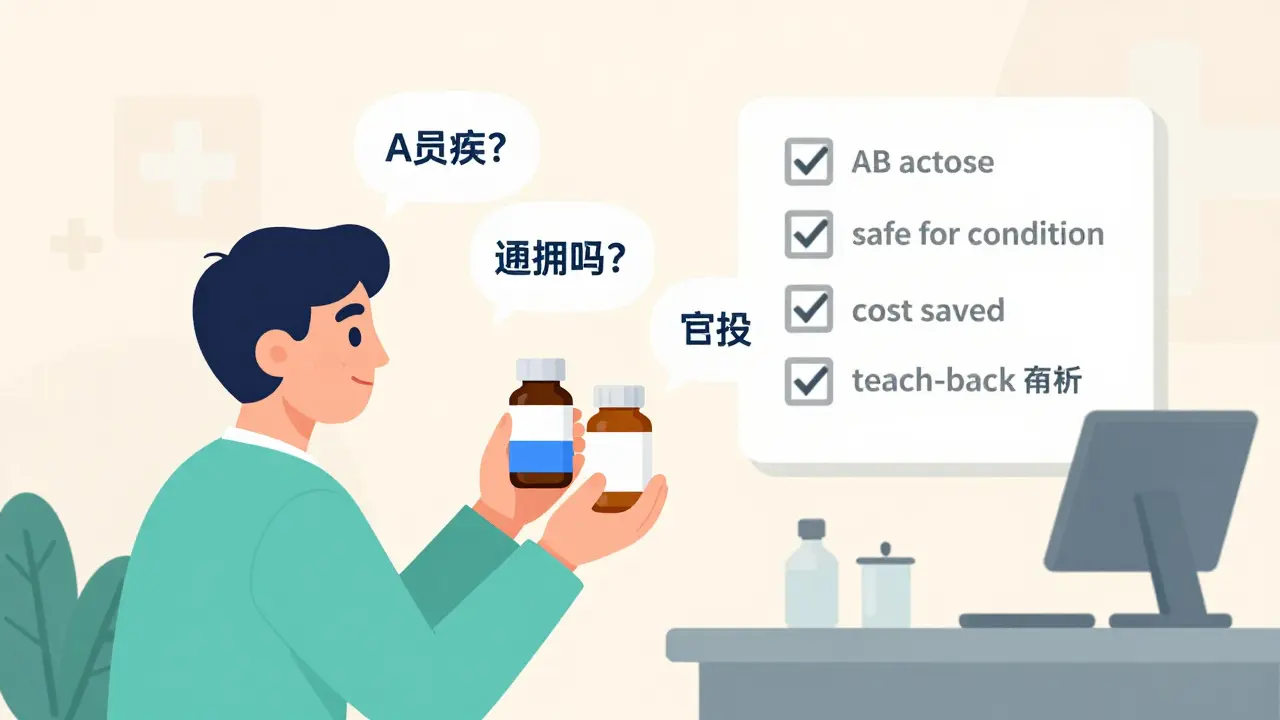
- Is this the same as my old pill? Yes-if it’s FDA-approved and has an "AB" rating in the Orange Book. That’s the gold standard for therapeutic equivalence.
- Why does it look different? The shape, color, or markings change because inactive ingredients (like dyes or fillers) differ. That doesn’t affect how the medicine works-but it can confuse you.
- Could I be allergic to something in it? Generic pills may use different fillers. If you’re allergic to lactose, gluten, or certain dyes, ask your pharmacist to check the ingredients. One patient on Drugs.com had a reaction because the generic contained lactose; the brand didn’t.
- Is this safe for my condition? For drugs with a narrow therapeutic index-like warfarin, levothyroxine, or phenytoin-small changes can matter. Some states restrict automatic substitution for these. Ask if your drug is on that list.
- Will this cost less? Usually, yes. But ask how much. Some generics cost 80-90% less. That’s $300 a month saved, like one patient reported.
How pharmacists check if you really understand
Good counseling doesn’t end with an explanation. It ends with a test-called "teach-back."
Your pharmacist might say: "Can you tell me how you’ll take this pill?" Or: "What will you do if you feel dizzy?"
This isn’t a trick. It’s how they know you’re not just nodding along. Studies show that using teach-back improves patient understanding by 89%. It cuts down on phone calls, mistakes, and hospital visits.
If your pharmacist skips this step, ask for it. You have the right to be sure.
When substitution isn’t automatic
In 33 U.S. states, your pharmacist can swap your brand-name drug for a generic without asking you. But in 17 states-including California, Texas, and Florida-you must give consent. That’s not just bureaucracy. It’s protection.
And even in states that allow automatic substitution, there are limits. Twenty-four states have lists of drugs that can’t be switched without a doctor’s okay. These are usually medicines where tiny changes in blood levels can cause serious problems. If you’re on one of them, your pharmacist should flag it.
If you’re unsure, ask: "Is this a substitution?" If they say yes, ask: "Did you check if it’s allowed?"
What to do if something feels off
Some people report feeling different after switching to a generic. That’s rare-but it happens. Possible reasons:
- Different fillers causing mild stomach upset
- Changes in absorption due to coating or tablet design
- Psychological effect-believing it’s "less effective" can make you feel worse
If you notice a change-new side effects, less control over your condition, or unusual fatigue-don’t assume it’s "all in your head." Go back to your pharmacist. Bring both pills. Ask them to compare the ingredients. They can check the FDA Orange Book and see if the generic is truly equivalent.
And if the problem continues, talk to your doctor. You might need to go back to the brand-or try a different generic.
Why this matters for your health and your wallet
Generics aren’t just about saving money. They’re about staying healthy. In 2021, 90.8% of all prescriptions filled in the U.S. were generics. That’s over 8 billion pills. And because of them, Americans saved $1.9 trillion between 2009 and 2019.
But savings only happen if people take their meds. And people only take them if they trust them.
One patient on PatientsLikeMe wrote: "My pharmacist showed me the FDA entry for my drug. I switched and saved $300 a month. No difference in how I felt." That’s the power of good counseling.
On the flip side, patients who got no explanation were twice as likely to stop taking their meds. That leads to worse outcomes-and higher costs down the line.
What’s new in 2025
Pharmacy counseling is evolving. In 2022, the FDA updated its Orange Book to make therapeutic equivalence ratings clearer. In 2023, the American Society of Health-System Pharmacists added new guidance on inactive ingredients, especially for patients with allergies.
And now, many pharmacies use short video clips to explain generics. A 2022 JAMA study found patients who watched a 90-second video were 37% more likely to accept a generic-and 82% reported feeling more confident about it.
Some states are starting to require these videos as part of counseling. If your pharmacy doesn’t offer one, ask if they can show you one on their tablet.
Bottom line
Generic medications are safe, effective, and legal. But they’re not magic. They need good communication to work.
When you pick up a generic, don’t just sign and leave. Ask the questions. Use the teach-back method. Check the ingredients. Know your rights. Your health-and your wallet-depend on it.
Look, I don’t care what the FDA says-I switched to a generic for my blood pressure med and felt like a zombie for two weeks. My doctor didn’t even warn me. These companies are cutting corners and we’re the guinea pigs.
The philosophical underpinning of pharmaceutical equivalence rests not in regulatory decrees, but in the ontological integrity of molecular identity-yet society has been conditioned to equate visual familiarity with therapeutic validity. The pill’s hue, its scoreline, its inert matrix-these are aesthetic artifacts of commercial entropy, not pharmacological deviation. To distrust a generic is to mistrust chemistry itself.
My grandma switched to generics and saved $200/month. She didn’t notice a difference. She just said, ‘Well, at least I can afford my coffee now.’
Hey everyone, I just wanted to say how much I appreciate this post. I’m from India and we rely on generics here more than anywhere else-my mom’s been on the same generic levothyroxine for 12 years and her TSH is perfect. I think what’s missing in the U.S. is the cultural trust in pharmacists. Here, we see them as healers, not just cashiers. I’ve seen pharmacists sit with patients for 20 minutes explaining why the pill looks different, drawing diagrams on napkins. It’s beautiful. Maybe we need more of that human touch, not just videos or forms. And if you’re worried about fillers? Ask. Always ask. I once had a friend react to cornstarch in a generic and no one told her. Just ask. It’s your right.
Oh, here we go again-the FDA propaganda tour. ‘Bioequivalent’? Ha. Did you know that the 80-125% range allows for a 45% variance? That’s not tight-that’s a free-for-all! And don’t get me started on the fact that generics are made in China and India, where inspection standards are laughable. My cousin’s heart medication made him hallucinate. Guess what? It was a ‘generic’ from a plant that didn’t even have running water. This isn’t science-it’s corporate greed wrapped in a lab coat.
My pharmacist showed me the Orange Book entry on my phone. Saw the AB rating. Switched. Saved $280. No side effects. No drama. Just cheaper medicine that works. Stop overthinking it.
Love this! My dad’s on warfarin and we were super nervous about switching, but our pharmacist sat down with us, showed the FDA page, and even called the doctor to confirm. We’ve been on the generic for a year now-same INR, half the cost. You guys are doing great work out there!
Pharmacy counseling is not optional. It is a professional obligation. The absence of teach-back constitutes negligence. Patients deserve clarity, not convenience. The data is unequivocal.