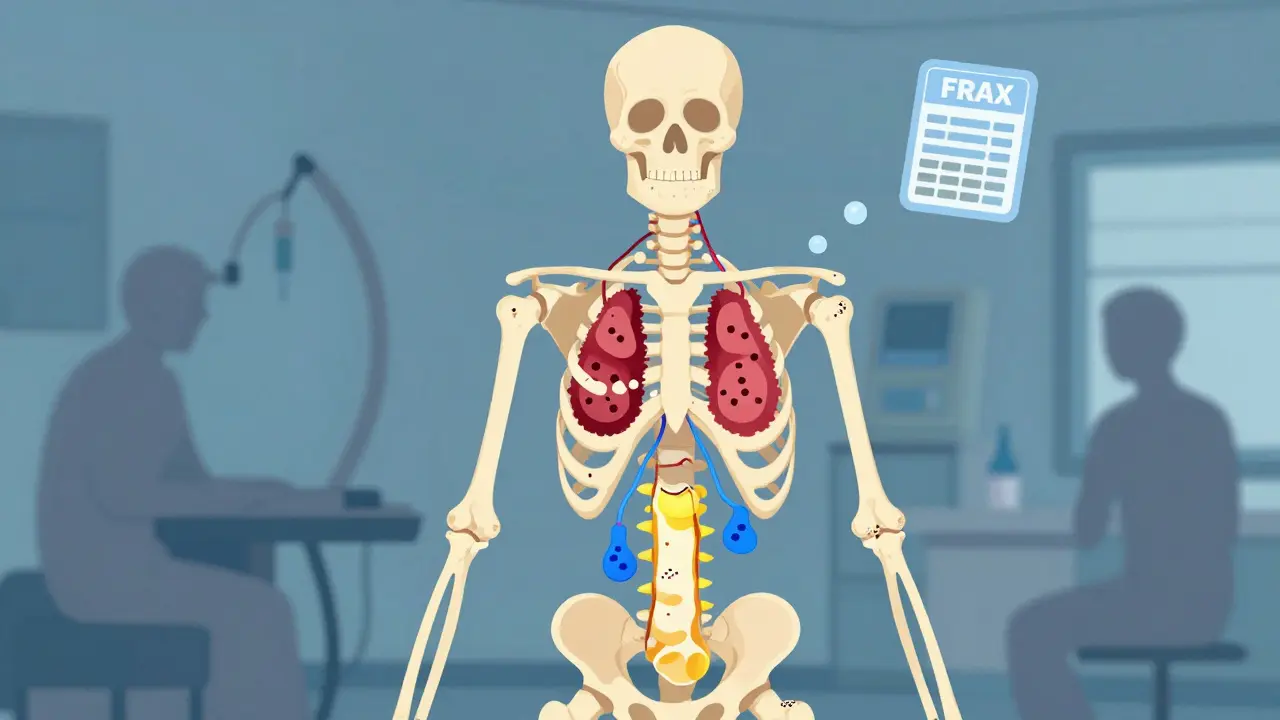
When your hormones are out of balance, your bones pay the price. Conditions like type 1 diabetes, untreated hyperthyroidism, and hypogonadism don’t just affect energy, weight, or mood-they quietly weaken your skeleton. People with these endocrine disorders face fracture risks that can be 6 to 7 times higher than average, even when their bone density scans look normal. This isn’t just about aging. It’s about biology gone wrong, and the tools we now have to fix it-FRAX and bisphosphonates-are changing how doctors see and treat bone loss in these patients.
Why Endocrine Disorders Break Bones
Your bones aren’t just static structures. They’re alive, constantly being broken down and rebuilt by cells called osteoclasts and osteoblasts. Hormones control this process. When you have an endocrine disorder, that balance shatters. In type 1 diabetes, insulin deficiency doesn’t just raise blood sugar-it weakens bone quality. Bone mineral density (BMD) might look fine on a DEXA scan, but the microstructure of the bone is damaged. Studies show these patients break bones 6-7 times more often than others, even with normal BMD. The FRAX tool, which estimates fracture risk, misses this. It underestimates their real risk by about 30%. Untreated hyperthyroidism speeds up bone turnover so much that you lose bone faster than your body can rebuild it. Even mild, undiagnosed cases can raise fracture risk by 15-20%. Hypogonadism-low testosterone in men or estrogen in women-causes rapid bone loss of 2-4% per year. That’s faster than most postmenopausal women lose bone. And if you’re on androgen deprivation therapy for prostate cancer? Your bone density can drop sharply within the first year. These aren’t rare edge cases. The National Institutes of Health lists these endocrine conditions as major secondary causes of osteoporosis. If you have one of them, you’re not just at higher risk-you’re in a high-risk category that needs specific attention.What Is FRAX, and Why It Matters
FRAX isn’t a machine. It’s a free, web-based calculator developed by the University of Sheffield in 2008. Today, it’s used in over 120 countries and built into DEXA machines and electronic health records. It doesn’t just look at your bone density. It asks: How old are you? Are you a smoker? Did your parent break a hip? Do you take steroids? Do you drink more than three alcoholic drinks a day? Do you have rheumatoid arthritis? For endocrine disease patients, FRAX lets doctors plug in their condition-diabetes, thyroid disease, hypogonadism-as a clinical risk factor. But here’s the catch: FRAX doesn’t fully capture the real danger in some endocrine disorders. In type 1 diabetes, it falls short. That’s why experts now recommend using FRAX with the Trabecular Bone Score (TBS), a software add-on that analyzes the texture of your bone on the DEXA scan. TBS reveals hidden damage in the bone’s internal structure, which is often wrecked in diabetes and other hormonal diseases. The thresholds for action are clear: if your 10-year risk of a major fracture is 20% or higher, or your hip fracture risk is 3% or higher, treatment is recommended-even if your T-score is only -1.5 (osteopenia, not full osteoporosis). These numbers aren’t arbitrary. They’re based on decades of clinical trials and population data. For a 65-year-old white woman with no other risks, FRAX without BMD shows a 1.3% hip fracture risk. But add a history of type 1 diabetes? That risk jumps to nearly 5%.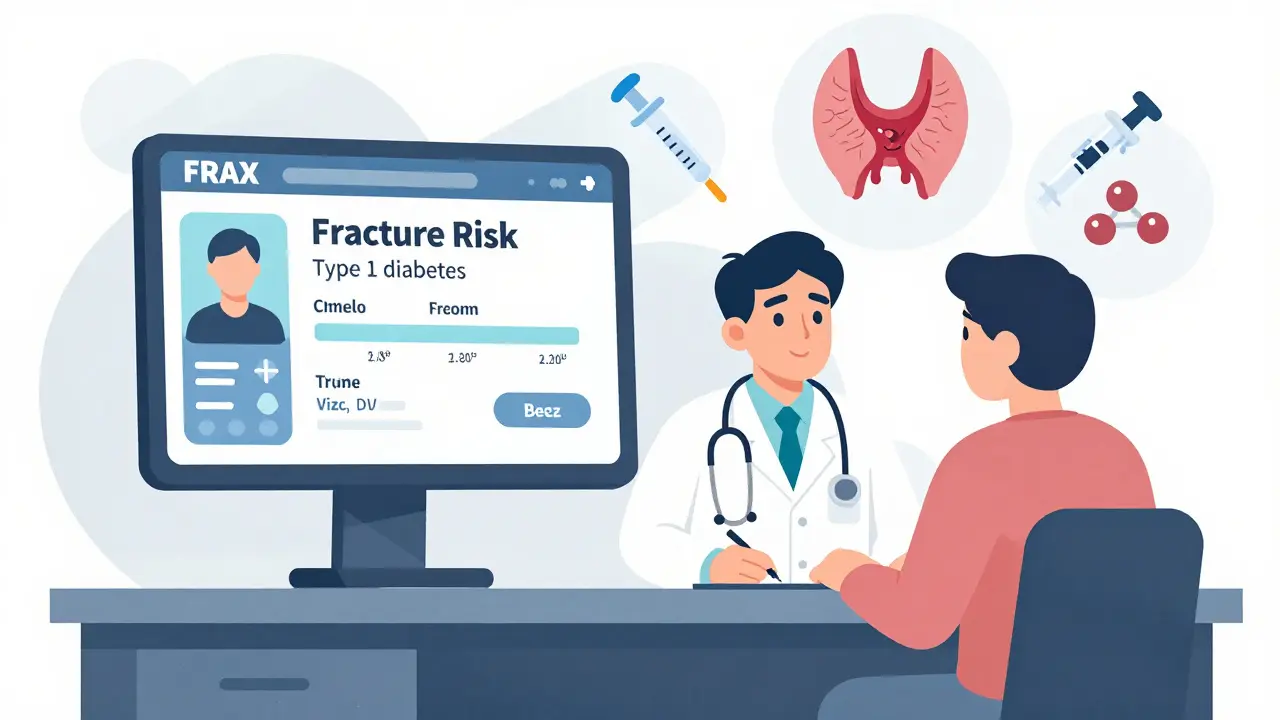
Bisphosphonates: The First-Line Fix
If your FRAX score puts you in the danger zone, bisphosphonates are the go-to treatment. These drugs-like alendronate (Fosamax), risedronate (Actonel), and zoledronic acid (Reclast)-slow down the bone-breakers: osteoclasts. They don’t build bone. They stop it from falling apart too fast. The numbers speak for themselves. In people with osteoporosis, bisphosphonates cut vertebral fracture risk by 40-70% and hip fracture risk by 40-50%. For someone with type 1 diabetes and a history of a wrist fracture, taking bisphosphonates isn’t optional-it’s life-changing. One study showed that after three years of treatment, fracture risk dropped to near-normal levels for their age group. Treatment length varies. Oral bisphosphonates are usually taken for 3-5 years. Zoledronic acid, given as an annual IV infusion, is typically used for 3 years. After that, your doctor rechecks your FRAX score and bone density. If your risk has dropped, you might pause treatment. But if you’re still at high risk-especially if you’ve had multiple fractures-you may stay on longer. For endocrine disease patients, guidelines are clear: the same thresholds apply. But experts stress that if you’ve had a recent fracture or multiple fractures, you’re in the “very high risk” group. That means faster action, tighter monitoring, and sometimes stronger drugs down the line.When FRAX Falls Short-And What to Do
FRAX is powerful, but it’s not perfect. It was designed for the general population. Endocrine diseases add layers of complexity it wasn’t built to fully handle. Type 1 diabetes is the biggest blind spot. FRAX doesn’t account for poor bone quality, microdamage from high blood sugar, or increased fall risk from nerve damage. That’s why the Bone Health and Osteoporosis Foundation is developing a diabetes-specific version of FRAX. Early trials show it improves risk prediction by 25%. Other conditions like hyperparathyroidism or Cushing’s syndrome also distort FRAX’s accuracy. In these cases, doctors rely on more than the calculator. They look at your history: How many fractures have you had? Are you on long-term steroids? Do you have low vitamin D? Is your kidney function normal? They might order a TBS scan, check your bone turnover markers, or even refer you to an endocrinologist. The bottom line: FRAX is a starting point, not the final word. If you have an endocrine disorder and your doctor says your FRAX score is “just below” the threshold, don’t accept that as the end of the conversation. Ask: Could my condition make my real risk higher? Should we check my TBS? Is a DEXA scan still needed even if my score is borderline?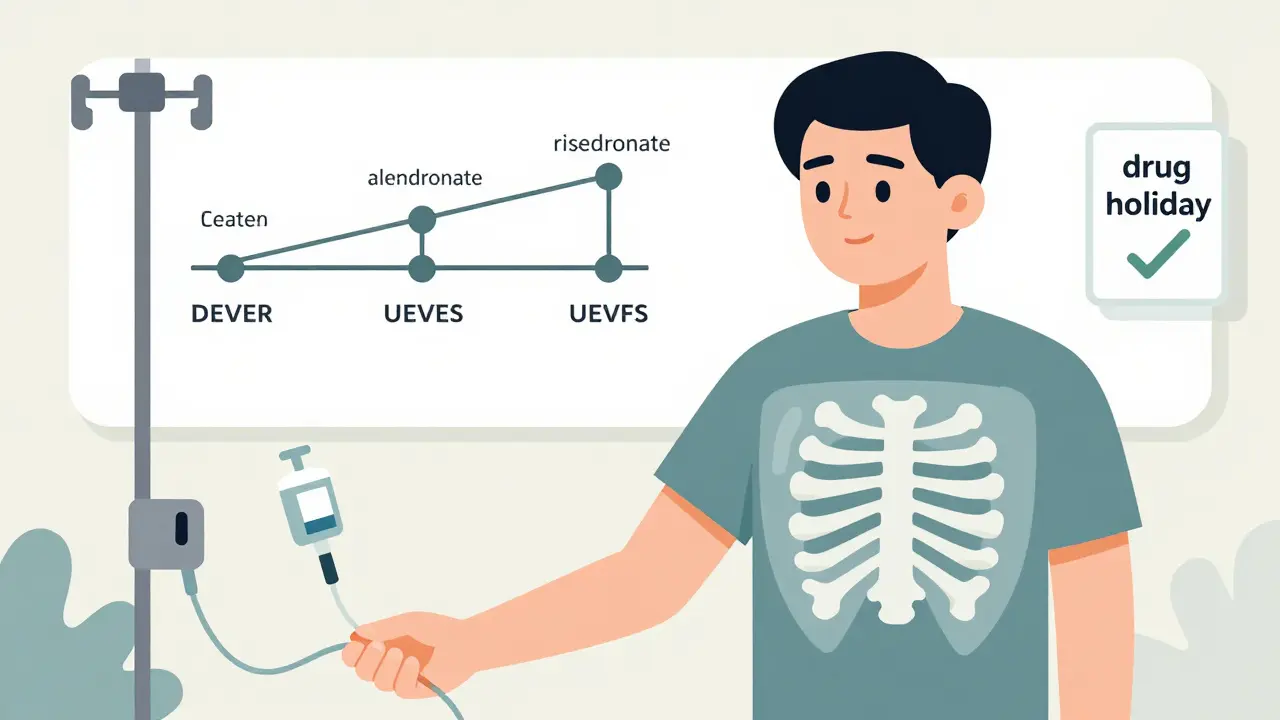
Who Should Get Tested and When
The U.S. Preventive Services Task Force recommends DEXA scans for all women 65 and older. But if you have an endocrine disease, you don’t have to wait. Men and women over 50 with any of these conditions should be evaluated:- Type 1 or long-standing type 2 diabetes
- Untreated hyperthyroidism or recent thyroid surgery
- Primary hypogonadism or androgen deprivation therapy
- Premature menopause before age 45
- Chronic glucocorticoid use (even low doses over 3 months)
- Chronic malnutrition or malabsorption (like celiac disease)
What Comes Next
The future of osteoporosis care in endocrine disease is moving fast. By 2025, most endocrinologists will use FRAX with endocrine-specific adjustments. New tools are on the horizon: AI models that combine FRAX with blood biomarkers, wearable sensors that track fall risk, and drugs that don’t just slow bone loss but actually rebuild it. But for now, the basics work. If you have an endocrine disorder, ask your doctor about your fracture risk. Don’t wait for a fracture to happen. Get FRAX calculated. Get a DEXA scan if needed. If your risk is high, bisphosphonates are safe, effective, and proven. They’ve helped millions. They can help you too.Can FRAX be used for people with type 1 diabetes?
Yes, but with caution. FRAX includes diabetes as a clinical risk factor, but it still underestimates fracture risk in type 1 diabetes by about 30%. For better accuracy, doctors should use FRAX with the Trabecular Bone Score (TBS), which assesses bone microstructure. New diabetes-specific FRAX adjustments are in development and may improve prediction by 25%.
Are bisphosphonates safe for people with endocrine disorders?
Yes, bisphosphonates are the first-line treatment for osteoporosis in endocrine disease patients, including those with diabetes, thyroid disorders, or hypogonadism. They reduce hip fracture risk by 40-50% and vertebral fractures by 40-70%. The same safety guidelines apply: avoid if you have severe kidney disease or cannot sit upright for 30 minutes after taking oral versions. Monitoring is key, especially after 3-5 years of use.
Do I need a DEXA scan if I have an endocrine disorder but no fractures?
Not always. Start with FRAX. If your 10-year risk of major fracture is over 9.3%, or you’re over 50 with a clinical risk factor like diabetes or hypogonadism, then a DEXA scan is recommended. If your FRAX score is low and you have no other risk factors, screening may not be needed yet. But if you’ve had a minor fracture, you don’t need a scan-you already qualify for treatment.
How long should I take bisphosphonates?
Most people take oral bisphosphonates for 3-5 years or receive annual zoledronic acid infusions for 3 years. After that, your doctor will reassess your fracture risk using FRAX and bone density. If your risk remains high, especially after past fractures, you may continue treatment. If your risk has dropped, you might take a “drug holiday.” Never stop without medical advice.
Is osteoporosis only a concern for postmenopausal women?
No. Men over 50 with endocrine disorders like hypogonadism, type 1 diabetes, or long-term steroid use are at high risk too. The National Osteoporosis Guideline Group recommends FRAX assessment for all men and women over 50 with clinical risk factors. Bone loss in men is often overlooked, but it’s just as dangerous.
FRAX is great, but I’ve seen too many patients with type 1 diabetes get dismissed because their DEXA looked ‘normal.’ The real issue is bone quality, not density. TBS should be standard, not optional. If your doctor isn’t talking about microstructure, they’re not doing their job.
Oh please. Another ‘medical authority’ telling people they’re fragile. I’ve got hypothyroidism, I lift weights, I eat kale, and I haven’t broken a bone since I was 12. Stop scaring people into taking drugs they don’t need. Bisphosphonates have side effects you wouldn’t believe-jaw necrosis, atypical femur fractures. You’re trading one problem for another.
Frankly, the entire FRAX paradigm is a statistical mirage built on population averages that ignore the heterogeneity of endocrine pathology. The reliance on T-score thresholds without accounting for collagen cross-linking, advanced glycation end-products (AGEs), or osteocyte apoptosis in diabetic osteopathy is not just inadequate-it’s epistemologically negligent. Until FRAX integrates biomarkers like CTX-1 and PINP into its algorithm, it remains a relic of 2008-era thinking. And yes, I’ve published on this in JBMR.
So FRAX is like a weather app that only looks at temperature but ignores humidity, wind, and whether you’re standing on a cliff? That’s wild. And bisphosphonates? They’re like putting a bandaid on a leaky dam-slows the drip, but doesn’t fix the pipe. I’ve got a cousin on Fosamax for 5 years and now she’s got a ‘femur whisper’-a tiny crack that showed up on an MRI. Doctors act like these drugs are magic bullets, but they’re more like… expensive insurance with weird fine print.
Just got my DEXA back. T-score -1.8, FRAX at 8.9%. Doctor said ‘close but no.’ I asked about TBS. He looked at me like I spoke Klingon. I’m going to the endo next week. If you’re over 50 and have diabetes, thyroid issues, or low hormones-don’t take ‘borderline’ as an answer. Fight for the scan. Your bones won’t complain until they break.
Thanks for this. I’m from Nigeria, and here, most people think osteoporosis is a ‘rich country problem.’ But my uncle with type 2 diabetes broke his hip from stepping off a curb. No one knew. We need more of this info in places like mine. 🙏
Wow. So we’ve turned bone health into a spreadsheet game where your risk is calculated by whether your grandma broke her hip and if you drink more than three beers? Meanwhile, real people are getting fractures because no one’s telling them to eat more protein, get vitamin D, or stop sitting on their butt all day. FRAX doesn’t care if you walk 10K steps a day. It just sees your age and your ‘clinical risk factors.’ Classic medicine: overcomplicate the simple, ignore the obvious.
Thank you for writing this-clear, precise, and deeply needed. I’m a GP in Scotland, and I see this daily. A 58-year-old man with prostate cancer on ADT, FRAX score ‘low,’ no scan done. He breaks his wrist three months later. Now he’s in pain, on morphine, and we’re scrambling. Please, if you’re reading this and have an endocrine condition-ask for FRAX + TBS. Don’t wait. And if your doctor says ‘you’re fine’-get a second opinion. Your skeleton doesn’t get a do-over.