When you’re fighting a serious bacterial infection like MRSA or infective endocarditis, daptomycin can be a lifesaver. But there’s a hidden risk that many patients - and even some doctors - don’t talk about until it’s too late: daptomycin muscle toxicity. It doesn’t show up in fever charts or blood cultures. It sneaks in as unexplained muscle pain, weakness, or cramps. And if you’re not checking your creatine phosphokinase (CK) levels regularly, you could be heading toward rhabdomyolysis without knowing it.
What Exactly Is Daptomycin Muscle Toxicity?
Daptomycin is a powerful antibiotic used for tough Gram-positive infections. It works by punching holes in bacterial cell membranes. But here’s the catch: it doesn’t just target bacteria. It can also damage your own muscle cells. This isn’t a rare side effect - real-world studies show 5% to 10% of patients develop some form of muscle toxicity, far higher than the 0.2% reported in early clinical trials. The damage happens because daptomycin binds to muscle cell membranes, especially under low-oxygen conditions. Think of it like a key that fits both bacterial and human muscle cell surfaces. When you’re sick with sepsis, have heart disease, or are in shock, your muscles are already low on oxygen. That’s when daptomycin becomes much more dangerous. A 2020 study showed muscle cells under hypoxic conditions suffered up to 60% more damage than those in normal oxygen levels.Why CK Monitoring Isn’t Optional
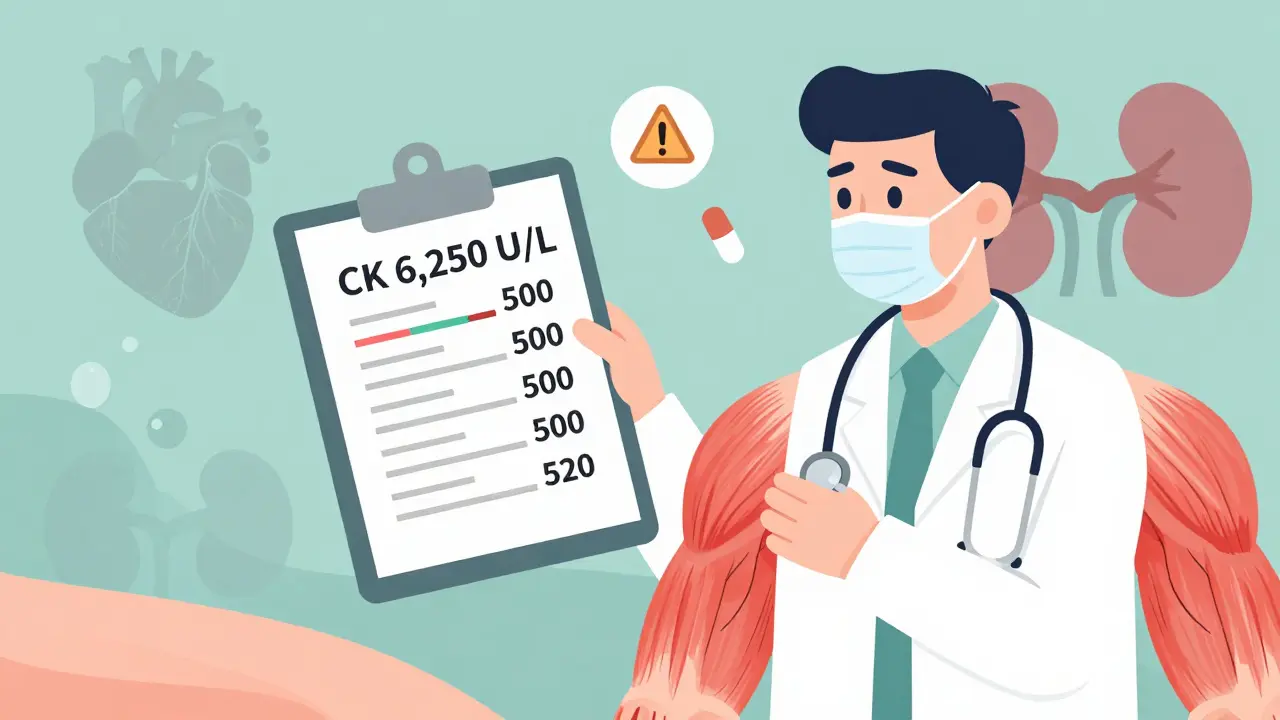
Creatine phosphokinase (CK) is an enzyme that leaks out of damaged muscle cells. When your muscles break down, CK levels rise in your blood. That’s why checking CK is the single most important safety step when you’re on daptomycin. The standard rule? Check CK once a week. But it’s not just about frequency - it’s about thresholds.- If you have muscle pain or weakness AND your CK is over 1,000 U/L - stop daptomycin immediately.
- If you feel fine but your CK hits 10 times the upper limit of normal (about 1,500-2,000 U/L depending on the lab) - stop it anyway.
What Symptoms Should You Watch For?
Muscle toxicity doesn’t always come with a siren. Sometimes, it’s quiet. Here’s what to look out for:- Unexplained muscle pain - especially in the thighs, shoulders, or back
- Weakness - feeling like you can’t climb stairs, lift your arms, or stand up from a chair
- Dark urine - like cola or tea - a sign your kidneys are struggling to filter muscle breakdown products
- Tenderness - muscles that hurt when you press on them
- Fatigue that doesn’t go away - not from the infection, but from your muscles literally breaking down
Higher Doses = Higher Risk?
Daptomycin is increasingly used at higher doses - 8 to 12 mg/kg per day - for bone and joint infections that need weeks of treatment. This isn’t just a guess. Pharmacokinetic studies show higher doses get better penetration into bone tissue. But here’s the trade-off: the risk of muscle toxicity climbs with dose. A 2023 study found that patients on doses above 6 mg/kg had a 2-3 times higher chance of CK elevations above 1,000 U/L. The same study also found that patients on longer courses (over 14 days) had a 30% higher incidence of symptoms. That doesn’t mean you shouldn’t use higher doses - sometimes you have to. But it does mean you need tighter monitoring. Weekly CK checks aren’t enough anymore. For patients on 8 mg/kg or more, some experts now recommend checking CK every 3-4 days during the first two weeks.Statins and Daptomycin: The Real Risk
For years, doctors were told to stop statins when starting daptomycin. The fear? The two drugs together would cause severe muscle damage. But here’s what the data actually says: a 2014 study of 220 patients found no statistically significant increase in muscle toxicity when statins were continued. Patients on both drugs had slightly higher CK levels - 10.2% vs. 5.3% - but the difference wasn’t large enough to prove causation. Still, many hospitals continue to recommend holding statins. Why? Because the consequences of missing a case of rhabdomyolysis are too severe. If you’re on a statin and start daptomycin, talk to your doctor. You might be able to keep your statin if your CK is normal and you’re on a standard dose. But if you’re on a high dose of daptomycin or have kidney disease, stopping the statin is still the safest move.Who’s at Highest Risk?
Not everyone on daptomycin gets muscle toxicity. But some people are sitting on a ticking clock:- Patients with heart disease or poor circulation - low oxygen makes daptomycin more toxic to muscles
- People with kidney problems - daptomycin is cleared by the kidneys, so levels build up
- Those on high-dose regimens (8 mg/kg or more)
- Patients treated for more than 14 days - especially for bone or joint infections
- Anyone with pre-existing muscle weakness or neuromuscular disorders
What Happens After You Stop Daptomycin?
The good news? Daptomycin-induced muscle damage is almost always reversible. Once you stop the drug, CK levels usually drop by half within 3-5 days. Muscle strength returns over days to weeks, depending on how bad the damage was. One case study followed a 68-year-old man with endocarditis who had a CK of 8,400 U/L. He stopped daptomycin, stayed hydrated, and got IV fluids. His CK fell to 1,200 U/L in 7 days. By day 21, he was walking without assistance. No permanent damage. But if you wait too long - if CK stays high for weeks - you can develop permanent muscle weakness or kidney failure. That’s why early detection matters more than anything.What About Other Antibiotics?
Vancomycin is cheaper and doesn’t cause muscle toxicity. But it’s harder to use - you need frequent blood tests to check levels, and it can damage your kidneys. Fluoroquinolones like ciprofloxacin cause tendon ruptures, not muscle breakdown. Telavancin and linezolid have their own risks - nerve damage, low platelets. Daptomycin’s advantage? It kills MRSA fast and doesn’t harm kidneys like vancomycin. But it trades one risk for another. That’s why monitoring CK isn’t a nuisance - it’s the price of safe use.Bottom Line: Don’t Guess. Test.
Daptomycin is a vital tool against superbugs. But it’s not a drug you can use on autopilot. If you’re prescribed daptomycin:- Ask for a baseline CK before starting
- Get weekly CK checks - every 7 days, no exceptions
- Report any muscle pain, weakness, or dark urine immediately
- If you’re on a high dose or have heart disease, ask if you need checks every 3-4 days
- Don’t assume statins are automatically dangerous - talk to your doctor about your personal risk
How often should CK levels be checked during daptomycin treatment?
CK levels should be checked at least once a week during daptomycin therapy. For patients on higher doses (8 mg/kg or more), those with kidney disease, heart failure, or prolonged treatment (over 14 days), checks every 3-4 days are recommended. Baseline CK should be measured before starting treatment.
What CK level means I should stop daptomycin?
Stop daptomycin immediately if you have muscle symptoms and your CK is above 1,000 U/L. Even without symptoms, discontinue if CK exceeds 10 times the upper limit of normal (typically 1,500-2,000 U/L, depending on the lab). These thresholds are based on clinical guidelines from the University of Nebraska Medical Center and are designed to prevent rhabdomyolysis.
Can I take statins while on daptomycin?
The risk of combining statins with daptomycin is lower than once thought. A 2014 study found no statistically significant increase in muscle toxicity. However, many doctors still recommend temporarily stopping statins during daptomycin treatment - especially at higher doses or in high-risk patients - as a precaution. Always discuss this with your doctor based on your individual health status.
Does daptomycin cause kidney damage?
Unlike vancomycin, daptomycin doesn’t directly damage the kidneys. But if muscle breakdown (rhabdomyolysis) occurs, the released muscle proteins can overload the kidneys and cause acute kidney injury. This is why monitoring CK and staying well-hydrated is critical - to protect your kidneys from secondary damage.
How long does muscle weakness last after stopping daptomycin?
Muscle weakness and pain usually begin improving within 3-5 days after stopping daptomycin. CK levels typically drop by half in that time. Full recovery of strength can take 1-4 weeks, depending on how high the CK peaked. Permanent damage is rare if the drug is stopped early.
Are there alternatives to daptomycin for MRSA infections?
Yes. Vancomycin is the most common alternative, though it requires frequent blood monitoring and carries a higher risk of kidney injury. Linezolid and telavancin are other options, but both have their own side effects - linezolid can cause nerve damage and low blood counts, while telavancin can harm kidneys. Ceftaroline is newer and effective against MRSA but isn’t used for bloodstream infections as often. The choice depends on the infection site, kidney function, and patient history.
13 Comments
Write a comment