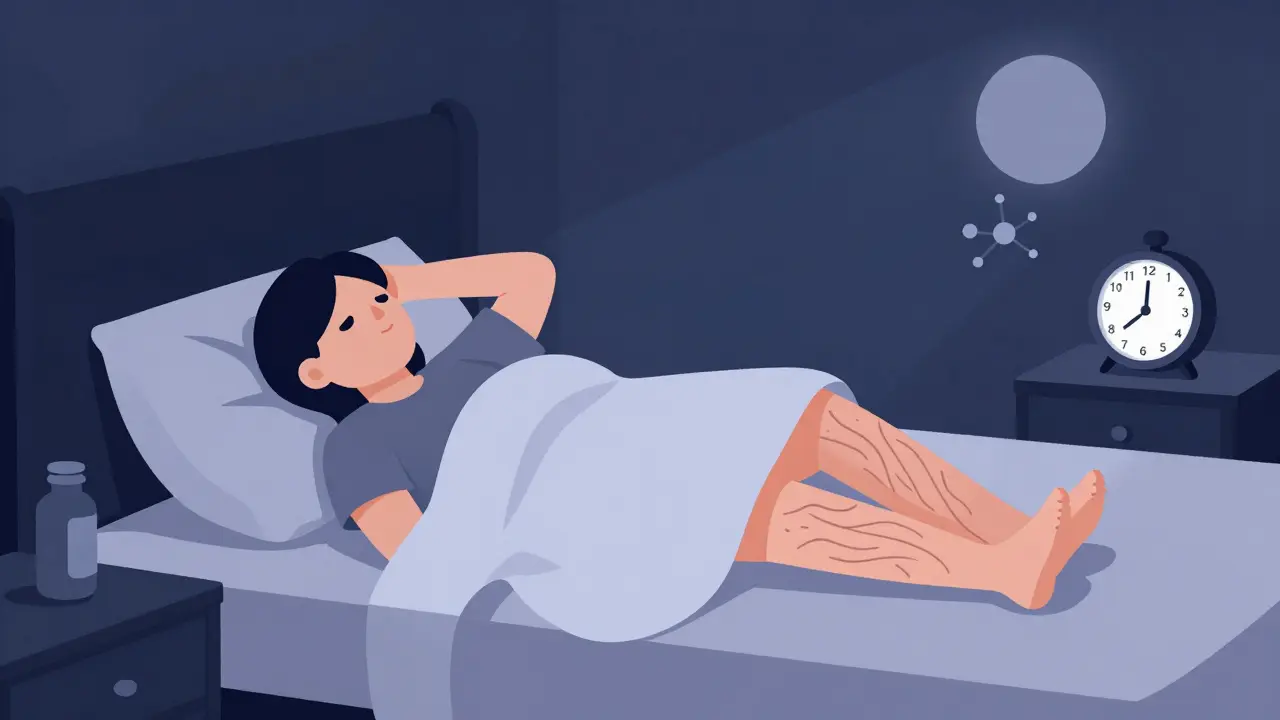
Imagine lying in bed, eyes wide open, legs screaming to move-but you can’t. Not because you’re anxious, not because you’re cold, but because something inside your nerves is twisting, tingling, crawling. It’s not just discomfort. It’s a biological rebellion that steals sleep, saps energy, and turns nights into battles. This is restless legs syndrome-a neurological condition that affects up to 10% of adults in the U.S., and for many, it’s been years before they even knew what was happening.
What Really Happens in Your Nervous System?
Restless legs syndrome, also called Willis-Ekbom disease, isn’t just ‘jittery legs.’ It’s a brain wiring problem. The core issue lies in the dopamine system-the same pathway that controls movement and reward in the brain. In people with RLS, dopamine signaling in the basal ganglia and spinal cord is disrupted. Brain scans show a 20-30% drop in dopamine transporter density in the striatum compared to people without the condition. That’s not a small glitch. It’s a major signal failure.Iron plays a silent but critical role here. Low iron levels in the substantia nigra-a region rich in dopamine-producing cells-worsen the problem. That’s why checking ferritin levels (a measure of stored iron) is one of the first things doctors do. If your ferritin is below 75 ng/mL, iron therapy can cut symptoms by 30-40%. But most people never get tested. They just assume they’re ‘restless’ or ‘stressed.’
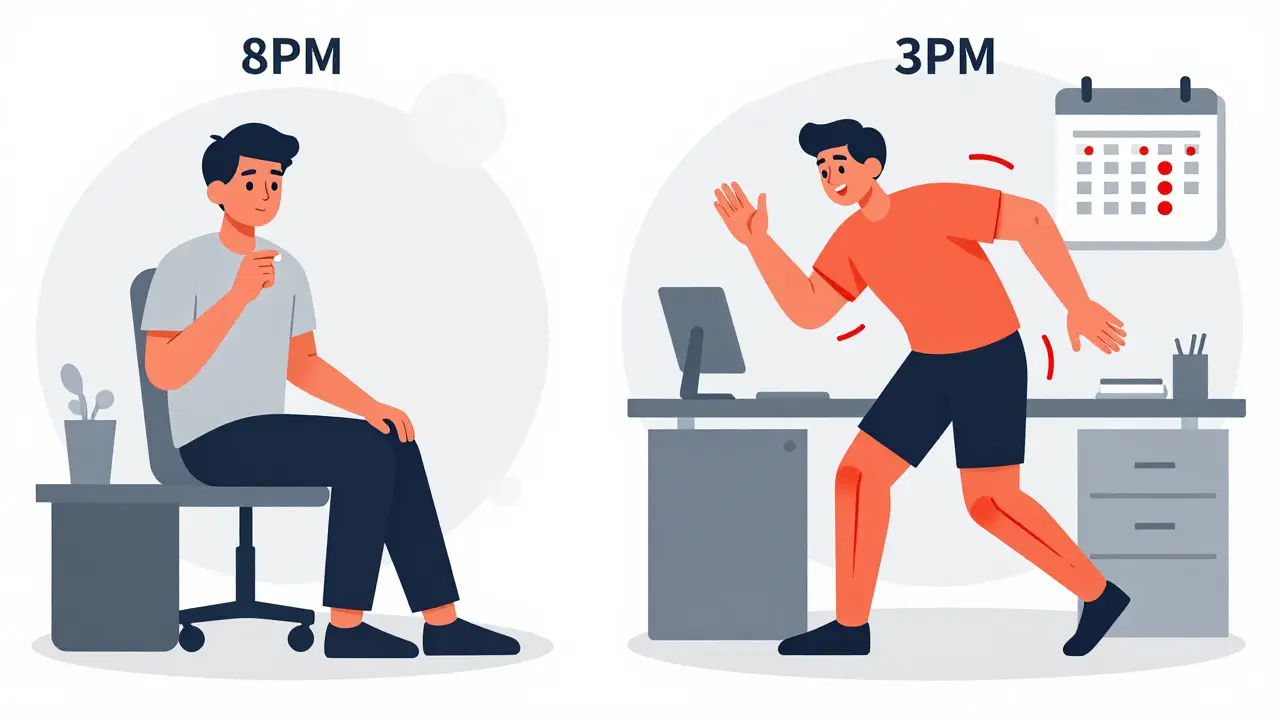
The symptoms follow a strict clock. They start or get worse when you’re still-sitting in a chair, watching TV, trying to fall asleep. By 8 p.m., they’re often three to four times worse than they were at noon. And they don’t just stay in the legs. For many, they creep into the arms, thighs, even the torso. Movement brings relief-walking, stretching, pacing-but only temporarily. The moment you stop, the urge returns, stronger than before.
How Sleep Gets Destroyed
Sleep isn’t just disturbed-it’s dismantled. People with RLS take 45 to 60 minutes just to fall asleep, compared to 15-20 minutes for most adults. Once asleep, they wake up 6 to 10 times a night. That’s not normal tossing and turning. That’s full awakenings, often triggered by sudden jerks in the legs. These aren’t random. They’re called periodic limb movements, and 80-90% of RLS patients have them. They happen every 20-40 seconds, up to 100 times an hour, breaking deep sleep into fragments.Polysomnography studies show RLS patients spend 25-40% more time in light sleep (N1 and N2 stages) and far less in restorative deep sleep (N3) and REM. Total sleep time drops by 30-50%. That’s not fatigue. That’s chronic sleep deprivation. And the effects aren’t just about feeling tired. Attention and working memory drop by 20-30%. Reaction times slow. Driving becomes dangerous-RLS patients are 2.3 times more likely to be in a car accident. One study found that 68% of people with untreated RLS reported falling asleep at stoplights or while reading.
Dopaminergic Therapy: The Quick Fix With a Hidden Cost
When symptoms are severe, doctors turn to dopamine-targeting drugs. Three are FDA-approved: ropinirole, pramipexole, and rotigotine. They work fast-often within an hour. Patients report being able to sleep through the night for the first time in years. For many, it’s life-changing.But here’s the catch: these drugs don’t fix the problem. They mask it. And over time, they make it worse. This is called augmentation. Instead of symptoms appearing only at night, they start in the afternoon. Then the morning. Then they spread to your arms. The urge gets stronger. You need higher doses. And the cycle tightens.
Studies show 20-70% of patients develop augmentation within a year, depending on the drug. Pramipexole has the highest risk-66% after three years. Rotigotine, the skin patch, is better at 26%. Why? It delivers dopamine more steadily, avoiding the spikes that trigger the brain’s resistance. Ropinirole is in the middle. But even the best option isn’t safe forever.
There’s another hidden danger: impulse control disorders. About 6-17% of people on these drugs develop compulsive behaviors-gambling, shopping, binge eating, hypersexuality. One patient on Reddit described racking up $20,000 in credit card debt from online shopping she couldn’t stop. The FDA requires black box warnings on all these drugs for this reason. Men with prior mental health conditions are at higher risk. But it can happen to anyone.
What Works Better in the Long Run?
There’s a quieter alternative: alpha-2-delta ligands. Gabapentin enacarbil and pregabalin were originally designed for seizures and nerve pain, but they’ve become first-line treatments for chronic RLS. Why? Because they don’t touch dopamine. They calm overactive nerves by blocking calcium channels.They don’t work as fast. It takes 2-4 weeks to feel the full effect. But they don’t cause augmentation. In a direct 2021 trial comparing pregabalin to pramipexole, both reduced symptoms by about the same amount-but augmentation occurred in only 8% of the pregabalin group versus 32% in the pramipexole group after six months. That’s a huge difference.
Cost is another factor. Dopamine agonists cost $800-$1,200 a year. Alpha-2-delta drugs run $1,500-$2,000. But if you factor in the cost of augmentation-more doctor visits, higher doses, switching meds, treating compulsive behaviors-the real price of dopamine drugs climbs fast.
Iron therapy is another non-dopamine option. If your ferritin is low, an IV infusion of ferric carboxymaltose can cut symptoms by a third to half. But it takes 3-6 months to work. And you need to be tested first. Most primary care doctors don’t order ferritin for RLS. That’s a missed opportunity.
Real People, Real Choices
A review of over 1,200 patient stories from Healthgrades, Drugs.com, and Reddit shows a clear pattern. Of those using dopamine drugs, 38% say they’re ‘saved.’ They finally sleep. They can work. They’re not exhausted all day.But 62% report negative experiences. Of those, 78% cite augmentation. One man said his symptoms started at noon after 10 months on pramipexole. He couldn’t sit through a movie. He had to walk his office hallway every hour. Another woman said her legs felt like they were being ‘electrocuted’ from the inside. She switched to pregabalin and got her life back.
On Reddit’s r/RLS community, 65% of people who’ve been on dopamine drugs for more than two years have switched to alpha-2-delta ligands. Pregabalin is the top choice. Why? Because they can finally sit still without fear.

How to Manage This Right
If you’re diagnosed with RLS, here’s what actually works:- Get your ferritin checked. If it’s below 75 ng/mL, ask about IV iron.
- Start with non-drug strategies: avoid caffeine and alcohol after noon, stretch before bed, try a warm bath, walk for 20 minutes in the evening.
- If you need medication, consider pregabalin or gabapentin enacarbil first-especially if your symptoms happen daily.
- If you try a dopamine drug, start at the lowest dose: 0.125 mg of pramipexole or 0.25 mg of ropinirole, taken 1-3 hours before symptoms usually start.
- Keep a daily symptom diary. Note when symptoms begin, how bad they are (1-10 scale), and if they spread. This catches augmentation early.
- Never increase your dose without talking to your doctor. More isn’t better-it’s riskier.
Many people spend years blaming themselves-‘I’m just not sleeping right,’ ‘I’m too anxious.’ But RLS is a real, measurable brain disorder. It’s not weakness. It’s neurology.
What’s Next?
New treatments are coming. A new extended-release version of ropinirole (Requip XL) reduces augmentation risk by nearly half compared to the old version. Clinical trials are testing fipamezole, a drug that targets a different brain pathway, and intranasal apomorphine, which delivers dopamine directly to the nose-bypassing the bloodstream and lowering side effects.Genetic testing is also on the horizon. Variants in the BTBD9 and MEIS1 genes can predict who’s more likely to respond to pramipexole-or who’s at high risk for augmentation. In one study, genetic profiling predicted treatment success with 72% accuracy.
For now, the best approach is patience and awareness. Dopamine drugs work-but they’re not a cure. They’re a tool. And like any tool, they need careful handling. The goal isn’t just to sleep. It’s to live without fear of your own body betraying you.
Can restless legs syndrome go away on its own?
Rarely. While some people experience temporary relief during pregnancy or after correcting iron deficiency, RLS is usually a chronic condition. For most, symptoms return or worsen over time without treatment. It doesn’t disappear without intervention.
Is restless legs syndrome the same as periodic limb movement disorder?
They’re closely linked but not the same. RLS is the urge to move your legs due to uncomfortable sensations-something you feel. PLMD is the involuntary jerking or kicking of limbs during sleep-something others might notice. About 80-90% of people with RLS also have PLMD, but not everyone with PLMD has RLS.
Why do dopamine drugs make RLS worse over time?
Dopamine receptors in the brain become oversensitive when constantly stimulated by medication. This causes the brain to respond by making symptoms appear earlier in the day, spread to other body parts, and feel more intense. This is called augmentation. It’s not a tolerance issue-it’s a neurological rewiring.
Can lifestyle changes alone treat RLS?
For mild cases, yes. Avoiding caffeine, alcohol, and nicotine; maintaining a regular sleep schedule; and doing light exercise like walking or yoga can reduce symptoms. Iron supplementation helps if levels are low. But for moderate to severe RLS, lifestyle changes aren’t enough on their own-they’re best used alongside medical treatment.
Are there any natural supplements that help with RLS?
Magnesium and folate have shown mild benefit in small studies, especially if you’re deficient. But there’s no strong evidence that supplements like valerian root or cherry extract work reliably. Iron is the only supplement with proven impact-but only if your ferritin is low. Always test before supplementing.
How do I know if I’m experiencing augmentation?
Watch for three signs: symptoms start earlier in the day (like afternoon instead of bedtime), spread to other body parts (arms, torso), or become more intense even with the same dose. If you notice any of these, talk to your doctor immediately. Early detection can prevent worsening.
RLS doesn’t have to control your life. But it won’t fix itself. Understanding the balance between relief and risk is the key to taking back your nights.
The dopamine transporter density reduction in the striatum is a well-documented neurochemical correlate, not merely an association. The 20-30% deficit aligns with meta-analyses from the Journal of Neurology, Neurosurgery & Psychiatry. Iron deficiency in the substantia nigra exacerbates this via impaired tyrosine hydroxylase activity - the rate-limiting enzyme in dopamine synthesis. Ferritin <75 ng/mL is a validated biomarker, yet screening remains underutilized in primary care due to reimbursement barriers and diagnostic inertia.
Augmentation is not tolerance; it’s receptor sensitization and downregulation of D2/D3 autoreceptors in the ventral tegmental area. This is why pulsatile dosing (e.g., immediate-release pramipexole) is far riskier than transdermal delivery. The pharmacokinetic profile matters as much as the pharmacodynamic effect.
Alpha-2-delta ligands work via α2δ-1 subunit modulation of voltage-gated calcium channels, reducing glutamate and substance P release in the dorsal horn. This mechanism avoids dopaminergic pathways entirely, hence no augmentation. Pregabalin’s bioavailability is dose-linear up to 300 mg/day - beyond that, saturation occurs. Dosing should be titrated slowly.
IV iron (ferric carboxymaltose) restores brain iron stores more effectively than oral, due to bypassing hepcidin-mediated absorption blockade. Serum ferritin is a poor proxy for CNS iron - CSF ferritin or MRI R2* mapping are better, but impractical. Still, serum ferritin <75 is a pragmatic threshold.
Genetic variants in MEIS1 and BTBD9 are linked to dysregulated iron homeostasis in the CNS, not just dopamine signaling. These SNPs explain ~15% of heritability. Pharmacogenomic testing is emerging but not yet standard. Worth considering in refractory cases.
So… the government knows about this but lets Big Pharma push dopamine drugs because they make more money? 😏
And now they’re testing intranasal apomorphine? 😂 Like, why not just inject it into your eyeball while you’re at it?
I’m just saying - if your legs are screaming, maybe the problem isn’t your brain… it’s your soul. Or the wifi. 🌐👻
Also, I tried magnesium. It worked. I’m now 72% spirit animal. 🦉
Look, I’ve had RLS since I was 19 and I’m 42 now. I tried everything. Dopamine drugs? Yeah, I got hooked. Started buying stuff I didn’t need. Bought a whole damn kayak I didn’t even know how to use. Then I woke up one day and realized I’d spent $25k on Amazon because my legs felt like they were full of ants.
Switched to pregabalin. Took 3 weeks. Didn’t feel like a miracle. But now I can sit through a damn movie without pacing. No gambling. No debt. No panic.
Doctors don’t tell you this stuff. They just hand you a script and say ‘take one.’ Like it’s aspirin. It’s not. It’s a minefield.
And yeah, ferritin. Get it checked. If your doc says ‘it’s fine’ and it’s 68? They’re wrong. 75 is the floor. Not the goal. The floor.
In India, we call this ‘jhadu ka jhatka’ - the broom shake. People think it’s just nerves or bad karma. No one tests ferritin. No one knows dopamine. But we have yoga. We have turmeric. We have 1000-year-old remedies.
Still… I tried pregabalin after my cousin in Chicago sent me this article. Took 10 days. Now I sleep 7 hours. No more midnight walks to the balcony.
Maybe science and tradition aren’t enemies. Maybe they’re just waiting to hold hands. 🙏
Oh, so now we’re supposed to believe that a $2000/month drug is ‘better’ than a $1000 one? How very… Silicon Valley. The real problem isn’t augmentation - it’s that medicine has become a product lineup. ‘Here’s your dopamine agonist. Here’s your premium version with fewer side effects. And here’s your subscription to lifelong neurological management.’
Meanwhile, the guy who lives in a van and eats canned beans has no access to IV iron or genetic testing. So he suffers. And that’s the real tragedy.
Stop selling solutions. Start fixing systems.
Also, ‘alpha-2-delta ligands’? That’s not a drug. That’s a password to a secret lab.
Bro. I was on pramipexole for 2 years. Augmentation hit me hard. Started at 4 PM. Then 11 AM. Then I couldn’t sit at my desk. Had to stand all day. My boss thought I was ADHD. I was just my legs trying to escape my body.
Switched to gabapentin. Took 3 weeks. Still not perfect. But I can sleep. And I didn’t go broke. Or start sexting strangers.
Doctors don’t warn you. They should. Like, put a warning label on the script. ‘WARNING: This may turn you into a shopping addict who can’t sit still.’
Also - ferritin. Get it checked. I was at 42. Now I’m at 98. I feel like a new person.
Wait - so if dopamine drugs cause augmentation, and augmentation is neurological rewiring… then why aren’t we studying the long-term structural changes in the basal ganglia? fMRI? DTI? Why is the research still stuck in symptom scales and self-reports? Where’s the neuroimaging data on the actual brain changes after 5 years of pramipexole? It’s not just ‘worse symptoms’ - it’s a rewired circuit. And we’re not measuring it.
Also - IV iron. Why is it not covered by insurance? It’s cheaper than 3 years of dopamine agonists. Why are we funding drugs instead of cures?
And who’s funding the genetic studies? Is it pharma? Is it NIH? Or is it just… silence?
Actually, the whole dopamine theory is oversimplified. RLS is likely a spinal cord phenomenon, not just brain-based. Animal models show that even with intact basal ganglia, spinal iron deficiency alone triggers RLS-like movements. The brain is just the loudspeaker - the real issue is in the dorsal horn. That’s why gabapentin works - it’s acting locally.
Also, the 10% prevalence in the U.S.? That’s inflated. It’s based on self-reporting. In Europe, it’s 5%. In Asia, 3%. Cultural bias in symptom reporting? Maybe. Or maybe the American diet is just… toxic.
And no, magnesium doesn’t work unless you’re deficient. And most people aren’t. Stop drinking that powder.
lol i had rls for years and thought it was just stress. then i read this and was like… oh. so i’m not lazy. i’m neurologically broken. cool.
got ferritin checked. was 58. did iv iron. now i sleep. no more walking around the house at 2am. my dog is happy.
also i’m not taking dopamine drugs. too scary. pregabalin is my new bff. even if it costs a fortune. worth it.
Let me get this straight - you’re telling me the same drugs that help you sleep also make you spend $20k on eBay and start gambling at 3 a.m.? And doctors just hand those out like candy? What the actual f*** is wrong with this system?
I’ve seen it. My cousin. On pramipexole. Bought 17 pairs of shoes. Started flirting with strangers online. Then she got depressed. Then she quit. Took 6 months to get back to normal.
And now you want me to believe that pregabalin is the answer? It’s more expensive? So what? At least I won’t end up in debt or jail.
Iron. Check it. If you’re not tested, you’re being failed by the system.
And stop calling it ‘restless legs.’ It’s not legs. It’s your nervous system screaming for help.
My mom had this. Thought it was ‘just aging.’ Finally got tested. Ferritin was 31. IV iron. Two weeks later, she slept through the night for the first time in 12 years.
She cried. I cried.
It’s not a curse. It’s a solvable problem.
Just get tested.
Just wanted to say thank you for writing this. I’ve been too scared to tell anyone I have RLS. Thought I was just ‘anxious.’ But this… this explains everything. I’m going to ask my doctor for ferritin tomorrow. And maybe pregabalin. Not dopamine stuff. Too scary.
Also - I’ve been walking at night for years. Didn’t realize it was a symptom. I thought I was just a night owl.
Now I feel less alone.
It is imperative to underscore that the pharmacological management of Restless Legs Syndrome must be predicated upon a comprehensive diagnostic evaluation, inclusive of serum ferritin quantification and exclusion of secondary etiologies. The current paradigm of empirical dopaminergic initiation constitutes a significant deviation from evidence-based standards of care. Furthermore, the absence of routine neurological follow-up exacerbates the risk of augmentation. It is recommended that clinicians adhere to the 2021 International Restless Legs Syndrome Study Group guidelines, which prioritize non-dopaminergic modalities in chronic, daily presentations. Patient education remains paramount.