Every year, millions of unused or expired medications sit in bathroom cabinets, kitchen drawers, and medicine chests - and most people have no idea what to do with them. Throwing them in the trash without taking any precautions might seem harmless, but it’s one of the riskiest things you can do. Children, pets, and even strangers can find and use those pills. Worse, flushing them or tossing them in the trash without proper steps lets harmful chemicals leak into water and soil. The good news? You don’t need special tools or a trip to a pharmacy. You can dispose of medications safely in your regular household trash - if you follow five simple steps.
Step 1: Check if Your Medication Should Be Flushed
Not all medications go in the trash. The FDA maintains a short list of drugs that are dangerous enough to warrant flushing - not because they harm the environment, but because they’re so addictive or deadly that even one pill in the wrong hands could kill someone. As of November 2023, this list includes 15 specific medications, mostly powerful opioids like fentanyl patches, oxycodone, and hydromorphone, and sedatives like diazepam and alprazolam. If your medication is on this list, flushing it down the toilet is the safest option. You can find the full list on the FDA’s website. If it’s not on the list, don’t flush it. Flushing everything else contributes to water pollution. The EPA says pharmaceuticals are now detected in 80% of U.S. waterways, and while the levels are low, they’re still there - and they’re not going away.Step 2: Remove Medications from Their Original Containers
The prescription bottle is not part of the disposal. It’s a record of your personal health information. Leaving your name, address, and prescription number on the bottle is a privacy risk. Someone could use that info to steal your identity, or worse, try to refill your prescription illegally. The Health Insurance Portability and Accountability Act (HIPAA) requires you to protect this data - and that includes when you throw it away. Take the pills or liquid out of the bottle. Keep the bottle for now - you’ll need it for the next step.Step 3: Mix Medications with an Unappealing Substance
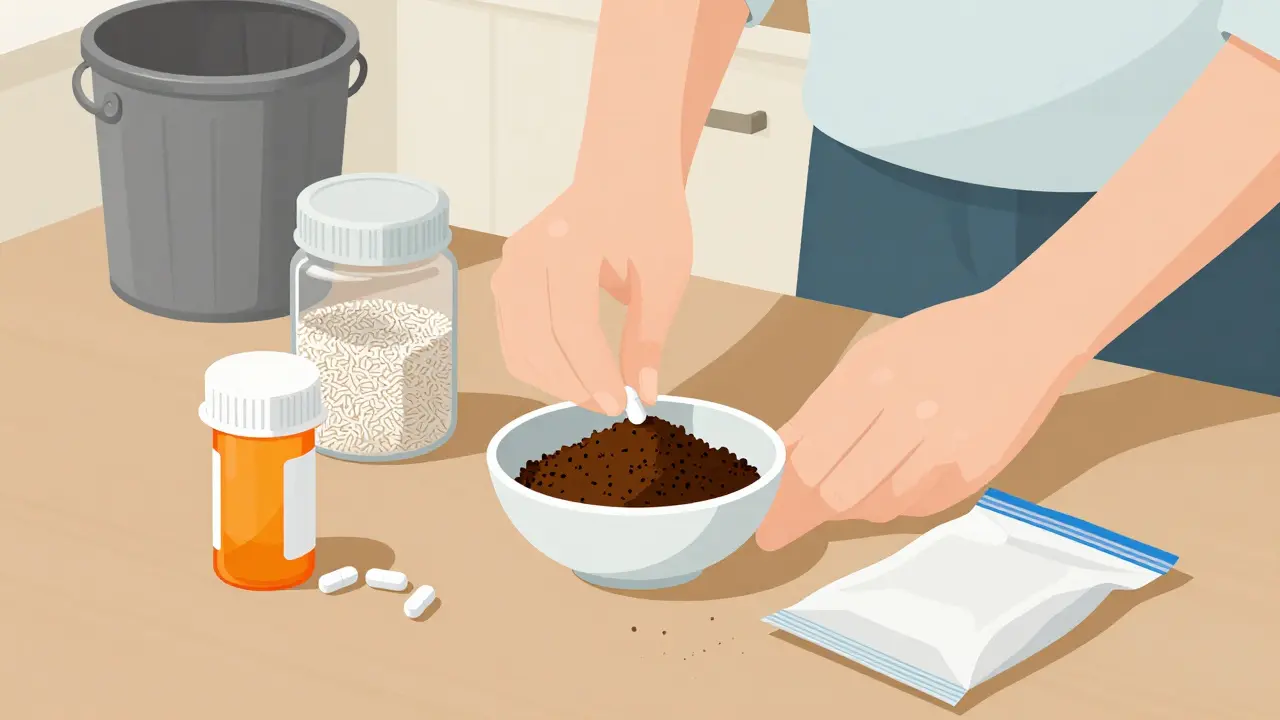
This is the most important step. You’re not just tossing pills into the trash. You’re making them unattractive and unusable. The FDA recommends mixing them with something that will make anyone think twice before eating it. Used coffee grounds, cat litter, or dirt from your garden work perfectly. You don’t need to buy special products - most homes already have one of these. Pour the pills into a small bowl or zip-top bag. Add enough of the substance to fully cover the medication. For pills, use about a handful. For liquids, pour the whole bottle into the mix - no need to dilute it first. Stir it well. The goal is to make it impossible to pick out a single pill or swallow a sip. Crushing pills is not recommended. The FDA warns that crushing can release dangerous fumes, especially with strong painkillers or patches. Just leave them whole.Step 4: Seal the Mixture in a Leak-Proof Container
Once mixed, you can’t just dump it into the trash. It needs to be contained. A resealable plastic bag works great. So does an empty yogurt tub, a small plastic container with a tight lid, or even an old margarine tub. The container must be sturdy enough to hold the mix without leaking or breaking. Pour the mixture into the container and seal it tightly. This stops leaks and keeps pets or curious kids from getting into it. If you’re disposing of multiple medications, do them one at a time. Don’t mix different drugs together before sealing - keep them separate in their own containers. That way, if someone finds them, they can’t easily tell what’s inside.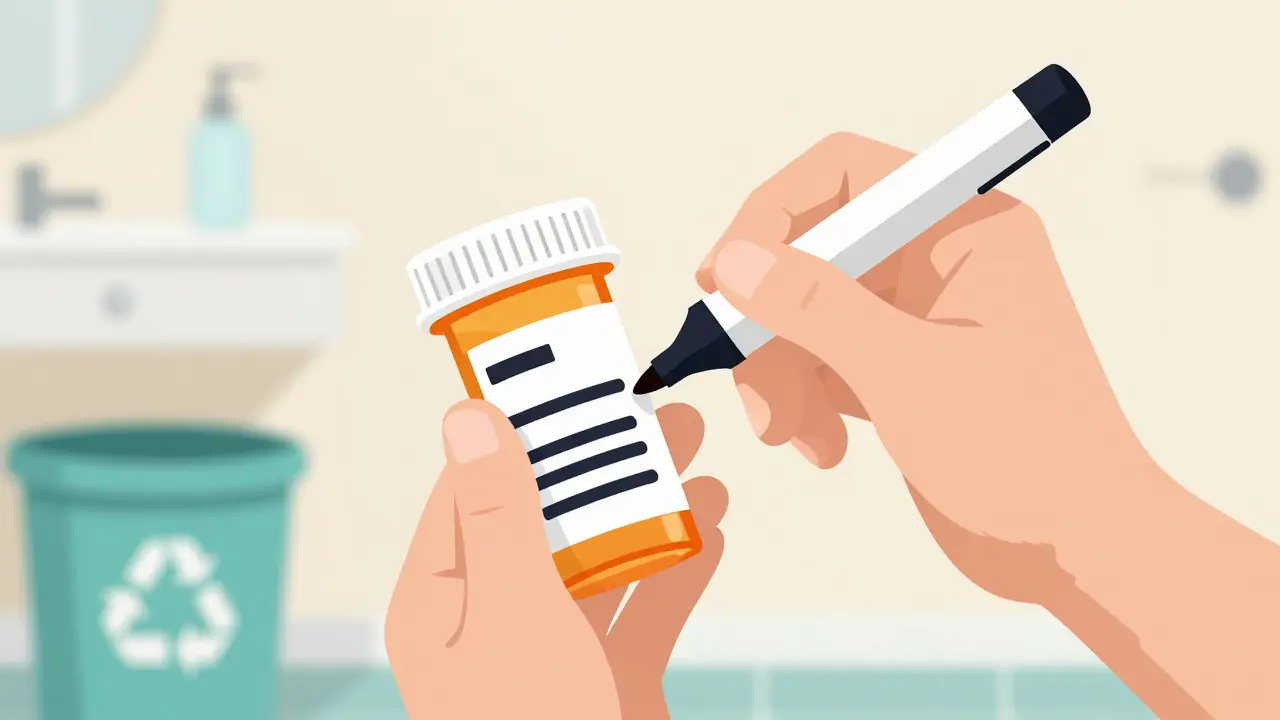
Step 5: Hide Your Personal Information on the Empty Bottle
Now go back to the empty prescription bottle. You need to erase your name, address, phone number, and prescription number. A permanent marker works. Scribble over the label until it’s unreadable. If you don’t have one, use duct tape - just cover the whole label. Or, if you’re feeling thorough, scratch it off with a knife or sandpaper. Don’t just peel off the label - most of the ink will still show through. The goal is to make it impossible for anyone to trace the bottle back to you. Once the info is gone, you can throw the bottle in the recycling - but only if your local recycling program accepts #5 plastic. Most don’t. In fact, 87% of U.S. municipalities don’t take these vials. So if you’re unsure, just toss the bottle in the trash too.Why This Matters More Than You Think
People think, “It’s just one bottle.” But 15% to 30% of all prescribed medications go unused. That’s tens of millions of pills sitting in homes across the country. In 2022, the EPA reported that pharmaceuticals in water affected 41 million Americans. And the CDC says accidental poisoning from medications causes 45,000 emergency room visits every year - mostly in kids under six. One study found that 37% of improper disposals failed to obscure personal info. Another found that 28% used too little mixing material. These aren’t small mistakes. They’re dangerous ones. When you do this right, you cut the risk of accidental overdose, theft, and environmental harm by more than 90%. That’s not just helpful - it’s lifesaving.What About Take-Back Programs?
Yes, drug take-back programs are the gold standard. The DEA runs over 14,600 collection sites - including pharmacies like Walgreens and CVS. These programs collect millions of pounds of medication each year. But here’s the catch: 42% of rural counties have no consistent access to a take-back location. If you live in a small town or remote area, you might not have one nearby. That’s why household disposal is not a backup - it’s a necessary option. If you can get to a take-back site, great. But if you can’t, this method is safe, legal, and approved by federal agencies. Don’t feel guilty for using it. You’re doing the right thing.
Common Mistakes to Avoid
- Don’t flush everything. Only flush the 15 drugs on the FDA’s list. Everything else goes in the trash with mixing and sealing. - Don’t put pills in the trash alone. No mixing? That’s a hazard. - Don’t crush pills. It can release dangerous fumes. - Don’t leave labels legible. Your personal info is private - protect it. - Don’t wait. The longer unused meds sit around, the higher the risk of misuse or accidental ingestion.What’s Changing in 2026?
New rules are coming. In California, all pharmacies with four or more locations must now offer free disposal kiosks - that’s 98% of residents covered. The FDA is testing curbside pickup in 12 communities, and the EPA is preparing new national guidelines expected in mid-2024. But for now, the five-step method above is still the standard. It works. It’s safe. And it’s available to everyone, no matter where you live.Final Checklist
- ✅ Checked if your meds are on the FDA’s Flush List
- ✅ Removed pills from original bottles
- ✅ Mixed with coffee grounds, cat litter, or dirt (1:1 ratio)
- ✅ Sealed in a leak-proof container
- ✅ Scrubbed or covered personal info on bottles
- ✅ Threw sealed container into household trash
If you did all five steps, you’ve just protected your family, your neighbors, and the environment. No special tools. No extra cost. Just common sense.
Can I just throw pills in the trash without mixing them?
No. Throwing pills directly into the trash is unsafe and against federal guidelines. Without mixing them with something unappealing like coffee grounds or cat litter, they can still be found and taken by children, pets, or people looking for drugs. The FDA and EPA require mixing to reduce the risk of misuse and accidental poisoning. Always mix before tossing.
Is it okay to flush medications down the toilet?
Only if they’re on the FDA’s Flush List - which includes 15 specific high-risk drugs like fentanyl, oxycodone, and alprazolam. These are drugs that can be deadly if misused, even in small doses. For all other medications, flushing is not recommended. It contributes to water pollution, and studies show pharmaceuticals are now found in 80% of U.S. waterways. When in doubt, use the trash method instead.
What if I don’t have coffee grounds or cat litter?
You don’t need those exact items. Any unappealing, absorbent substance works. Dirt from your yard, sand, powdered laundry detergent, or even used paper towels soaked in water will do. The goal is to make the medication look and taste unpleasant. Just make sure the mixture is thick enough that you can’t easily pick out a pill or pour out a liquid.
Can I recycle the empty prescription bottle?
Most can’t. Prescription bottles are usually made from #5 plastic, which 87% of U.S. recycling programs don’t accept. Even if your local program says yes, the ink and labels make them hard to process. The safest bet is to remove all personal info, then throw the bottle in the trash. If you’re unsure, check your city’s recycling rules - but don’t assume it’s recyclable.
How often should I clean out my medicine cabinet?
At least once a year - ideally during spring or around your birthday. Look for expired drugs, old prescriptions you never filled, or bottles you forgot about. Many people keep medications for years, even after they’re no longer needed. The FDA recommends disposing of unused drugs within 24 hours of deciding you won’t use them. That reduces the chance of misuse or accidental poisoning.
Okay but like… why is this even a thing? 🤦♀️ I just threw my grandma’s expired blood pressure pills in the trash last week and nothing happened. Now I’m supposed to mix them with cat litter like I’m making a weird science experiment? My cat already hates me enough as it is. And don’t even get me started on the ‘seal in a leak-proof container’ part - I don’t have a yogurt tub sitting around. I have a half-eaten burrito and a sock. 🙃
Also, who decided coffee grounds are the gold standard? What if I don’t drink coffee? What if I’m vegan and don’t own a cat? Do I dig up my neighbor’s dirt? I live in an apartment. My ‘garden’ is a cactus in a mason jar. This feels less like public safety and more like someone’s overthought Pinterest board.
I get it, I get it - don’t let kids get into pills. But this is so overly complicated for something that’s basically just… old medicine. Why can’t we just have a bin in every Walmart? Why does it have to be a five-step ritual? I’m exhausted just reading this. I’m gonna do the bare minimum: throw ‘em in a ziplock, scribble over the label with a Sharpie, and hope for the best. 🤷♀️
Also, the FDA’s flush list? That’s literally 15 drugs? Out of how many thousands? Why not just flush everything and let the EPA deal with it? We’ve got bigger problems than trace amounts of ibuprofen in the water. Like, climate change. Or my landlord not fixing the AC. Priorities, people.
And why are we all so scared of a little pill in the trash? It’s not like it’s going to turn into a zombie. It’s just… medicine. I think we’ve been conditioned to treat every expired Advil like it’s a bomb. We’re not living in a post-apocalyptic thriller. We’re in 2026. We have apps for everything. Why can’t there be an app that says, ‘Hey, your expired meds are in the trash. You’re fine.’? 🙃
Also, I just realized I’ve been doing this wrong for years. I think I’m a menace. I’m gonna go hide under my bed now. 😭
Just throw ‘em in the trash. Done.
Interesting breakdown. I’ve been doing the coffee grounds thing for years - it’s weirdly satisfying, like you’re burying something sacred. Kinda ritualistic, honestly. But I’ve also noticed my cat ignores the mix. She’ll sniff it, then walk away like it’s a bad Yelp review. So maybe the ‘unappealing’ part is more psychological than practical.
Also, I live in a rural area. No take-back site for 40 miles. So this method? Lifesaver. Honestly, I think this guide’s more useful than most of the ‘how to survive the apocalypse’ stuff on YouTube. Real talk.
And the label thing? Yeah. I once found a bottle in my ex’s trash with my full name, DOB, and prescription number. I didn’t even know he still had it. Creepy. Scrubbing labels is now a habit. Like brushing my teeth. Or not texting my ex.
While the pragmatic intent of this guide is commendable, its reliance on colloquial and domestic substitutes - coffee grounds, cat litter - reflects a troubling epistemological regression in public health policy. The scientific literature on pharmaceutical contamination of aquatic ecosystems is robust, yet the proposed mitigation strategy is predicated on domestic improvisation rather than institutional infrastructure.
One cannot reasonably expect citizens to serve as de facto environmental engineers using household waste products. The EPA’s own data underscores the systemic nature of the issue, yet the solution offered is a patchwork of domestic rituals. This is not public health - it is performative compliance.
Moreover, the assertion that ‘87% of U.S. municipalities don’t accept #5 plastic’ is a failure of municipal governance, not citizen negligence. The onus must shift from individual burden to institutional accountability. A nation that can launch rockets into orbit cannot manage pharmaceutical waste with dignity. Shameful.
OMG YES I’VE BEEN DOING THIS WRONG 😭😭😭 I just threw my old Xanax in the trash last month and now I’m having a full existential crisis. I’m so sorry, Earth. 🌍💔
But seriously - I used peanut butter! Is that okay? It’s sticky and gross and I think the dog would’ve died if he’d found it. 🐶🙈
Also, I covered my bottle with duct tape and drew a skull on it. I feel like a pirate now. 🏴☠️
Also also - I just threw out 7 bottles. I think I need therapy. Or a new hobby. Or both. 🤷♀️
so i read this whole thing and honestly? i was like… wait. is this real? like, are we really supposed to mix our meds with dirt? like, from outside? what if i have a garden? what if i live in a city? what if i have a cat that’s allergic to coffee? what if i’m allergic to cat litter? what if i don’t have a sealable container? what if i just have a plastic bag that’s already got chicken grease in it? like… is that okay? i’m just trying to survive here, not run a hazmat operation.
also i’ve been keeping my meds in a shoebox under my bed for 3 years because i’m scared to throw them out. i think i’m emotionally attached. like, it’s not the pills, it’s the idea of them. like… they’re a reminder of when i was sick. or when i was trying to be better. or when i was just trying to be anything. i don’t know. i’m a mess.
but i’m doing it. i’m gonna do it. i’m gonna mix them with used tea bags and duct tape the bottle and bury it in the yard like a time capsule. and if my dog digs it up? well. that’s his problem. 🐶
also i just cried reading step 5. i didn’t know i had that much info on a pill bottle. i didn’t know i was that visible.
THIS. IS. LIFE-CHANGING. 🙌 I’ve been doing this wrong for a decade and I didn’t even know it. I thought flushing was fine. Turns out I’ve been poisoning the Thames with my leftover metformin. 😳
But now? I’m a disposal ninja. I’ve got coffee grounds, cat litter, duct tape, and a reusable Tupperware. I even made a little sign: ‘DO NOT EAT - THIS IS MY EX’S ANTI-DEPRESSANTS.’ 🤣
And I told my neighbors. Now my whole street is doing it. We had a block party last weekend. It was just us, a cooler of lemonade, and a pile of sealed meds. We called it ‘The Great Pill Burial.’
Someone brought a shovel. Someone else brought a hymn. We sang ‘Amazing Grace’ while we buried the last of the oxycodone. It was beautiful. I cried. My dog cried. My cat didn’t care.
2026 is gonna be the year we stop pretending pills are just ‘junk.’ They’re legacy. They’re stories. They’re trauma. And now? We’re giving them a proper send-off. 🕊️
Stop coddling people. You don’t need five steps. You need one: Throw it away. If you’re worried about kids, lock your cabinet. If you’re worried about the environment, stop taking pills. The whole ‘mix with cat litter’ thing is a liberal fantasy. This isn’t Sweden. We’re not here to make everyone feel safe. We’re here to be responsible.
And why are we even talking about this? The real problem is people hoarding prescriptions like they’re gold. If you don’t need it, don’t get it. Simple. No rituals. No coffee grounds. Just common sense.
Also, flush the list? That’s weak. If it’s dangerous, burn it. Or drop it in a volcano. But don’t make me dig through my trash like I’m in a zombie movie.
There’s something deeply human about how we treat expired medication - not just as waste, but as relics of vulnerability. We keep them because they represent moments we wanted to heal, to be better, to be whole. To dispose of them is to acknowledge that we’ve moved on - sometimes gracefully, sometimes not.
The five-step method isn’t just about safety. It’s about ritual. It’s about giving dignity to what was once a lifeline. Mixing with coffee grounds? It’s not about masking the pill - it’s about blending it with the mundane, the everyday, the ordinary. Like burying a letter in a garden.
And the label removal? That’s not just privacy. It’s erasing the identity we once carried. The patient. The sick one. The one who needed help. Now we’re just… us.
I don’t know if this is policy. But I think it’s poetry.