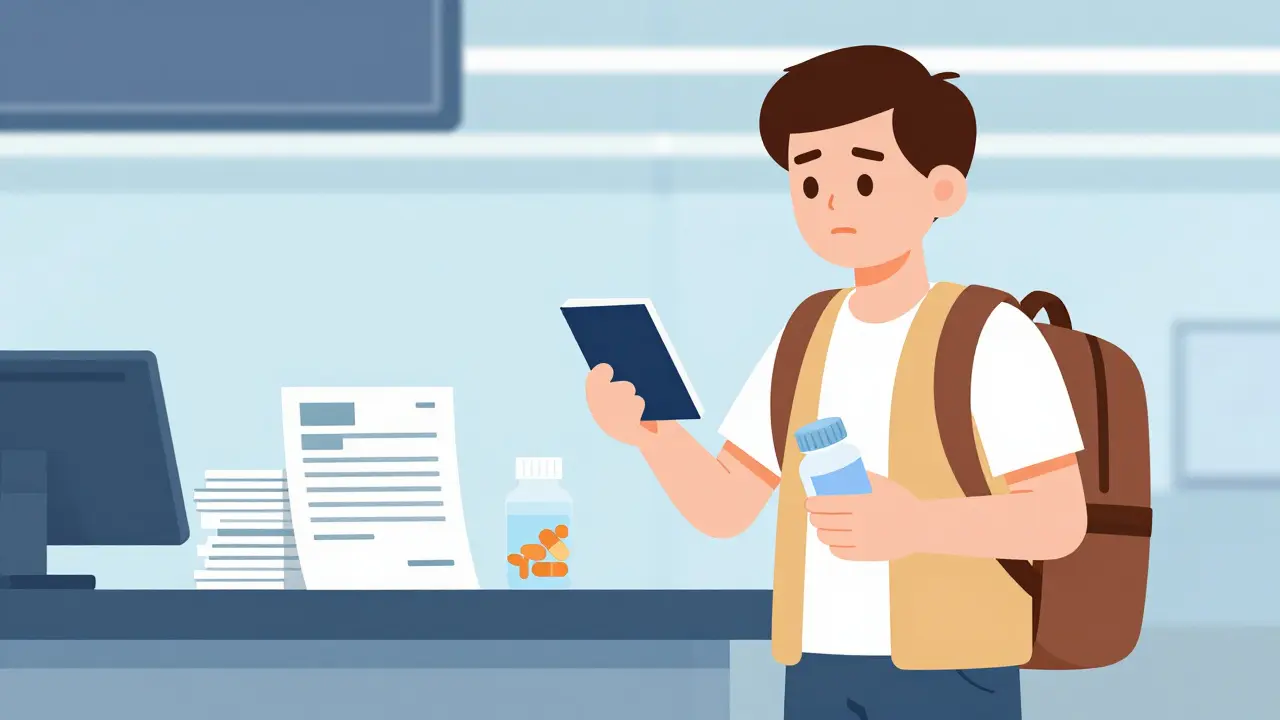
The Risky Business of Carrying Meds
You have packed your suitcase. You have checked your passport. But did you check if your anxiety medication is actually legal in the country you are visiting? Many travelers assume their U.S. or European prescriptions are universal currency. They are wrong. In places like Dubai or Singapore, a standard prescription pill can land you in serious legal trouble. As of 2025, the World Health Organization (WHO) reports that 80% of the global population still struggles with inadequate access to pain treatment, yet regulations around those same medicines vary wildly.
If you rely on daily medication, your trip planning isn't complete until you have solved the paperwork puzzle. It is not just about carrying a bottle in your bag. It involves understanding how local laws treat controlled substances. For example, hydrocodone is common in America but banned entirely in Japan. This guide covers what changed in 2025, the new documentation standards you need, and how to avoid having your medicine confiscated at customs.
Key Takeaways
- Schedule Check: Always verify your medication status using the INCB Country Regulations database before booking flights.
- Letter Format: By 2026, doctor's notes must include ICD-11 codes and generic drug names to pass customs in most major regions.
- Quantity Limits: Stick to the "90-day rule," but know exceptions exist for countries like Japan (30 days) and Singapore (14 days).
- Original Containers: Keep all pills in their pharmacy-labeled boxes. Loose pills in ziplock bags raise red flags with inspectors.
- Backup Plan: Have a digital copy of your prescription accessible via email or cloud storage in case physical documents are lost.
Why International Drug Laws Differ So Much
The confusion stems from old international treaties. We are operating under frameworks like the 1961 Single Convention on Narcotic Drugs. These agreements were designed to stop trafficking, not to help patients with chronic conditions travel. Consequently, every nation interprets these rules differently. Some governments prioritize patient safety and access, while others maintain strict prohibition stances on anything that could potentially be abused.
In 2025, the WHO updated its guidelines to push for more balanced policies, acknowledging that the suffering caused by lack of access is unacceptable. However, the ground reality remains fragmented. The International Narcotics Control Board (INCB) tracks this. While 68 countries provide clear traveler regulations, 124 others leave it to chance. If you fly into a country without published guidelines, you are effectively rolling the dice. This is especially true for benzodiazepines and stimulants, which account for 43% of medication-related travel incidents.
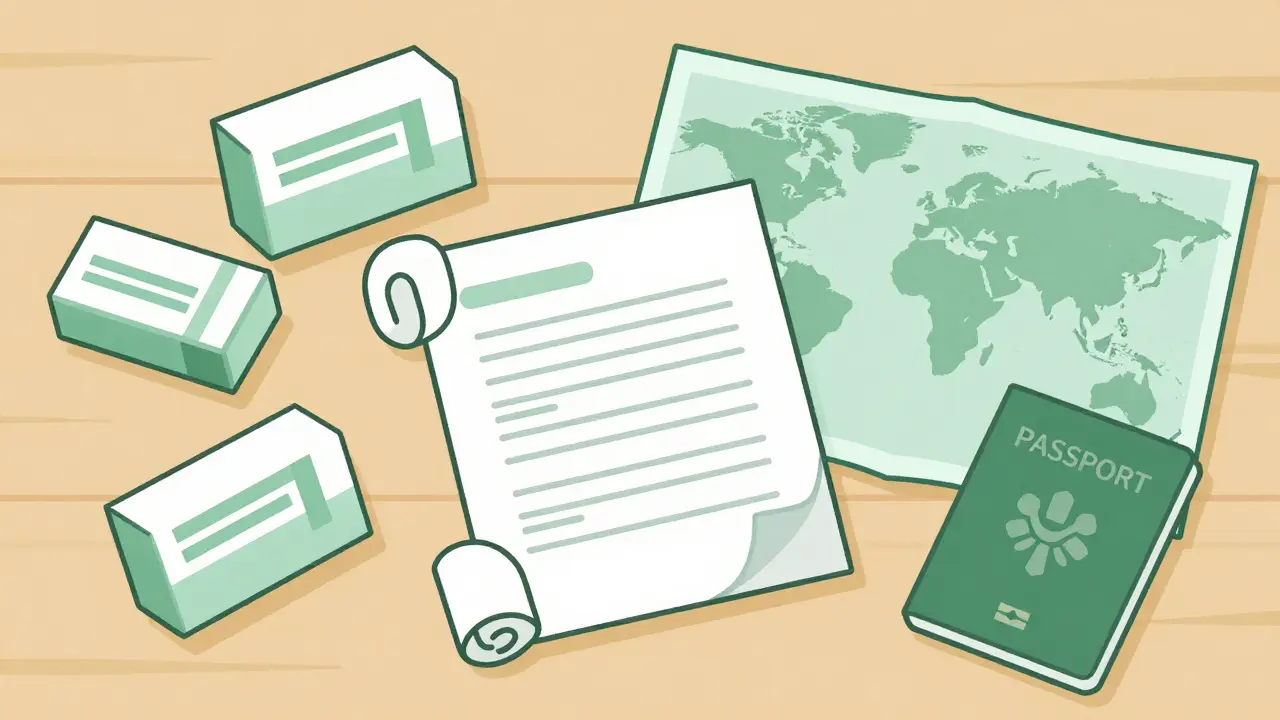
The Essential Documentation Packet
You cannot just walk through immigration with a bottle of pills. You need a dossier. Based on the CDC Yellow Book 2025, here is exactly what you need to prepare 8 to 12 weeks before departure. Most travelers skip the notarization step, which causes nearly 62% of rejection cases in non-English speaking regions.
- The Original Prescription: Ensure the name on the label matches your passport exactly. Typos get flagged.
- The Doctor's Letter: This letter must be on official clinic letterhead. It needs to state your diagnosis, specifically using ICD-11 codes. Simply saying "migraines" might not work anymore; codes add legitimacy.
- Translation Services: If traveling to Spain, Germany, or parts of Asia, get this letter translated and notarized into the local language. Do this before you leave home.
- Quantity Verification: Your doctor should specify the exact quantity allowed. Exceeding personal use limits triggers suspicion of smuggling.
Navigating Regional Restrictions
Regions enforce these rules differently. Knowing the geography of drug policy saves headaches. Let's look at where travelers often get stuck.
The Schengen Zone Advantage
Within the European Union, things are surprisingly smooth thanks to the Falsified Medicines Directive. If you hold a valid prescription from one member state, you can usually fill it in another. There is an "European Prescription" mechanism recognized in 24 states covering 450 million people. For example, a traveler reported using a German electronic prescription to refill sertraline in France within two hours. However, once you leave the EU, the harmonization stops. Turkey, Switzerland, and Ukraine have different entry requirements despite being neighbors.
High-Risk Zones
The Middle East and Southeast Asia maintain stricter controls. Australia and New Zealand prohibit pseudoephedrine due to meth production concerns-something that is legal in the U.S. In 2025 alone, Sydney Airport confiscated 387 packages containing these ingredients. Meanwhile, the United Arab Emirates has zero tolerance for Zolpidem. Even with a doctor's note, thousands of travelers have been detained over sleeping aids. In Malaysia, Alprazolam (Xanax) is completely prohibited regardless of origin. Never enter these borders without explicit pre-approval from their Ministry of Health.
| Region/Country | Control Level | Max Supply Allowed | Specific Bans |
|---|---|---|---|
| United States | Schedule II/III | No limit | Amphetamine restrictions for import |
| Japan | Strict Narcotics Law | 30 Days | Hydrocodone prohibited |
| UAE/Dubai | Mandatory Pre-Authorization | Variable | Zolpidem, Clonazepam |
| Singapore | Poison Act Enforcement | 14 Days | Caffeine injections banned |
| Australia | Pseudoephedrine Prohibition | 90 Days (general) | Decongestants limited |

Getting Refilled Locally
What happens when you run out mid-trip? In 2025, 41% of travelers with chronic conditions found themselves short on supplies. You cannot just buy more at a corner pharmacy in every city. You will need a local prescriber.
This process varies by medical infrastructure. In Europe, finding a GP is easy. You present your original script, get assessed, and leave with a renewal. In emerging markets, you might need to visit a specialist. Here is a strategy for managing refills:
- Identify Clinics First: Before leaving, find a clinic network like IAMAT (International Association for Medical Assistance to Travellers) which verifies over 1,400 clinics globally.
- Use Telemedicine: As of late 2025, 41 countries expanded telemedicine capabilities for tourists. Apps like MediFind allow virtual consultations to authorize local pharmacies. Check your insurance provider's app to see if they cover international online visits.
- Bridging Supplies: If your home prescription expires upon return, ask your doctor for a "bridge supply" before you travel. Carry the full amount you legally can for the trip duration plus buffer days.
Remember the 2026 WHO implementation plan. New standardized documentation templates are expected by Q2 2026. If you travel after June 2026, start asking your doctor for the "International Medical Certificate" format rather than a standard letter. This transition aims to reduce the 6.2 hours average travelers currently spend navigating bureaucracy.
Troubleshooting Common Issues
Even with preparation, snags happen. Maybe you pack liquid medication that exceeds the standard carry-on limit. Since April 2025, the Transportation Security Administration (TSA) permits medically necessary liquids over 3.4 ounces if declared. However, other countries have stricter liquid rules. Always separate meds from liquids in your bag.
Another common failure point is brand name confusion. In some countries, a drug exists only under a different name. Codeine might be sold in Mexico OTC but restricted elsewhere. Always carry the generic name of your drug on your documentation. "Paracetamol" instead of "Tylenol" helps pharmacists worldwide understand your needs. If your meds contain codeine or morphine, flag these specifically on your packing declaration form.
Can I carry my medication in checked luggage?
Never. Checked bags go into the cargo hold where temperatures fluctuate, risking medication efficacy. Furthermore, if your luggage is lost, you are stranded without treatment. Always keep critical meds in your carry-on under your seat or easily accessible area.
Do I need to declare CBD oil at customs?
This depends entirely on the destination. Many nations classify CBD as a controlled substance even if it is legal in the US. Always check the local narcotics schedule. In many Asian and Gulf states, THC-free CBD products are still illegal imports.
If you are unsure, leave it at home. The fine or legal penalty for importing hemp-derived products in strict jurisdictions far outweighs the cost of buying a substitute there.
How much extra medicine should I pack?
Aim for a 7-day buffer beyond your return date. Delays happen. However, strictly adhere to the maximum quantity allowed by the transit and destination country laws (usually 90 days). Having too much looks like smuggling.
Is a digital copy of my prescription enough?
It is a backup, not a primary tool. While apps like MyTravelMed work for tracking, border control agents typically demand physical paper copies with wet signatures or stamps. Digital copies help if originals are stolen, but rarely replace the hard copy at immigration.
What if the airline confiscates my liquid meds?
Declare them before screening. Present your documentation to the security officer immediately. Under recent TSA and EU aviation security updates, reasonable quantities for medical use are exempt from the standard 3.4oz liquid rule, provided they are inspected separately.
I honestly think people who pack their own meds abroad deserve whatever trouble they get by thinking US rules apply globally. It is absolutely pathetic how naive Americans act when they walk through customs thinking their little white bottle holds any power here. If you want to travel then learn that your prescription isn't currency in Dubai or Singapore. These countries aren't going to bend over backwards just because you have anxiety back home in Ohio. You think you know what constitutes legal transport until you get stopped at the gate. The idea that everyone needs special treatment is getting ridiculous.
This whole article is just fearmongering designed to sell more paperwork.
people get scared easily i understand why that info helps though
The concept of borders creates artificial scarcity on relief chemicals yet we pretend sovereignty matters above human physiology itself it is a game played by bureaucrats
sorry angel but rules matter here i was detained for decongestants once and it wasn't fun really check the local bans first mate :)
Polypharmacy interactions are often overlooked during international transit where pharmacokinetic profiles might shift due to environmental stressors. Bioavailability studies suggest certain formulations degrade under tropical humidity conditions common in Southeast Asia regions mentioned. You need to account for therapeutic index variances when declaring quantities at customs checkpoints specifically.
bureaucracy is hard everywhere my cousin got stuck with generic name issues in delhi recently too
They want us tagged by every pill we swallow while crossing the ocean into their digital nets. Big Pharma loves this surveillance state dream where our chemistry defines our citizenship status. Wake up before the microchips in the liquid meds reveal the location data to the UN watchers.
We must consider the profound implications of pharmaceutical regulation on the freedom of movement across geopolitical landscapes today. When you separate yourself from your medication supply chain you essentially surrender autonomy to the arbitrary whims of distant authorities who hold power over your biology. This creates a dependency relationship that strips away the illusion of bodily independence that citizens claim to possess inherently. It becomes clear that health security is just another layer of border enforcement that governments use to filter populations efficiently. We travel assuming rights exist universally but medicine reminds us that chemical compounds are treated like weapons of war in many jurisdictions worldwide. Consider how a simple benzodiazepine tablet can define whether you are a patient or a criminal depending on which soil you step upon. There is a deep irony in carrying salvation in your pocket while fearing imprisonment for possessing it. Modern society demands compliance before compassion in these high stakes environments involving public health safety protocols strictly enforced. It makes one wonder if the cure is truly compatible with the cost of liberty required to maintain access legally. Perhaps the solution lies less in better documentation and more in global consensus regarding essential medical human rights standards. Until then travelers must navigate this minefield with caution knowing full well the ground is unstable beneath every flight path taken. Documentation acts as the only shield against the unpredictable violence of unreasoning administrative systems currently governing air travel. We ignore these facts at our peril and assume protection exists where none truly resides physically or legally. Therefore preparation is merely survival instinct manifesting through paper trails rather than genuine care for passenger welfare overall. It serves as a stark reminder that bodies remain subject to state power regardless of personal necessity or medical history background checks.