Statin Exercise Safety & Risk Calculator
This tool helps assess your potential risk of Statin-Associated Muscle Symptoms (SAMS) during exercise based on current medical research regarding medication type, dosage, and activity intensity.
Recommendation:
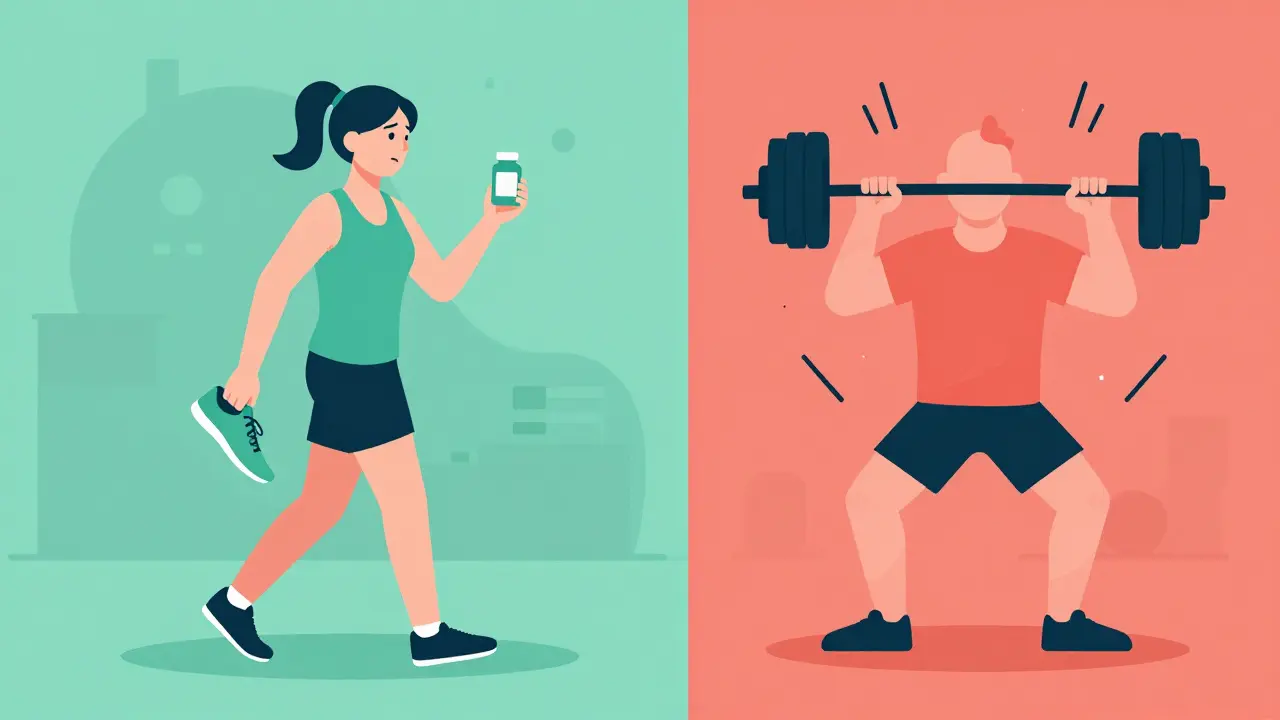
You take your pill. You hit the gym or go for a run. Then comes the ache. Is it the workout? Or is it the statin you’ve been taking to protect your heart? For millions of people, this question creates a cycle of fear and inactivity. The truth is, the relationship between statin therapy and exercise-induced muscle damage is complex, but recent science offers a clear path forward.
The Reality of Statin-Associated Muscle Symptoms (SAMS)
Statin-associated muscle symptoms (SAMS) are real, but they affect fewer people than you might think based on online forums. Clinical trials show that about 5% to 10% of users experience genuine muscle issues. However, real-world data from a 2014 study in JAMA Internal Medicine suggests up to 29% report some form of discomfort. Why the gap? Often, anxiety plays a role. If you believe the drug will hurt your muscles, your brain may interpret normal post-workout soreness as something more sinister.
The key is distinguishing between two types of pain. Statin-related pain usually appears within 30 days of starting the medication and persists regardless of whether you move or rest. In contrast, exercise-induced muscle damage follows specific workouts, feels localized to the muscles used, and resolves with rest. Harvard Medical School’s 2024 guide emphasizes this temporal analysis: if the pain goes away when you stop exercising, it’s likely not the statin alone causing the issue.
Moderate Exercise Is Safe, Even With SAMS
Here is the most important takeaway from current research: moderate-intensity exercise does not worsen muscle injury in statin users. A pivotal April 2023 study published in the Journal of the American College of Cardiology (JACC) by researchers at Radboud University Medical Center tested this directly. They measured biomarkers like creatine kinase (CK) in three groups: symptomatic statin users, asymptomatic statin users, and non-statin controls.
The results were striking. After a 30-minute moderate cycling test, CK levels rose similarly across all groups. Symptomatic statin users saw their CK rise from 128.9 U/L to 149.3 U/L, while controls went from 130.1 U/L to 148.5 U/L. Dr. Michelina Catacola, the lead author, stated clearly: "Statin therapy does not augment exercise-induced muscle injury... and moderate-intensity exercise is safe for statin users with or without SAMS." This means walking, light cycling, or swimming at a conversational pace is generally safe and beneficial.
When Vigorous Exercise Becomes Risky
Safety changes when intensity spikes. Vigorous exercise, defined as 70-85% of your maximum heart rate, carries higher risks. A 2007 study of Boston Marathon runners found that statin users had significantly higher CK levels (mean 1,082 U/L) compared to non-users (mean 742 U/L) 24 hours after the race. Older athletes were even more susceptible.
The type of movement matters too. Eccentric exercise-where muscles lengthen under tension, like running downhill or lowering weights slowly-causes more micro-tears. A 2016 study showed eccentric exercise increased CK levels by 300% in statin users versus 200% in controls. If you are experiencing muscle symptoms, the American College of Sports Medicine recommends avoiding high-intensity interval training (HIIT) and heavy eccentric loading until symptoms resolve. Stick to concentric movements (pushing/pulling) and steady-state cardio instead.
| Intensity Level | Heart Rate Zone | Risk Profile | Recommendation |
|---|---|---|---|
| Moderate | 40-70% Max HR | Low | Safe for all statin users, including those with SAMS |
| Vigorous | 70-85% Max HR | Moderate to High | Avoid if symptomatic; monitor CK if asymptomatic |
| Eccentric Focus | N/A | High | Avoid during active muscle symptoms |

Lipophilic vs. Hydrophilic Statins: Does Type Matter?
Not all statins behave the same way in your body. Lipophilic statins like atorvastatin (Lipitor), simvastatin (Zocor), and lovastatin dissolve in fat and penetrate muscle tissue more readily. Hydrophilic statins like pravastatin (Pravachol) and rosuvastatin (Crestor) are water-soluble and stay mostly in the bloodstream.
This difference impacts muscle risk. The STOMP trial found that high-dose atorvastatin (80 mg/day) increased CK levels by 11.3% after six months, even in people without symptoms. FDA data from 2022 shows atorvastatin 80 mg carries a 10.5-fold higher risk of myopathy than pravastatin 40 mg. If you struggle with muscle pain, switching from a lipophilic to a hydrophilic statin has a 65% success rate in reducing symptoms. Many patients, like marathon runner John Davis, found relief by switching from atorvastatin to rosuvastatin while maintaining their training volume.
The CoQ10 Connection and Mitochondrial Health
Why do statins cause muscle issues? One leading theory involves coenzyme Q10 (CoQ10). Statins block HMG-CoA reductase, an enzyme needed for cholesterol production, but also for CoQ10 synthesis. A 2015 study by Marcoff and Thompson found statins reduce CoQ10 levels by 40% within 30 days. CoQ10 is crucial for mitochondrial energy production. Without enough of it, your muscles may fatigue faster and recover slower.
Supplementing with 200 mg of CoQ10 daily is a common strategy. A 2023 meta-analysis in the Journal of Clinical Lipidology reported a 78% success rate in managing symptoms when combining exercise modification with CoQ10 supplementation. While not every patient responds, it is a low-risk intervention worth discussing with your doctor. Additionally, genetic factors play a role. The SLCO1B1 gene variant increases SAMS risk during exercise by 2.3-fold. Genetic testing may become standard for personalized recommendations in the coming years.
Practical Steps for Managing Pain and Recovery
If you are dealing with muscle pain, don’t just stop moving. Complete inactivity weakens muscles and can worsen cardiovascular health. Instead, follow these evidence-based steps:
- Start Low and Go Slow: Begin with moderate walking at 3-4 METs intensity for 10-15 minutes daily. Increase by 5-minute increments weekly only if tolerated.
- Monitor Biomarkers: Ask your doctor to check CK levels before starting exercise and again 24-48 hours after. Levels exceeding 1,000 U/L (5x upper limit of normal) warrant temporary cessation.
- Adjust Medication Strategy: Discuss dose reduction or switching to a hydrophilic statin. Some doctors prescribe statins every other day, which maintains cholesterol benefits while reducing muscle exposure.
- Track Your Symptoms: Keep a log of pain onset, duration, and relation to activity. This helps distinguish SAMS from exercise soreness.
Remember, the goal is not to eliminate all sensation but to manage functional comfort. Most patients see improvement within 3-6 months of adjusting their routine. The American Heart Association reports that 68% of statin-prescribed patients now receive exercise counseling, reflecting a shift toward proactive management rather than avoidance.
Future Directions and Personalized Care
Research is evolving rapidly. The Statin-Exercise Interaction Registry (SEIR), launched in April 2024, tracks 10,000 patients to refine guidelines. Preliminary data is expected in late 2025. Meanwhile, cardiologists are increasingly encouraging moderate exercise for SAMS patients-a jump from 54% in 2022 to 82% in early 2024. As we move toward personalized medicine, expect guidelines to incorporate genetic profiling and individual metabolic responses, ensuring you can protect your heart without sacrificing your mobility.
Can I still run marathons while taking statins?
Yes, but with caution. Moderate endurance training is generally safe. However, ultra-endurance events like marathons involve vigorous exertion and eccentric stress. Monitor your CK levels closely. If you experience persistent pain, consider switching to a hydrophilic statin like rosuvastatin or pravastatin, which have lower muscle penetration rates.
How long does statin muscle pain last after stopping exercise?
If the pain is purely exercise-induced, it should resolve within 48-72 hours with rest. If pain persists beyond this window or occurs at rest, it may be related to the statin itself. Consult your doctor for CK testing and potential medication adjustment.
Does CoQ10 supplementation really help with statin side effects?
Evidence is mixed but promising. A 2023 meta-analysis suggested a 78% success rate when combining CoQ10 (200 mg daily) with exercise modification. It helps replenish depleted mitochondrial energy stores. While not a cure-all, it is a safe adjunctive therapy worth trying under medical supervision.
Which statin is least likely to cause muscle pain?
Hydrophilic statins like pravastatin and rosuvastatin are less likely to cause muscle pain because they do not penetrate muscle tissue as easily as lipophilic statins (atorvastatin, simvastatin). Pravastatin 40 mg has a significantly lower risk profile for myopathy compared to high-dose atorvastatin.
Should I stop taking my statin if I have muscle pain?
Do not stop abruptly without consulting your doctor. Stopping statins increases cardiovascular risk. Instead, work with your physician to adjust the dose, switch to a different statin, or implement a graded exercise program. Temporary discontinuation may be necessary if CK levels exceed 1,000 U/L, but this should be medically supervised.
They want you to believe it's just 'muscle soreness' but the biomarkers don't lie when you look at the raw data from the suppressed trials. The pharmaceutical industrial complex is terrified of people realizing that moderate exercise actually counteracts the mitochondrial depletion caused by these lipid-lowering agents. It is a calculated narrative to keep you compliant and sedentile while they profit from the subsequent cardiovascular interventions. You are being gaslit into thinking your pain is imaginary or purely psychological when in reality it is a physiological rejection of the synthetic inhibition of HMG-CoA reductase. Wake up.
i mean i get where sean is coming from with the distrust but honestly i have been taking rosuvastatin for three years now and i still go to the gym twice a week without any major issues so maybe its not all a conspiracy and just about finding the right balance between medication and activity levels which varies from person to person
You're all missing the point entirely because you're focusing on the drug instead of the lifestyle choices that necessitate the drug in the first place. I refuse to take statins and my cholesterol is fine because I eat meat and dairy like God intended, unlike the heart-attack waiting walks here who blame their genetics for their poor dietary habits. This article is just propaganda to make you feel better about popping pills instead of fixing your diet.
Listen up folks!! You gotta push through the pain thats how growth happens! If your muscles hurt its just weakness leaving the body dont let some doctor tell you to stop moving because you need that endorphin rush to stay alive and kicking. Keep grinding and ignore the naysayers who say moderate is safe because safe is boring and boring gets you killed in this dog eat dog world we live in today!
Oh wow, Jeremy, what a revolutionary concept: pushing through pain until you collapse. Truly inspiring. But yes, because ignoring medical advice about creatine kinase levels is exactly how you ensure you never have to deal with rhabdomyolysis. Thanks for the motivation, I'll be sure to add 'regret' to my workout playlist.
i switched to pravastatin last month and oh my god the difference is night and day i can finally run without feeling like my legs are made of lead and everyone says its just placebo but i know its real because my knees dont ache anymore so if anyone else is suffering please try switching types before giving up on exercise completely
I appreciate Kavitha sharing her experience; it really highlights the importance of individualized care plans. However, I must gently remind everyone that while personal anecdotes are valuable, they do not replace clinical evidence. We should strive for a community where we support each other's health journeys without dismissing scientific guidelines. Let us continue this discussion with respect and an open mind toward both patient experiences and medical research findings.
The notion that hydrophilic statins are a panacea is utterly ridiculous. I have taken pravastatin for a decade and still experience profound fatigue after minimal exertion, yet here we are praising the water-soluble option as if it solves everything. This binary thinking ignores the complex pharmacokinetics and genetic predispositions that render many patients symptomatic regardless of the specific agent prescribed. It is simplistic and dangerously misleading.
honestly sherrie u got a point there its not just about the type of statin its also about how ur body processes it like my cousin took coq10 supplements along with his meds and said it helped a bit but then he stopped taking them and felt worse again so its tricky business for sure
I think we can all agree that finding the right balance is incredibly difficult for so many of us out there who are trying to manage our heart health while still wanting to enjoy an active lifestyle. It is wonderful to see such diverse perspectives shared here because it reminds us that we are not alone in our struggles and that there is hope for improvement whether through medication adjustments or lifestyle changes. Let us continue to support one another with kindness and understanding as we navigate these complex health decisions together.